
Key Points
Key Points
- No single settled explanation for dreaming exists yet
- REM sleep combines high brain activity with muscle paralysis
- Memory replay and emotional processing are leading explanations
- Dreams mix memory fragments into emotionally coherent stories
- Forgetting dreams is normal and depends on waking from REM
- New 2026 studies link more REM time with broader health benefits
On This Page
- In This Guide, You Will Learn
- The Night I Stopped Asking What My Dream Meant
- Subscribe to CAAW News
- What Is REM Sleep, and Why Does It Produce Vivid Dreams?
- Memory: Your Brain’s Overnight Editing Room
- Emotion: Why Dreams Feel So Intense
- Why Dreams Are Bizarre, and Why We Forget Most of Them
- What New Research in 2026 Adds to the Story
- Frequently Asked Questions
- Why do we dream?
- Do dreams mean something?
- Why do I forget my dreams so quickly?
- Is it normal not to remember dreams?
- Can dreams help creativity or problem-solving?
- How can I sleep better for healthier dreaming?
- Final Thoughts
- React to this story
I once woke up convinced I had missed a train that did not exist, and I lay there laughing at myself, wondering why my brain had staged such a convincing little play while I was asleep. That question, why do we dream at all, has followed me ever since, because dreams feel so real and yet so strange, and they vanish so quickly. I have spent a lot of mornings trying to hold onto a dream, and a lot of evenings wondering what my sleeping brain was actually doing. In this article I will share what science says in 2026, in plain language, so you can understand your own night-time movies without myths, without fortune-telling, and without pretending we have all the answers, because honestly, we do not yet.
A quick trust note: dream science is still active research, not settled fact. I will tell you where researchers agree, where theories compete, and where I am sharing an interpretation rather than a proven cause.
In This Guide, You Will Learn
- What happens in your brain during REM sleep
- Why memory and emotion are the leading explanations for dreaming
- Why dreams feel vivid, bizarre, and hard to remember
- What new 2026 research says about REM sleep and health
- How to sleep better so your brain gets its night shift done
The Night I Stopped Asking What My Dream Meant
I used to keep a dream dictionary by my bed, and I would look up every symbol as if my brain were sending coded messages. A falling dream meant one thing, a teeth dream meant another, and I felt clever for decoding them, until I learned that science does not support that kind of fixed dictionary at all.
What changed my mind was learning that dreams are more likely the experience of a busy brain doing maintenance work, not a secret letter to decode. Researchers still debate the exact purpose, but one recent summary put it plainly: scientists still do not have one definitive explanation for dreaming, though research links it closely to REM sleep and to memory and emotional processing, and that honesty felt more useful than any symbol list.
So I stopped asking, what did my dream mean, and started asking a better question: what was my brain doing while it made that dream? That shift made my sleep feel less mysterious and more like a process I could actually support.

What Is REM Sleep, and Why Does It Produce Vivid Dreams?
I picture REM sleep, rapid eye movement sleep, as the brain’s paradoxical shift: the brain lights up with activity almost like waking, the eyes move quickly under closed lids, and yet the body’s voluntary muscles are mostly paralysed, which stops us acting out our dreams.
Most vivid dreaming happens in this stage, and adults spend roughly a fifth to a quarter of total sleep in REM, according to material citing the National Institute of Neurological Disorders and Stroke, as reported in a neuroscience explainer that notes adults spend approximately 20 to 25 percent of total sleep in REM. That is why a full night, with several REM cycles, gives you more dreaming than a short, broken night.
The paralysis part always reassured me once I understood it. It is not a flaw, it is protection, and the high brain activity is not random noise alone, it is tied to the replay and reshaping work I describe next, even if scientists still argue about exactly how much of dreaming is purpose and how much is side effect.
Memory: Your Brain’s Overnight Editing Room
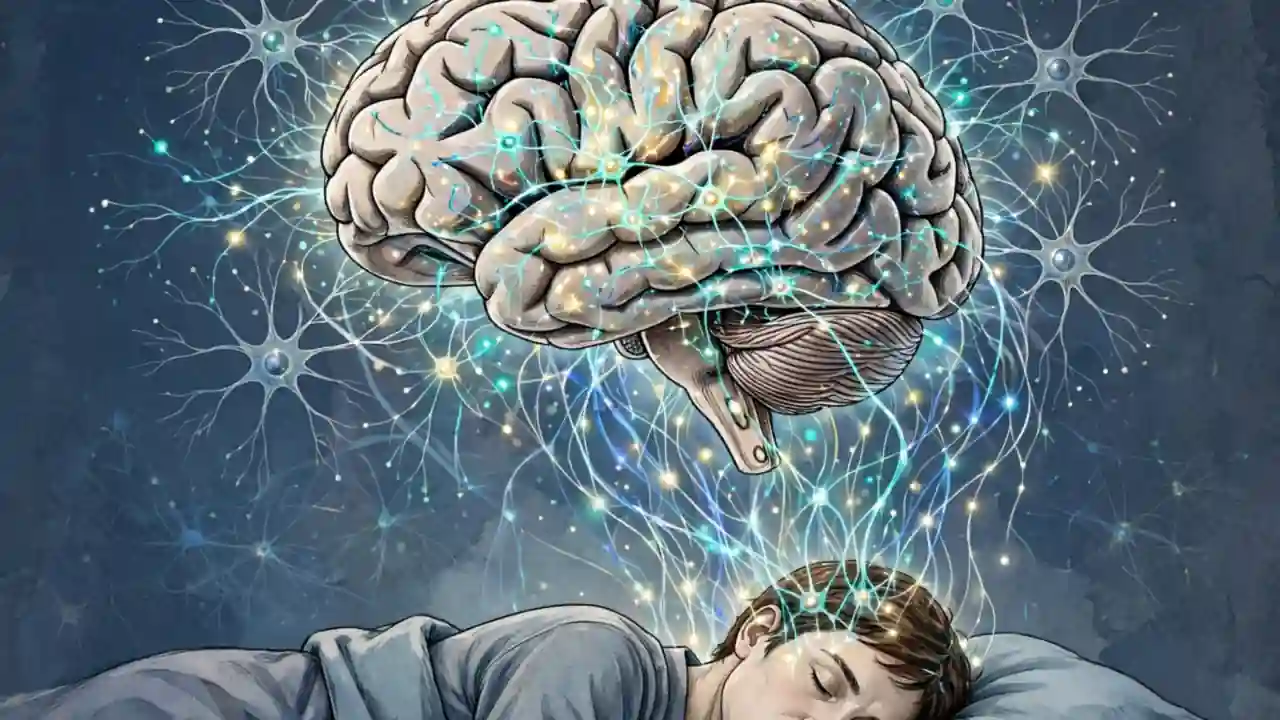
I love the editing-room image, because it matches how my dreams feel: fragments of the day, cut together in new orders, with people and places mixed up. During sleep, the brain replays experiences, strengthening some connections and letting others fade, in a process called memory consolidation, and dreams may partly reflect that replay and integration.
One explainer describes how during sleep the brain transfers information from short-term storage in the hippocampus to long-term storage in the neocortex, replaying the day’s experiences, and in animal studies those replays have been observed at speeds many times faster than real time. That does not mean every dream is a literal replay, because the brain also recombines fragments in novel ways, which is why your childhood home can appear next to a colleague you met last week.
I have noticed this in my own life: after a day of learning something new, my dreams seem busier, stranger, and more crowded, as if my brain were trying out different cuts of the same footage. That is anecdote, not proof, but it fits the broader finding that people who sleep fully after learning tend to do better on flexible thinking and pattern tasks the next day.
Another recent summary made the same point in plainer terms: studies consistently find that people who get a full night’s sleep, especially with plentiful REM, do better on tasks requiring flexible thinking, pattern recognition, and emotional learning, and in some experiments dreamers who reported task-like dream fragments improved the most by morning.
Emotion: Why Dreams Feel So Intense
I have woken up angry at someone for something they only did in a dream, and I have felt embarrassed telling my partner about it, because the emotion felt completely real even though the event never happened. That intensity has a brain basis: the amygdala, a key emotional centre, is highly active during REM sleep.
Researchers at UC Berkeley, as described in a neuroscience explainer, found that REM sleep specifically reduces the emotional charge attached to difficult memories, because stress-related chemicals such as norepinephrine drop during REM, letting the brain reprocess experiences without the same panic. The memory stays, but its sting softens, which is why REM has been called a form of overnight therapy.
That idea helped me be kinder to myself after bad dreams. A nightmare does not mean I am broken, and a sad dream does not mean I am secretly unhappy; it may mean my brain is doing difficult filing work, sorting an emotional experience into a safer place. Poor REM sleep, by contrast, is consistently associated with anxiety and emotional difficulty, which is one more reason I protect my sleep instead of treating it as wasted time.
Why Dreams Are Bizarre, and Why We Forget Most of Them
I used to be frustrated that I could remember a dream perfectly at 3am and lose it completely by breakfast, until I learned that forgetting is normal, not a personal failure. We can have several dreams a night, and whether we remember one depends heavily on when we wake, especially waking directly from REM, and on how quickly we write it down or talk about it.
The bizarreness has a similar explanation. One 2026 explainer summarised the leading view as dreams likely being a combination of memory processing, emotional regulation, and random brain activity shaped into stories by the mind, and that combination explains why dreams feel emotionally coherent even when their logic is nonsense. The brain’s storytelling systems stitch fragments together, so a familiar face, a recent worry, and an old place can share one scene without any of it needing to make waking sense.
I also learned to stop worrying that I do not dream, because I almost certainly do. Not remembering dreams is common, and it does not mean the night shift did not happen; it usually means I woke at a different point in the cycle or moved on too quickly to catch the memory.
What New Research in 2026 Adds to the Story
I was struck by two 2026 findings that make REM sleep feel less like a curiosity and more like a health matter. First, a study published in Communications Biology in 2026 explored what researchers called the energy paradox of REM sleep, finding that energy flow in the brain is dynamically reorganised during REM, possibly because neurons consume large amounts of energy to support memory-related reorganisation, according to a report on the REM sleep energy paradox.
Second, a large UK Biobank analysis reported in 2026 found that people who spent more time in REM sleep had a lower risk of many diseases over nearly nine years of follow-up, with each extra block of REM time tied to broader protection, as summarised in a report noting people who spent more time in REM sleep had a significantly lower risk of developing 83 distinct diseases in that dataset. I am careful here: an association in a large study is not proof that extra REM alone prevents disease, and other health habits matter too, but it is a strong reason not to treat dream sleep as disposable.
Taken together, these findings support a humbler, more practical conclusion: dreaming is probably not one thing with one job, but the visible side of a brain that is consolidating memory, calming emotion, and reorganising itself under tight energy limits, all at once.

Callout: My gentle dream-catching routine. Keep a notebook by your bed, write one line the moment you wake, even if it is only a feeling or a colour, and do not judge it. You are not decoding a prophecy, you are catching a fading memory, and over a week you may notice which days, worries, or late meals seem to crowd your nights.
Frequently Asked Questions
Why do we dream?
Science has no single settled answer yet. The strongest evidence points to a combination of memory consolidation, emotional processing, and the brain shaping its own activity into stories during REM sleep, rather than one simple purpose.
Do dreams mean something?
Dreams can reflect recent experiences, worries, and emotions, but there is no reliable fixed dictionary where each symbol always means the same thing. It is more useful to ask what your brain may have been processing than to decode a dream like a code.
Why do I forget my dreams so quickly?
Forgetting is normal. We have several dreams a night, and recall depends on waking from REM, staying still for a moment, and recording the dream quickly before waking life overwrites it.
Is it normal not to remember dreams?
Yes. Not remembering dreams does not mean you do not dream. It usually means you woke at a different sleep stage or did not catch the memory before it faded.
Can dreams help creativity or problem-solving?
There is evidence that sleep and dreaming can improve flexible thinking, pattern recognition, and problem-solving, and many people report fresh ideas after sleep. That does not mean every dream contains a solution, but a rested brain is a more creative one.
How can I sleep better for healthier dreaming?
Keep regular sleep times, wind down without bright screens, and avoid heavy meals and alcohol late at night, all of which can fragment REM sleep. For food ideas that support rest, see our guide to the best foods for better sleep, and for a calm wind-down, try the best cosy games for relaxing or the best study playlists at low volume.
Final Thoughts
I started out wanting my dreams decoded, and I ended up respecting them more as work than as messages. Your brain, while you lie still and unaware, is filing memories, softening hard feelings, and trying new combinations of everything you lived that day, and that quiet labour deserves a good night’s sleep, not a rushed one.
You have done well to read this far, and I hope your next strange dream feels a little less confusing and a little more human. Keep that notebook close, be patient with the fading details, and tell us in the comments about a dream you still remember, because our night-time stories, shared gently, remind us how wonderfully busy our sleeping minds really are.
React to this story