Key Points
Key Points
- A quantum internet uses entanglement for security based on physics, not just mathematics
- Entanglement does not send messages faster than light
- Quantum repeaters are the key unsolved piece for long-distance networks
- Europe's QIA received 47.5 million euros to build a full-stack prototype
- Canada's QEYSSat mission aims to demonstrate space-to-ground quantum communication
- A consumer quantum internet is years away; early benefits will be indirect
On This Page
- What You Will Learn in This Guide
- What Is a Quantum Internet, in Plain Language?
- Subscribe to CAAW News
- Why Building It Is So Hard: The Repeater Problem
- Europe’s Big Bet: The Quantum Internet Alliance Prototype
- Canada’s Satellite Play and the Global Race
- The Three Problems Nobody Has Fully Solved Yet
- What a Quantum Internet Could Actually Do for You
- Frequently Asked Questions
- Will a quantum internet replace my current internet?
- Is quantum communication faster than light?
- When will I be able to use a quantum internet?
- Why are governments funding this if it is so far away?
- What is a quantum repeater, in simple terms?
- Who is leading the race in 2026?
- Final Thoughts
- React to this story
I first heard the phrase quantum internet in a lecture hall, and I will be honest with you, I assumed it was science fiction with a fancy name. It sounded like something from a film, not something engineers would build in my lifetime. Then, in October 2026, a European consortium announced €47.5 million in new funding to build a full-stack quantum internet prototype, and suddenly the science fiction had a budget, a timeline, and fifty partner institutions behind it. If you have ever wondered what comes after today’s internet, or why governments and companies are racing to build something most of us cannot yet use, this guide is for you. I will explain, in plain language, what a quantum internet is, why it is so hard to build, who is racing to build it first, and what it could actually do for ordinary people. This is for curious readers, not physicists, and by the end you will understand the race, the obstacles, and the realistic timeline, without needing a physics degree.
Trust nudge: Quantum physics is easy to exaggerate and hard to explain simply, so I have kept every technical claim tied to a published 2026 report linked below, and I flag clearly where a result is a laboratory demonstration rather than a working service you could use today.
What You Will Learn in This Guide
- What a quantum internet is, and how it differs from the internet you use every day
- Why entanglement is both the superpower and the headache of quantum networking
- Who is leading the race in 2026, from Europe’s Quantum Internet Alliance to Canada’s satellite mission
- The three hard problems engineers must solve before a quantum internet can scale
- What a quantum internet could do for security, computing, and science, and when you might notice it
What Is a Quantum Internet, in Plain Language?
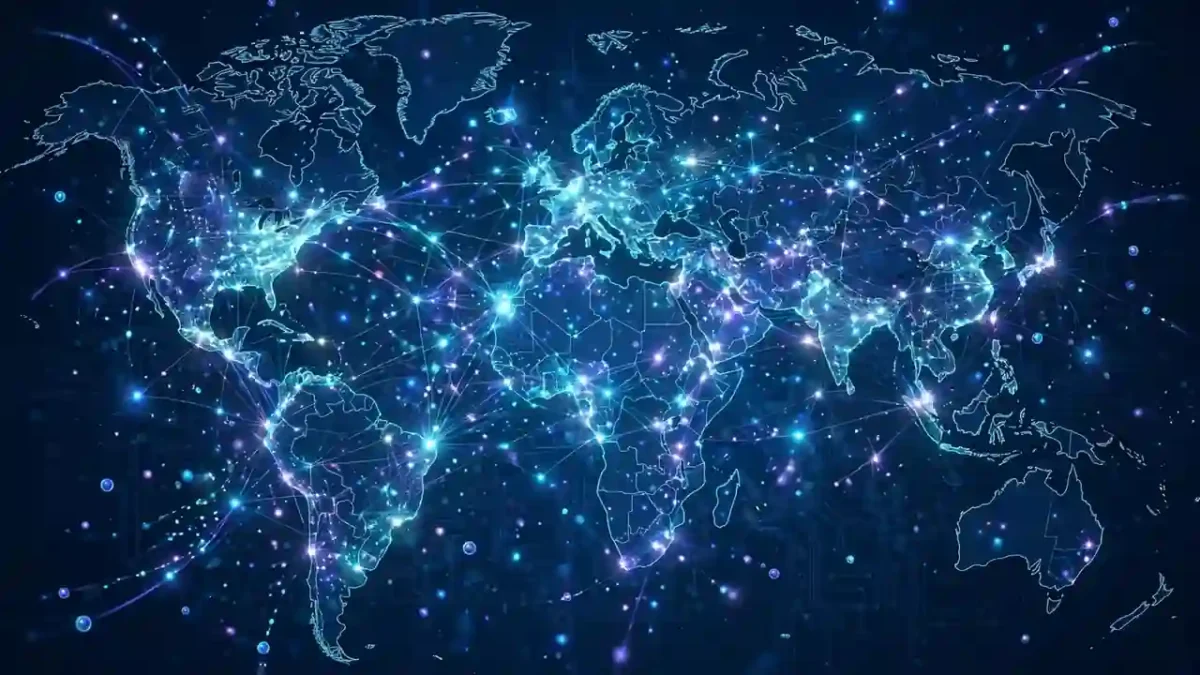
I like to start with the internet you already know, because the quantum version is best understood by contrast. Today’s internet sends information as bits, which are either 0 or 1, carried by electrical signals or pulses of light through fibre cables and wireless links. It is fast, reliable, and brilliantly engineered, but it has a weakness that matters more every year: its security depends on mathematical problems that are hard for today’s computers to solve, but may not stay hard forever, especially if large quantum computers arrive. A quantum internet, by contrast, sends information using qubits and a strange quantum property called entanglement, and its security comes from the laws of physics themselves, not just from hard mathematics.
Entanglement is the heart of it, and it is worth taking a moment to understand, because everything else follows from it. When two particles are entangled, their states are linked in such a way that measuring one instantly tells you something about the other, no matter how far apart they are. If someone tries to intercept or eavesdrop on an entangled connection, the act of measuring it disturbs it, and that disturbance can be detected. That is why a quantum internet promises communications that are, in principle, provably secure against eavesdropping, in a way today’s internet cannot guarantee. It is not about sending messages faster than light, which is a common myth, and I want to correct that plainly: entanglement does not let you send usable information instantly, and it does not break the speed of light. It lets you share a secure connection, and then use that connection to protect ordinary messages.
A quantum internet is also not a replacement for your home broadband, at least not in the form engineers are building now. Think of it instead as a new kind of network that will run alongside today’s internet, connecting quantum computers to each other, linking sensors that need extraordinary precision, and carrying the most security-sensitive communications. Your videos will still travel over today’s internet. Your bank’s most sensitive keys, a network of quantum computers solving a problem together, or a telescope array synchronised to extraordinary precision, might one day travel over a quantum network. That distinction keeps expectations honest, and it explains why the first users will be governments, researchers, and large organisations, not households.
Why Building It Is So Hard: The Repeater Problem
If entanglement is so powerful, why do we not already have a quantum internet? The answer is a problem I find both simple and brutal. Entanglement is fragile. The photons that carry it get lost in fibre cables, and the quantum memories that store it forget their state quickly. A quantum network does not send entanglement down a wire the way an ordinary network sends a signal. It has to make entanglement between two distant memories, and making it is probabilistic: most attempts fail, because photons are lost in the fibre. If the entanglement is lost faster than it is made, the network never gets going, and that is the wall engineers have been trying to climb.
The solution is a device called a quantum repeater, which is very different from an ordinary internet repeater. An ordinary repeater simply amplifies a weakening signal, but quantum information cannot be copied or amplified in that way without destroying it. A quantum repeater must instead create entanglement over short hops, store it, and then stitch those hops together into a longer entangled link, a process called entanglement swapping. It is one of the hardest engineering challenges in the field, because every hop adds loss, noise, and delay, and the memories must hold their state long enough for the whole chain to succeed. Until repeaters work reliably over long distances, quantum networks stay limited to metropolitan areas or single laboratory links, no matter how good the individual components are.
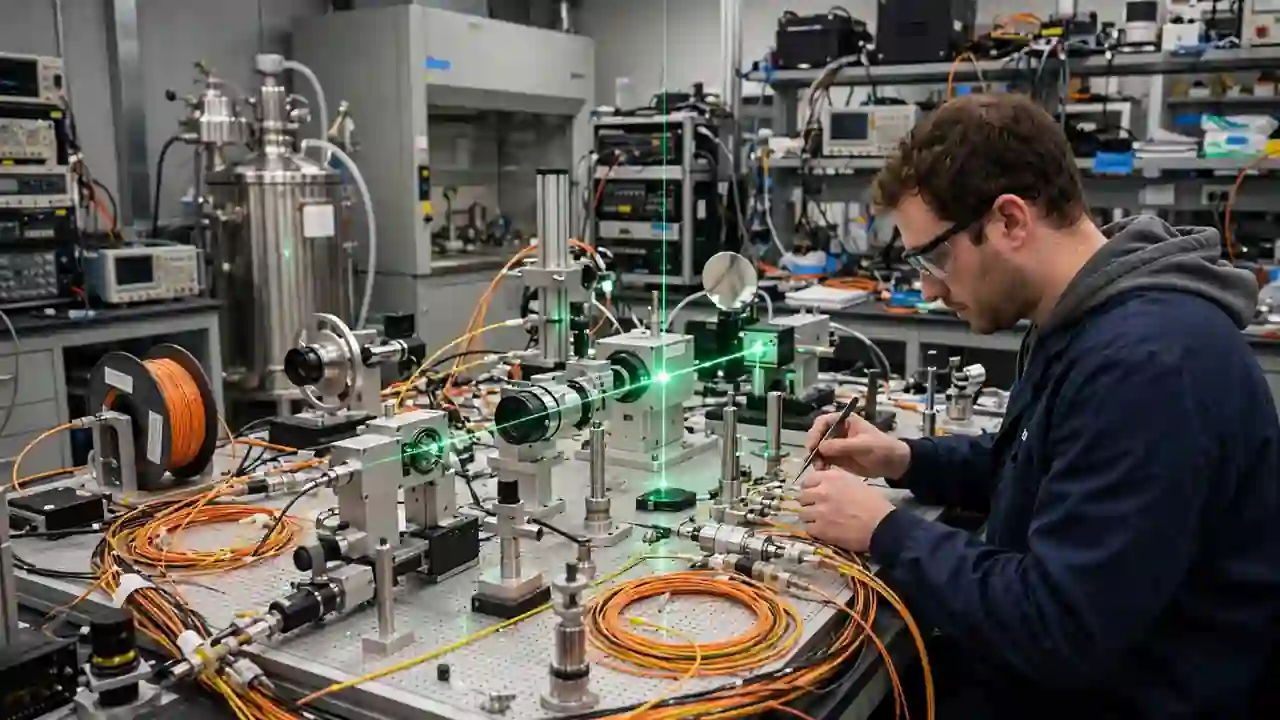
That is why a result reported in 2026 from the University of Science and Technology of China mattered so much to researchers, even though it sounds modest to an outsider. A team there reported entanglement between two trapped-ion memory nodes, joined by 10 kilometres of fibre, that lasted longer than the average time it took to establish it. That is the break-even point: past that point, a link can be made faster than it is lost, which is the minimum a repeater chain needs. The paper, published in Nature in 2026, credited three ingredients: an ion memory that holds its state for a long time, an efficient ion-to-photon interface at telecom wavelengths, and an optimised single-photon entanglement protocol. Ten kilometres is not a continent, and nobody is claiming it is, but crossing break-even is the kind of threshold that turns a curiosity into a building block, and engineers notice thresholds like that.
Europe’s Big Bet: The Quantum Internet Alliance Prototype
The largest and most concrete step in 2026 comes from Europe, and I want to describe it carefully, because it is the clearest picture we have of what a first quantum internet prototype will actually look like. The Quantum Internet Alliance (QIA), a consortium of more than 50 institutions across 12 European member states, led by TU Delft and coordinated in its next phase by QuTech, has received €47.5 million in new funding from the European Commission. The funding agreement, known as Specific Grant Agreement 2, supports the next 42 months of research and development, building on a first phase that ran from October 2022 to March 2026.
In that first phase, QIA expanded its European platform for quantum internet development, integrating hardware, software, and networking research, and laying the technological foundations for a prototype network. The next phase has a bolder goal: to combine those components into a complete, programmable, full-stack quantum network prototype capable of running real quantum network applications. A key milestone is demonstrating how two metropolitan-scale quantum networks can be interconnected via a long-distance fibre link using quantum repeaters. That milestone is the whole race in miniature, because connecting two city-scale networks over a long fibre link is exactly what a real quantum internet must do, and nobody has yet done it at scale.
The prototype will use trapped-ion quantum internet nodes arranged in two metropolitan-scale networks, connected through hundreds of kilometres of optical fibre, with the University of Innsbruck and AQT receiving €5.4 million as part of the package for their part of the work. QIA director Stephanie Wehner has said that Europe is at the very forefront of quantum internet technologies worldwide, and that this prototype may become the first of its kind in the world. That is a bold claim, and it should be read as ambition from a project leader, not as a finished result. But the funding, the timeline, and the specific milestone give the claim weight, because they can be checked as the work progresses. If QIA connects two metropolitan networks through a repeater link in the next few years, that will be a genuine landmark, and if it does not, we will know that too.
Canada’s Satellite Play and the Global Race
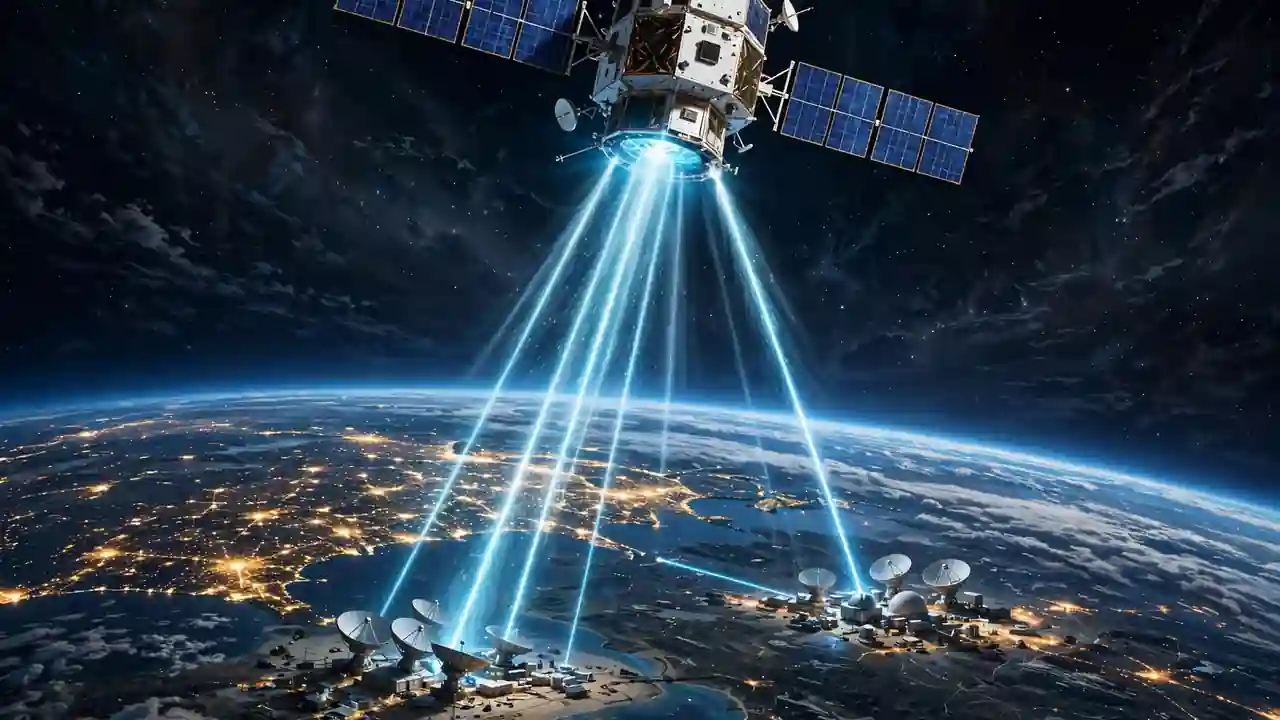
Europe is not racing alone, and the global picture is one of the most interesting parts of this story. In Canada, Simon Fraser University and its partners are pursuing a satellite route to a global quantum internet, because satellites offer a way to connect distant ground stations without laying fibre across oceans or continents. Physicist Thomas Jennewein, recruited to Simon Fraser University as Canada Excellence Research Chair in Global Quantum Internet Systems, leads the Quantum EncrYption and Science Satellite (QEYSSat) mission, which aims to demonstrate quantum communication and quantum key distribution between space and ground, with stations across Canada, with a launch planned for 2026. If it succeeds, it will show that quantum keys can be shared from orbit to ground stations hundreds or thousands of kilometres apart, a step toward a truly global network that fibre alone cannot easily provide.
Canada’s effort is closely linked to Photonic Inc., a company co-founded by Stephanie Simmons, whose team has demonstrated the first electrically-injected single-photon source in silicon, using qubits called T centres. That sounds technical, but its importance is practical: silicon is the material the entire computer industry is built on, and a quantum device that works in silicon, and can be controlled electrically as well as optically, is far easier to manufacture at scale than a device that requires exotic materials and delicate laboratory conditions. Daniel Higginbottom, director of academic research at Photonic, has described electrical control as a step toward applications in a scalable quantum computer, and scalable is the word that matters here, because a quantum internet built from laboratory curiosities will never reach beyond a few cities.
Beyond Europe and Canada, China, the United States, and other countries are investing heavily in quantum communication, including satellite demonstrations and metropolitan fibre networks, though the details and claims vary widely and should be read with care. The race is not a single sprint with one finish line, but several parallel races: who builds the first programmable metropolitan network, who demonstrates the first reliable repeater link, who launches the first working quantum satellite service, and who turns any of those into a standard other networks can join. Different countries may win different races, and the eventual global quantum internet, if it emerges, will likely be stitched together from national and regional networks, much like today’s internet was.
The Three Problems Nobody Has Fully Solved Yet
I want to be direct about the obstacles, because a guide that only celebrates progress would mislead you. The first problem is distance. Fibre loss means entangled photons rarely survive more than tens of kilometres without a repeater, and reliable, long-distance quantum repeaters are still being developed, not yet deployed as routine infrastructure. The second problem is memory. Quantum memories must hold fragile states long enough for entanglement to be established across a chain, and while memories have improved dramatically, they are still far from the stability of ordinary computer memory. The third problem is standardisation and scale. Different teams use different kinds of qubits, including trapped ions, photons, silicon defects, and superconducting circuits, and those systems do not yet speak to each other easily. A network that only connects identical devices in one laboratory is a demonstration, not an internet.
There are also practical problems that rarely make headlines but will decide whether a quantum internet ever leaves the laboratory. Quantum devices often require extreme cooling, vibration isolation, or precise laser control, which makes them expensive and delicate to operate outside a research facility. Skilled engineers are scarce, and the supply chains for specialised components are still immature. And the business case is still forming: the first customers will be governments and large organisations with secrets worth protecting at any cost, not consumers, which means early networks will be funded as strategic infrastructure, much like early internet backbones were, rather than as commercial services competing on price.
What a Quantum Internet Could Actually Do for You
So what, concretely, could a quantum internet do, once it works? The clearest application is ultra-secure communication. By distributing encryption keys through entanglement, two parties can detect eavesdropping in principle, and can protect messages against future quantum computers that might break today’s encryption. For banks, governments, hospitals, and critical infrastructure, that is not a luxury, it is insurance against a future in which today’s encrypted archives could be decrypted retrospectively. This is why so much early funding comes from public sources with a security interest, not just from curiosity.
The second application is distributed quantum computing. A single quantum computer, however powerful, has limits, but a network of quantum computers, linked by entanglement, could tackle problems together that none could solve alone, from simulating new materials and drugs to optimising complex logistics. That is a longer-term vision, and it depends on quantum computers themselves maturing, but the network and the computers are advancing together, and each makes the other more valuable. The third application is ultra-precise sensing and timing. Entangled sensors in different locations could synchronise clocks or measure tiny changes, such as gravitational shifts, with precision far beyond today’s instruments, which could improve navigation, earth observation, and fundamental science. None of these applications will appear on your phone next year, and anyone who tells you otherwise is selling something, but all of them are serious enough that governments are funding them now.
A realistic timeline, as I see it: Metropolitan quantum networks and satellite key-distribution demonstrations through the late 2020s. A first programmable prototype linking two metropolitan networks, if QIA’s milestone succeeds, within the next few years. A larger, multi-city network in the 2030s, if repeaters mature. A global quantum internet you might indirectly benefit from, through more secure banking or government services, in the 2030s at the earliest, and a consumer-facing quantum service, if one ever makes sense, well beyond that. Treat any timeline shorter than this with scepticism, and any timeline that claims certainty with even more.
Frequently Asked Questions
Will a quantum internet replace my current internet?
No, not in the foreseeable future. A quantum internet will run alongside today’s internet, handling the most security-sensitive communications and linking quantum computers and sensors, while ordinary browsing, streaming, and messaging continue over today’s networks, which are faster, cheaper, and far more mature for everyday use.
Is quantum communication faster than light?
No. Entanglement does not let you send usable information faster than light, and it does not break the laws of physics. It lets two parties share a secure entangled connection, and then use that connection to protect ordinary messages sent at ordinary speeds.
When will I be able to use a quantum internet?
As a direct consumer service, not for many years, and possibly never in the form of a household connection. You are more likely to benefit indirectly, through banks, hospitals, or government services that use quantum-secured links to protect your data, and that indirect benefit is still years away at scale.
Why are governments funding this if it is so far away?
Because the security stakes are long-term. Messages encrypted today could be stored and decrypted later by a future quantum computer, so governments and large organisations want quantum-safe communications ready before that future arrives, not after it. Strategic infrastructure is often funded decades before it becomes a consumer service.
What is a quantum repeater, in simple terms?
A quantum repeater is a device that extends entanglement over long distances by creating entanglement over short hops and stitching those hops together, without copying the quantum information, which physics forbids. Reliable repeaters are the key missing piece for a large-scale quantum internet.
Who is leading the race in 2026?
Europe’s Quantum Internet Alliance leads on the most concrete prototype plan, with €47.5 million in new funding and a goal of linking two metropolitan networks. Canada is leading a satellite approach with the QEYSSat mission, and China and the United States are pursuing their own fibre and satellite programmes. Different teams lead different parts of the race.
Final Thoughts
I started this guide thinking the quantum internet was science fiction, and I end it thinking something more interesting. It is not science fiction anymore, but it is not a product either. It is a vast, difficult engineering project, funded by governments, pursued by rival teams on several continents, and measured in milestones that sound small to outsiders but mean everything to engineers: a link that lasts longer than it takes to make, two city networks joined by a repeater, a key shared from a satellite to the ground. Those milestones are how a science fiction idea becomes infrastructure, one hard step at a time, and the race to build a quantum internet in 2026 is really a race to pass the next few of those steps first. You do not need to follow every paper to appreciate what is happening. Just remember the three ideas that matter: entanglement makes security a matter of physics, repeaters make distance possible, and the first networks will serve the most sensitive users before they ever serve you. When the next headline arrives, and it will, ask whether it crossed a threshold, or just repeated a promise, and you will understand the race better than most of the people writing about it. If this guide helped you make sense of a story you saw recently, share it with someone who also wondered what a quantum internet actually is, and tell me in the comments which application, security, computing, or sensing, you think matters most.
React to this story