Key Points
Key Points
- Europa Clipper launched 14 October 2024 and is cruising to Jupiter on a 1.8-billion-mile gravity-assist route
- NASA plans an Earth gravity-assist flyby on 3 December 2026, the last big push before the Jupiter leg
- Arrival at Jupiter is planned for April 2030, with the 49-flyby Europa science campaign starting in early 2031
- The mission hunts habitability, not life directly: ice thickness, ocean depth, surface chemistry and possible plumes
- Short flybys from Jupiter orbit keep the spacecraft out of Europa's harsh radiation belts
- At mission end, planned for 2034 or later, the spacecraft will be deliberately crashed, most likely into Ganymede, to protect Europa
On This Page
- Subscribe to CAAW News
- In This Article
- What Europa Is, and Why One Icy Moon Matters So Much
- What Europa Clipper Actually Is: A Flying Laboratory, Not a Lander
- Why 2026 Matters: The Earth Flyby That Sends It to Jupiter
- What It Is Hunting Beneath the Ice, Instrument by Instrument
- What Europa Clipper Cannot Do, and Why That Honesty Matters
- What Happens Next: From the 2026 Flyby to the 2031 Science Tour
- Frequently Asked Questions
- When will Europa Clipper reach Europa?
- Why does it take so long to get there?
- Will Europa Clipper find life?
- How much water is in Europa’s ocean?
- Why does it fly past Europa 49 times instead of orbiting it?
- What happens to the spacecraft at the end of the mission?
- Can I follow the mission myself?
- Final Thoughts
- React to this story
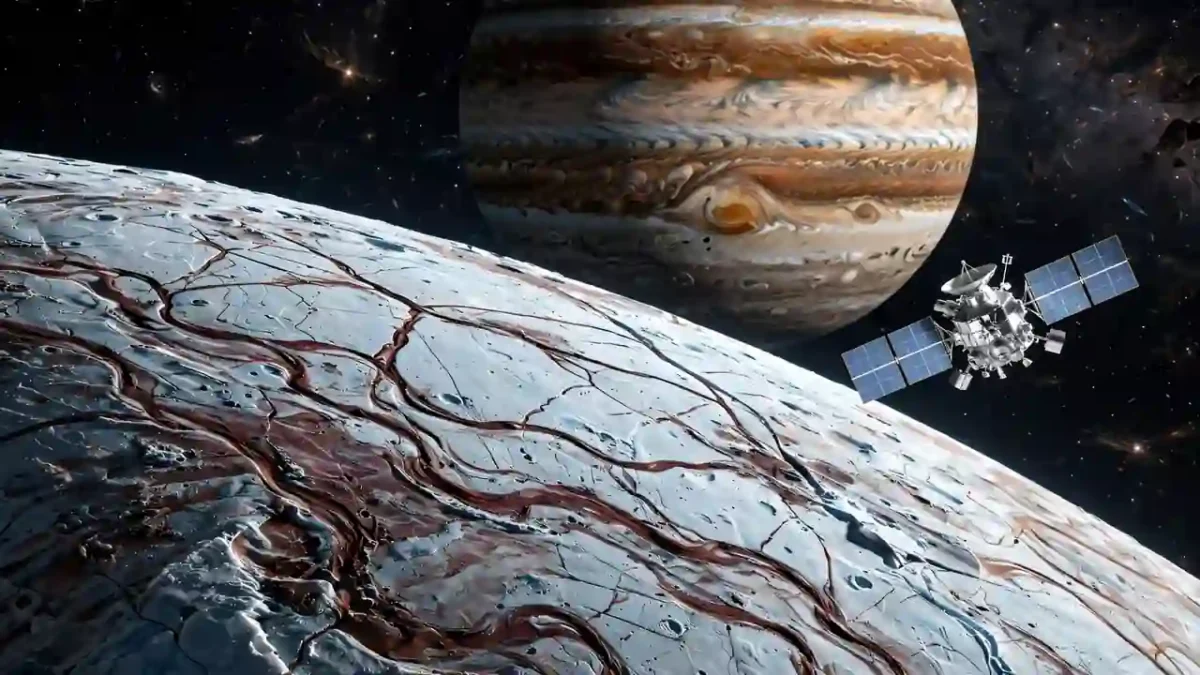
I have a confession to make: I spent far too long staring at a photograph of Europa and wondering what it would feel like to stand on that ice. The picture showed a cracked, shining ball, crossed by dark lines like a broken eggshell, hanging against black space. It looked cold, silent and impossibly far away. And yet, underneath that ice, scientists believe there is an ocean holding more water than all of Earth’s oceans combined. That single fact stopped me in my tracks the first time I read it, and it has not let me go since.
I am not a NASA scientist, and I will not pretend to be one. I am a space writer who has followed this mission since before it left Earth, reading NASA’s mission pages, the launch coverage and the science explainers as they appeared. What I can do is translate the science into plain words, show you where each claim comes from, and be honest about what this spacecraft can and cannot do. If you have ever wondered whether we are alone in the universe, this is one of the most serious attempts ever made to answer that question properly.
Here is the worry I hear from readers again and again: space headlines promise aliens every other week, and then nothing happens, and you feel cheated. I get it. So let me be clear from the start. Europa Clipper will not find a little green person waving from under the ice. It is not built to do that, and anyone who tells you otherwise is selling you something. What it can do is far more exciting in my view: it can tell us, with real measurements, whether Europa’s hidden ocean has the ingredients life needs. That answer alone would change how we think about our place in the universe.
Trust nudge: Every date, distance and instrument detail below is tied to a published source linked in the text. Where the science is still uncertain, I say so openly instead of quietly picking the version I like best.
In This Article
- What Europa is, and why scientists care so much about one icy moon
- What Europa Clipper actually is, and how it got on its way
- Why 2026 matters: the Earth flyby that slingshots it toward Jupiter
- What it is hunting beneath the ice, instrument by instrument
- What it cannot do, and why that honesty matters
- What happens next, all the way to 2031 and beyond
- Your questions, answered simply
What Europa Is, and Why One Icy Moon Matters So Much
I first learned about Europa the way most people do: as one of Jupiter’s four big moons, spotted by Galileo Galilei back in 1610. That sounds like ancient history, and in a way it is. But for almost four hundred years, Europa was just a bright dot in a telescope. Nobody knew what lay beneath its surface, because nobody could see through the ice.
That changed when NASA’s Galileo spacecraft orbited Jupiter from 1995 to 2003. Galileo found strong evidence that Europa hides a global, salty ocean beneath its frozen crust. Think about that for a second. A moon smaller than our own Moon, orbiting a giant planet hundreds of millions of kilometres from the Sun, may hold a liquid ocean that wraps the whole world. NASA’s own mission pages describe Europa as an ocean world, and estimates often cited by NASA suggest its ocean holds about twice as much water as all of Earth’s oceans put together. I still find that number hard to believe, and I have checked it more than once.
Why does that matter? Because on Earth, wherever we find liquid water, we tend to find life. Deep in the dark ocean, around vents on the seafloor, microbes thrive without a single ray of sunlight. They live off chemistry instead: heat and minerals from below, mixing with cold water from above. If Europa’s ocean works anything like that, with a rocky seafloor below and an ice shell above, then the three ingredients scientists look for could all be there: liquid water, chemistry and an energy source. Scientists call that combination habitability. It does not mean life is there. It means life could be possible there, and that is a question worth a billion-dollar spacecraft.
The surface gives us clues too. Europa’s ice is cracked into long, dark lines called lineae, and in places it looks broken and refrozen, as if something from below pushed its way up. Those cracks are one reason scientists think the ice shell and the ocean talk to each other. If material from the ocean reaches the surface, a spacecraft flying overhead could sample it without ever drilling a hole. That is a big deal, and it shapes the whole mission.
What Europa Clipper Actually Is: A Flying Laboratory, Not a Lander
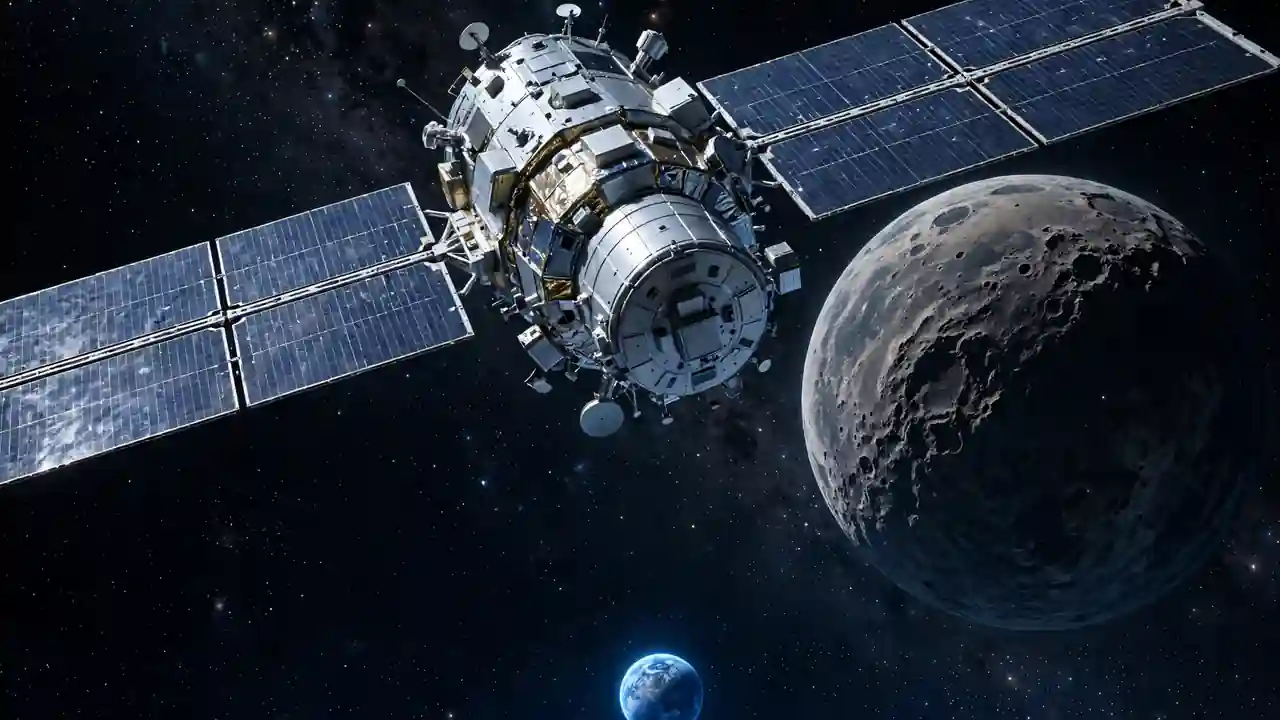
When I first saw the size of Europa Clipper, I laughed out loud. This is not a small, neat probe. It is the largest interplanetary spacecraft NASA has ever built, with solar arrays stretching wider than a basketball court when fully deployed. It needs those huge panels because sunlight at Jupiter is roughly twenty-five times weaker than sunlight at Earth, and the spacecraft runs on solar power. Everything about it is built for a long, cold, dark journey.
Europa Clipper launched on 14 October 2024 aboard a SpaceX Falcon Heavy rocket from Florida. I watched that launch the way I watch all the big ones: nervous, hopeful, and slightly amazed that we can throw a machine across the solar system and expect it to arrive years later, exactly on target. The spacecraft is not heading straight to Jupiter, though. A direct flight would need far more fuel than it can carry. Instead, it is borrowing speed from planets along the way, in a trick called a gravity assist.
Think of it like a skateboarder grabbing the bumper of a passing car for a boost, except the car is a planet and the skateboarder is a spacecraft worth billions. Clipper swung past Mars on 1 March 2025, using the planet’s gravity to bend its path and change its speed. That flyby was not just clever navigation. It was also a chance to test instruments and take pictures, and NASA used it well. The next boost is the one that matters most in 2026, and I will come to it in a moment.
The spacecraft carries nine science instruments, and I will walk through the most important ones below. It also carries a vault: a thick box made from aluminium-zinc alloy that shields its sensitive electronics from Jupiter’s brutal radiation. I love that detail, because it tells you everything about the challenge. Jupiter’s magnetic field traps charged particles into radiation belts so fierce that an unprotected spacecraft would be fried. Clipper’s answer is simple and smart: do not stay in the danger zone any longer than you have to.
Why 2026 Matters: The Earth Flyby That Sends It to Jupiter
Here is the part of the story I think most people miss. In 2026, Europa Clipper is not arriving anywhere exciting. It is coming home, briefly, for one last push. NASA plans an Earth gravity-assist flyby on 3 December 2026, in which the spacecraft will swing past our own planet and steal a little of Earth’s orbital momentum to fling itself outward toward Jupiter. After that, there is no turning back. The long cruise becomes the final leg.
I know what you might be thinking: is that not a waste of two years? It is the opposite. Without those planetary boosts, the mission would have needed a far bigger rocket or a much longer journey, or both. The Mars flyby in 2025 and the Earth flyby in 2026 are what make the 1.8-billion-mile journey possible at all. That number sounds absurd, and it is: the route is far longer than the straight-line distance from Earth to Jupiter, because the path bends through the inner solar system before heading out. NASA’s mission timeline describes the total journey as about 1.8 billion miles, or 2.9 billion kilometres.
So if you read a headline in December 2026 saying Europa Clipper flew past Earth, do not be disappointed that it did not find anything yet. That flyby is the mission’s last big navigation milestone before the quiet years. After December 2026, Clipper heads outward, and the team will spend the cruise checking instruments, planning the science tour, and waiting. Arrival at Jupiter is planned for April 2030, with the dedicated Europa flyby campaign beginning in early 2031. I will be watching, and I suspect you will be too.
What It Is Hunting Beneath the Ice, Instrument by Instrument
This is the section I most wanted to write, because it is where the mission stops being a story about travel and starts being a story about detective work. Clipper will not orbit Europa itself. That would keep it inside Jupiter’s radiation belts for far too long. Instead, it will orbit Jupiter and swoop past Europa 49 times, dipping in for less than a day each time, then retreating to safer space for two or three weeks before coming back. Each flyby looks at a different place, at a different height, building up a global picture piece by piece.
The first thing it hunts is the ice shell itself: how thick is it, and does it move? An ice-penetrating radar called REASON will bounce radio waves off the ice and listen for echoes from below, a bit like a doctor using an ultrasound scan. If the shell is thin in places, or if there are lakes of water trapped inside the ice, REASON should see the signs. A magnetometer will measure how Europa’s magnetic field changes as Jupiter’s field sweeps past it. A salty, global ocean conducts electricity, and that creates a tell-tale magnetic signature. Together, those two measurements can tell us how deep the ocean is and how thick the ice above it is.
The second hunt is for chemistry. Spectrometers and cameras will map the surface in fine detail, looking for salts and organic compounds, the carbon-based chemicals that are the building blocks of life as we know it. The surface matters because, if ocean material is pushed up through cracks, the surface becomes a window into the ocean. Clipper’s cameras will photograph the surface at resolutions fine enough to pick out features just a few metres across, so scientists can see where fresh material may have erupted most recently.
The third hunt is the one that makes my heart beat a little faster: plumes. The Hubble Space Telescope has reported hints of water vapour puffing off Europa’s surface, like a geyser, but those hints have been intermittent and hard to confirm. If a plume is active during a flyby, Clipper’s dust analyser, SUDA, and its mass spectrometer, MASPEX, could fly through the spray and taste it, measuring what chemicals it contains. That would be the closest thing to sampling the ocean without landing. But I must be honest with you: a plume is an opportunity, not a promise. Nobody can guarantee one will be blowing at the right moment.

What Europa Clipper Cannot Do, and Why That Honesty Matters
I have made this mistake myself in the past, so let me say it plainly: Europa Clipper cannot detect life. It has no microscope for microbes, no net for fish, and no drill for reaching the ocean. The ocean may lie kilometres beneath the ice, far deeper than any instrument on this spacecraft can reach. If you see a social media post claiming Clipper will photograph alien life in 2031, you can safely ignore it.
What it can do is answer the question that has to come first: is Europa habitable? Are the water, chemistry and energy all present, in the right places, at the right times? If the answer is yes, then a future mission can be designed to go further: perhaps a lander that samples surface ice, or one day, a probe that melts its way down. If the answer is no, that matters too. It would tell us that an ocean alone is not enough, and it would push scientists to look harder at other ocean worlds, like Saturn’s moon Enceladus, which also sprays ocean material into space.
There is another honest limit worth knowing. At the end of its mission, planned for 2034 or later, Clipper will be deliberately crashed, most likely into Jupiter’s moon Ganymede. That sounds sad, and in a way it is. But it is also careful planetary protection: scientists do not want a dead spacecraft crashing into Europa and contaminating the very ocean they are trying to study. Even in death, the mission is designed to protect its target. I respect that.
Clipper does not fly alone in spirit, either. The European Space Agency’s Jupiter Icy Moons Explorer, known as JUICE, launched in 2023 and will study Jupiter’s moons too, eventually orbiting Ganymede. The two missions will give scientists overlapping views of the same system, and together they will teach us more than either could alone. That cooperation, across agencies and continents, is one of my favourite parts of this story.
What Happens Next: From the 2026 Flyby to the 2031 Science Tour
Let me lay out the timeline in plain words, because I find it helps to see the whole journey at once. Launched in October 2024, Clipper used Mars in March 2025, uses Earth in December 2026, and arrives at Jupiter in April 2030. After orbit insertion and preparations, including help from flybys of Ganymede and Callisto to shape its path, the 49-flyby science tour begins in early 2031. That tour will last several years, and the data will keep scientists busy for decades after that.
Between now and 2030, what should you watch for? First, the December 2026 Earth flyby itself, and any images or updates NASA releases around it. Second, instrument checkouts and calibration work during the cruise, which NASA reports from time to time. Third, the approach to Jupiter in late 2029 and early 2030, when the spacecraft will start seeing its destination as more than a bright point. I will be following all of it, and I will explain each stage as it happens, without hype and without pretending a navigation milestone is a discovery.
Here is my personal stake in this, and I will not hide it. I grew up believing the search for life beyond Earth was a question for science fiction. Europa Clipper is proof that it is now a question for science. It may not give us the answer we dream of, but it will give us a real answer, measured and checked, about one of the most promising places in the solar system. For me, that is enough to keep watching the sky.
The one thing to remember: Europa Clipper is not hunting aliens. It is hunting habitability: water, chemistry and energy, measured beneath the ice across 49 flybys. If those ingredients are there, the next mission can hunt for life itself.
Frequently Asked Questions
When will Europa Clipper reach Europa?
It is planned to enter orbit around Jupiter in April 2030, with its dedicated Europa flyby campaign beginning in early 2031. It will not land on Europa, and it will not orbit Europa directly.
Why does it take so long to get there?
The spacecraft uses gravity assists from Mars and Earth to gain speed without carrying huge amounts of fuel. That makes the journey longer in miles, about 1.8 billion, but possible with the rocket that launched it.
Will Europa Clipper find life?
No, not directly. It is designed to find out whether Europa’s ocean has conditions that could support life. Detecting life itself would need a future mission built for that job.
How much water is in Europa’s ocean?
NASA-cited estimates often describe Europa’s ocean as holding about twice as much water as all of Earth’s oceans combined, though the exact volume depends on the ocean’s depth, which Clipper will help measure.
Why does it fly past Europa 49 times instead of orbiting it?
Europa sits deep inside Jupiter’s harsh radiation belts. Short flybys from a wider orbit around Jupiter limit the spacecraft’s time in the danger zone, while still building up global coverage over many passes.
What happens to the spacecraft at the end of the mission?
After its science tour, planned to end in 2034 or later, it is expected to be deliberately crashed, most likely into Ganymede, so it cannot contaminate Europa.
Can I follow the mission myself?
Yes. NASA publishes mission updates, images and timelines on its Europa Clipper pages, and the December 2026 Earth flyby is a good moment to start following along.
Final Thoughts
I started this article staring at a photograph of a cracked ball of ice, and I will end it the same way, because that image still moves me. Beneath those cracks may lie an ocean larger than all of ours, dark and salty and older than human civilisation by billions of years. We have sent a machine to find out whether that ocean could cradle life, and in December 2026 that machine swings past our own planet for its final push outward. That is not science fiction. That is happening, right now, in our lifetime.
If this story grabbed you the way it grabbed me, keep an eye on the December flyby, and come back for the 2030 arrival. The ocean is not going anywhere. But our understanding of it is about to change, one flyby at a time, and I cannot wait to see what we learn. Tell me in the comments: what do you hope Europa Clipper finds first, the depth of the ice, the chemistry of the surface, or a plume rising into space?
Sources: NASA Europa Clipper mission pages; NASA mission timeline reporting; Wikipedia’s Europa Clipper summary, cross-checked against NASA dates.
React to this story