Key Points
Key Points
- A mat, bands, and medium dumbbells cover about 90 percent of home training.
- Adjustable dumbbells replace many fixed pairs in a tiny footprint.
- Fabric loop bands stay put and are ideal for hip and glute work.
- Buy in stages: mat and bands first, dumbbells second, extras only when needed.
- About two metres by two metres of clear floor is enough for most routines.
- The best kit is the one you can set up in under two minutes.
On This Page
- What You Will Learn
- What I Learned From My Expensive Mistake
- Subscribe to CAAW News
- 1. Adjustable Dumbbells: The Heart of a Home Gym
- 2. Resistance Bands: The Cheapest Real Strength Tool
- 3. A Good Mat, a Kettlebell, and the Useful Extras
- Three Starter Kits, Honestly Priced
- Setting Up a Space You Will Actually Use
- Frequently Asked Questions
- What is the minimum equipment I need to work out at home?
- Are adjustable dumbbells worth it?
- Can resistance bands replace free weights?
- How much space do I need for a home gym?
- Should I buy a bench straight away?
- What should I check before buying a pull-up bar?
- How do I avoid buying gear I never use?
- Final Thoughts
- React to this story
I once spent a whole month’s budget on home gym gear I barely used, and that mistake taught me the most useful lesson in this guide. I bought a bulky machine, a rack of weights, and gadgets I saw in videos, and within weeks they became expensive clothes hangers in the corner of my spare room. The machine was too big, the weights were too heavy for some moves and too light for others, and the whole setup felt like a chore before I even started. Then I sold most of it, kept a mat, a set of bands, and one pair of adjustable dumbbells, and suddenly I trained three times a week without thinking about it. That small, simple kit is the heart of this guide. In it I will show you the best home workout equipment in 2026 without a gym, what to buy first, what to skip, and how to build a setup that fits a small room, a modest budget, and a real life. If you have a flat, a busy schedule, or a history of buying gear you never use, this guide is for you, and we will build your kit step by step, in the right order.
Trust nudge: I have not been paid by any brand named here. Prices and product details come from public 2026 buying guides I checked during my research, and they can change, so please check the current price before you buy. I link to those guides so you can compare for yourself.
What You Will Learn
- The five pieces of kit that cover almost every home workout
- Why adjustable dumbbells beat a full rack for most homes
- How to choose resistance bands that actually last
- What a kettlebell, a bench, and a pull-up bar add, and when to buy them
- Three starter kits for three budgets, from under a drawer to a full corner
- How to set up a small space so you actually use it
- The buying mistakes I made, so you can skip them
- Answers to the questions I hear most before someone buys
What I Learned From My Expensive Mistake
My expensive mistake had a simple cause. I bought for the person I wished I was, an athlete with a garage gym, instead of the person I actually was, a busy beginner in a small flat. The best equipment is not the most impressive equipment. It is the equipment you can set up in under two minutes, store without rearranging the room, and use for moves you actually repeat. Guides for small spaces say the same thing in different words. The gear that survives in a small home is the gear that stores flat or stacks, that folds away, and that covers many moves for little money. That is why my final kit is so small, and why it works so well.
One widely read 2026 guide puts the minimum starter kit beautifully simply. A yoga mat, a set of resistance bands, and one pair of medium-weight dumbbells cover about 90 percent of effective home training, with a starting cost under 200 dollars. You can read that breakdown in this 2026 essentials guide, which lists five essentials under 600 dollars in total, including a good mat, bands, dumbbells, and a speaker for motivation. Another 2026 guide agrees on the core combination, naming adjustable dumbbells, an adjustable bench, resistance bands, and one pull-up or cable option as the smartest setup for most people, chosen for exercise variety, footprint, durability, and value per movement. That guide is this home gym equipment comparison, and it is worth reading before you spend anything.
I also learned to buy in stages, which is the advice every good small-space guide repeats. Buy the mat and bands first, learn them for a month, and only then decide what is missing. If you miss heavy leg work, add a kettlebell or heavier dumbbells. If you miss pulling moves, add a door anchor or a pull-up bar. If you miss supported pressing, add a folding bench. Buying in stages stops the cupboard of regret I built the first time, and it means every purchase solves a real gap in your training, not an imagined one.
1. Adjustable Dumbbells: The Heart of a Home Gym
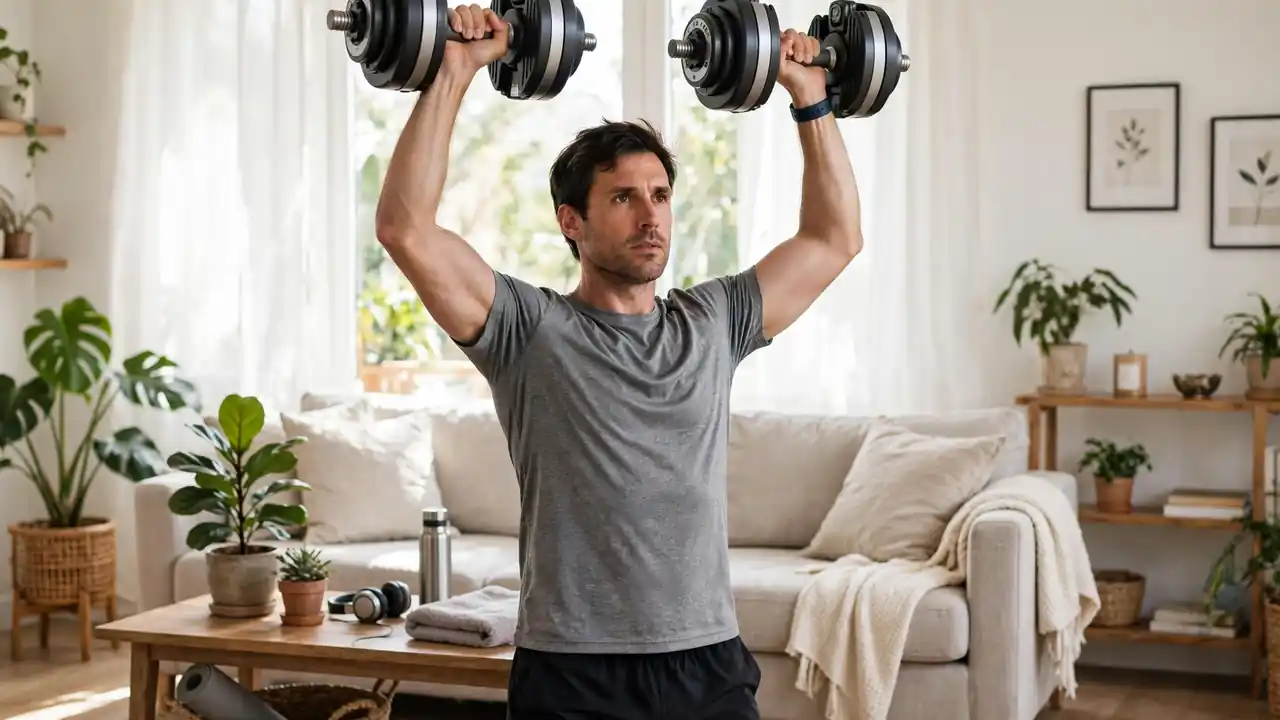
If I could keep only one purchase, it would be adjustable dumbbells, and I say that after years of training with them. A good pair replaces many fixed pairs in the footprint of two dumbbells, which matters enormously in a small home. The popular BowFlex SelectTech 552, for example, replaces roughly 15 pairs of dumbbells from 5 to 52.5 pounds in a footprint smaller than a nightstand, according to the 2026 comparison I linked above, with prices reported around 349 to 429 dollars. Cheaper dial and plate systems exist too, and the right one depends on your budget and how fast you like to change weights between sets.
I use dumbbells for presses, rows, split squats, curls, carries, and goblet squats, which is most of a full-body program on its own. For beginners, a useful starting range is 5 to 10 pounds for arm and shoulder work, 15 to 25 pounds for upper-body compound moves, and 30 to 50 pounds for lower-body work like goblet squats, as reported in the essentials guide above. If that sounds like a lot, remember that adjustable dumbbells grow with you. You start light, learn good form, and turn the dial up as you get stronger, without buying a new pair every few months. Watch out for one honest limit. Advanced lifters may outgrow a 52.5-pound top weight for heavy rows and squats, so if you already lift heavy, look for a heavier adjustable set or fixed dumbbells from the start.
For the training itself, I pair dumbbell work with the simple bodyweight plan in our strength training guide and our home workouts guide, which both show how little you need to begin. Dumbbells do not replace good form or regular sessions. They simply give good form more room to grow, and that is exactly what a first big purchase should do.
2. Resistance Bands: The Cheapest Real Strength Tool
Resistance bands were my best value purchase, and I wish I had bought them first. A set costs little, weighs almost nothing, stores in a drawer, and travels anywhere, yet it adds real resistance to rows, presses, squats, hip work, and warm-ups. Bands are also kind to joints, because the resistance rises as the band stretches, which suits many beginners. I use loop bands for glute and hip work, and tube bands with handles and a door anchor for rows and presses, and together they cover the pulling moves that bodyweight alone struggles to provide.
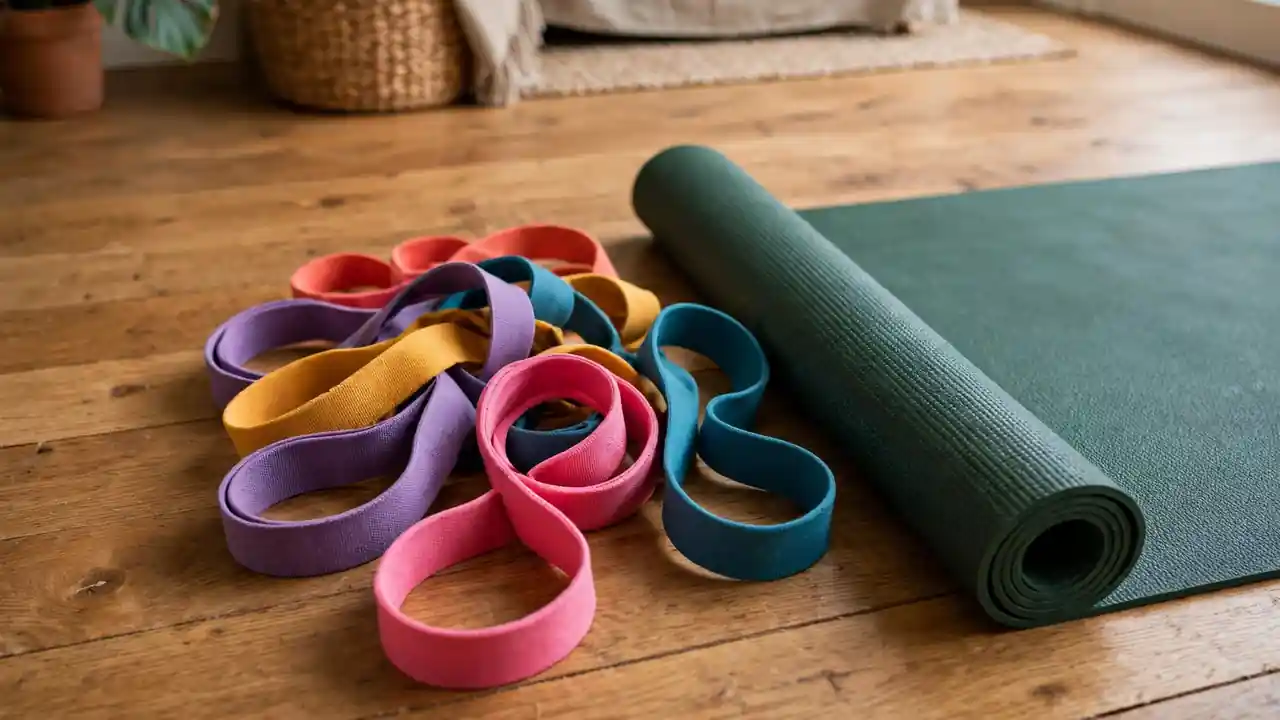
When you shop, I recommend fabric loop bands for lower-body work, because they stay in place instead of rolling up your legs mid-set, and they feel more comfortable on bare skin. For tube bands, check the handles, the door anchor, and the clips before you buy, because cheap clips and thin handles are where budget sets fail. Replace bands when you see fraying, thinning, or small nicks, and never stretch a damaged band near your face. A worn band is not a bargain. It is a snap waiting to happen, and I replace mine at the first sign of wear, without arguing about the cost.
Bands have one honest limit you should know. They do not offer the same precise, heavy progression as dumbbells for advanced strength work, so serious lifters will still want weights for their main lifts. The best approach, confirmed by several 2026 guides, is to combine both. Use dumbbells or a kettlebell for your main strength moves, and bands for warm-ups, accessory work, travel, and extra volume. That combination is cheap, compact, and surprisingly complete.
3. A Good Mat, a Kettlebell, and the Useful Extras
A good mat sounds boring until you train without one. A thick, grippy mat protects your knees and elbows on hard floors, stops you sliding during planks, and marks out your training space in a shared room. I chose a mat that is thick enough for floor work but not so soft that I wobble during standing moves, and I keep it rolled where I can see it, because a visible mat is a daily reminder. You do not need the most expensive mat on the market, but a thin, slippery mat will annoy you every session, and annoyance is what kills habits.
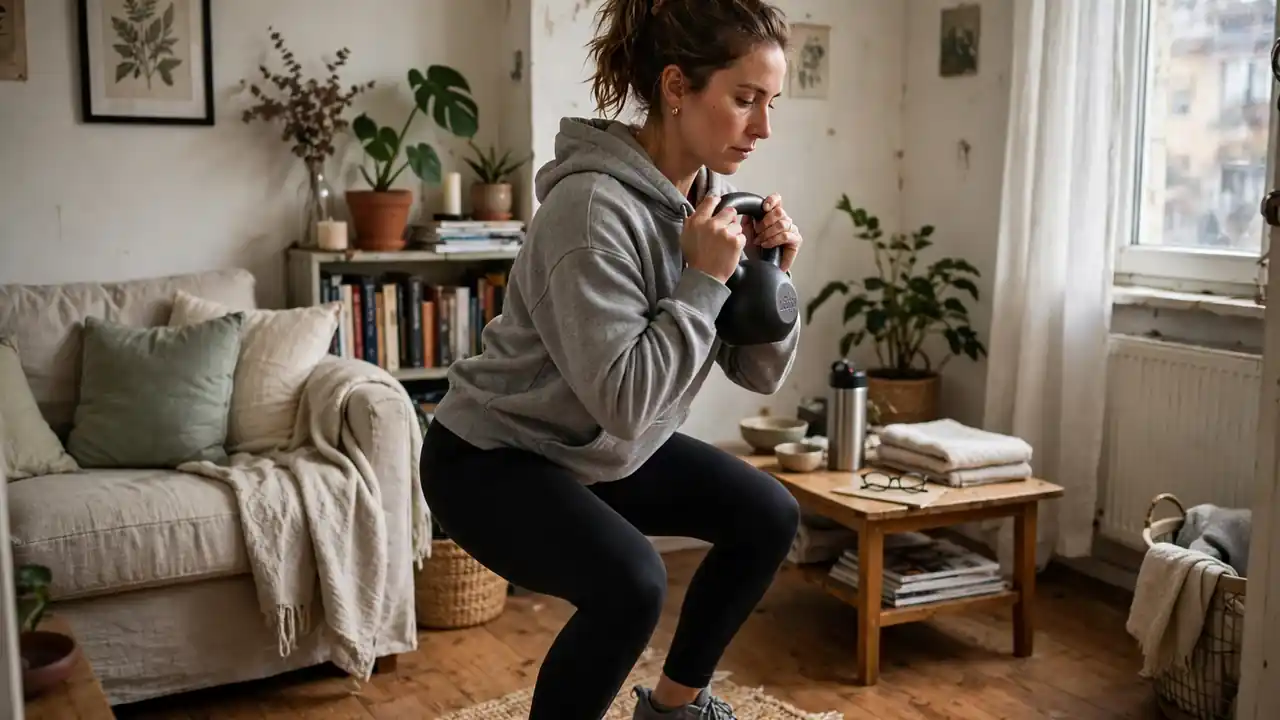
A kettlebell is my favourite second purchase after dumbbells. One medium kettlebell, chosen with care, covers goblet squats, Romanian deadlifts, swings for conditioning, and carries for grip and core, all in a footprint smaller than a shoebox. Start with a weight you can control with perfect form, not the weight you wish you could lift, and learn the hinge pattern slowly, because kettlebell swings reward good technique and punish rushed technique. If you have wrist or back problems, skip swings and use the kettlebell for slow, controlled squats and deadlifts instead, or ask a qualified coach to check your form once.
The useful extras, in the order I would buy them, are a folding adjustable bench, a doorway pull-up bar, a jump rope, and an ab roller. A bench supports presses, rows, and step-ups, and a folding bench stores flat against a wall. A doorway pull-up bar adds the vertical pulling move that dumbbells cannot fully replace, but check your door frame first, because not every frame suits one. A jump rope is the cheapest cardio tool there is, and an ab roller is a small, focused core tool for people who already train regularly. None of these are needed on day one. They are rewards for a habit that already exists, and buying them in that spirit keeps them useful instead of dusty.
Three Starter Kits, Honestly Priced
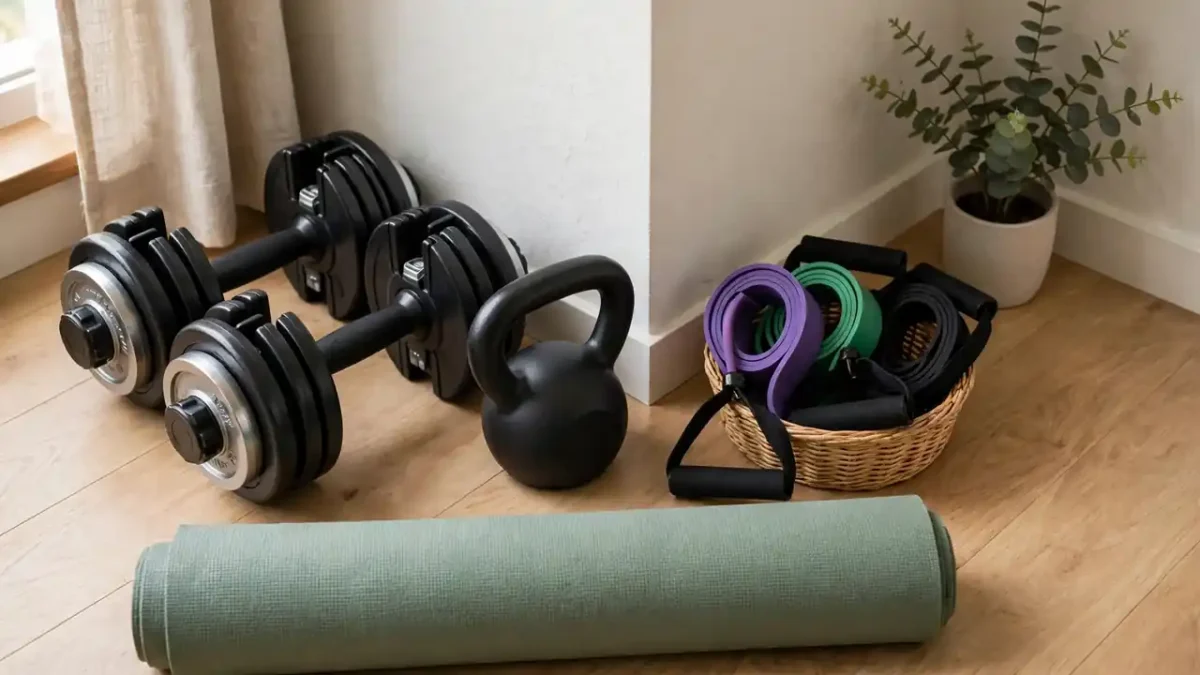
Here are the three kits I recommend to friends, based on what actually gets used. The drawer kit, for the smallest budgets and spaces, is a mat, a set of loop bands, and a set of tube bands with a door anchor. That covers full-body training, mobility, and warm-ups, and it stores in a drawer. The corner kit, my personal recommendation for most people, adds one pair of adjustable dumbbells to the drawer kit, and that single addition unlocks heavy-enough pressing, rowing, and leg work for years. The dedicated corner kit adds a kettlebell and a folding bench to the corner kit, and that is a genuinely complete home gym that still fits in a corner of one room.
I also think about noise and neighbours, because I live in a flat. Dumbbells on a mat are quiet. Kettlebell work on a mat is quiet. Jump rope on a hard floor downstairs can be noisy, so I skip it indoors and use it outside or swap it for marching and step work. Measure your floor space before you buy anything large, and favour equipment that folds to under 30 centimetres deep where possible, so it slides behind a sofa or into a wardrobe. A setup that needs rearranging the room every time will not survive a busy week, while a setup that lives in its corner will.
Setting Up a Space You Will Actually Use
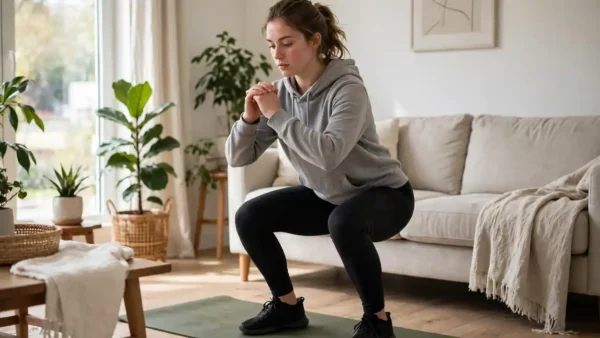
I train in a corner of my living room that measures about two metres by two metres, and that is enough for every move in my program. I keep my mat rolled beside the sofa, my dumbbells on a small tray, and my bands in a basket, so setup takes less than a minute. I train at the same time most days, after my morning coffee, with a short playlist, and that routine matters more than any purchase. If you share your home, agree on your training corner and your training time with the people you live with, because a setup that annoys your household will not last either.
Safety matters in a small space too. Clear the floor, move loose rugs, and keep a clear path around you. Check door anchors and pull-up bars before every use, and test them with a gentle pull first. Wear shoes that grip, or train barefoot on a mat if that feels steadier for you, but never train in socks on a smooth floor. Keep water nearby, rest between sets, and stop if you feel sharp pain, dizziness, or unusual shortness of breath. Good equipment supports safe training, but it never replaces attention and good form.
Related reading on CAAW News: our beginner yoga guide, our beginner running plan, our walking guide, and our strength starter plan after 40.
Frequently Asked Questions
What is the minimum equipment I need to work out at home?
A mat, a set of resistance bands, and one pair of medium-weight dumbbells cover about 90 percent of effective home training, according to the 2026 essentials guide I quoted. You can start with bodyweight alone and add bands first, but that trio is the smallest kit I would call complete.
Are adjustable dumbbells worth it?
For most homes, yes, especially flats and small rooms. One pair replaces many fixed pairs, saves floor space, and grows with you as you get stronger. A full rack is better only if you have dedicated space and want instant weight changes between sets without adjusting a dial.
Can resistance bands replace free weights?
For beginners and intermediate trainers, bands build real strength, especially for accessory and hip work. For heavy main lifts, they lack the precise progression of dumbbells, so the best setup combines bands with weights rather than choosing one alone.
How much space do I need for a home gym?
About two metres by two metres of clear floor is enough for most full-body routines with dumbbells, bands, and a kettlebell. Measure before you buy anything large, and favour folding or stackable pieces that store without rearranging the room.
Should I buy a bench straight away?
No, unless you already train regularly and miss supported pressing and rowing. Start with the mat, bands, and dumbbells, and add a folding bench when your program genuinely asks for it. A bench bought too early often becomes a storage shelf.
What should I check before buying a pull-up bar?
Check your door frame type, its width, and its weight limit, and test the bar with a gentle pull before full use. If your frame does not suit a doorway bar, a band with a door anchor gives you a useful pulling alternative without drilling or damage.
How do I avoid buying gear I never use?
Buy in stages, one purchase at a time, and only to solve a gap you felt in the last month of training. If you cannot name the gap, you do not need the gear yet. Wait a month, train with what you have, and let the gap name itself.
Final Thoughts
I started this guide with my cupboard of regret, and I want to end it with the small corner that replaced it. A mat, bands, and adjustable dumbbells gave me back my strength, my time, and my confidence, without a gym, without a garage, and without another expensive mistake. Your kit does not need to impress anyone. It needs to fit your room, your budget, and your life, and to be ready in under a minute when your training time arrives. Start with the drawer kit this week, add dumbbells when you are ready, and tell me in the comments what you bought first and how it felt. Your honest answer might save the next reader from the same expensive mistake I made.
React to this story