Key Points
Key Points
- Astronomers have resolved the true, uneven shape of an exoplanet's atmosphere for the first time, finding WASP-17b is subtly egg-shaped.
- The Cornell-led team used a new 'transmission strings' technique on James Webb Space Telescope observations, published in Nature Astronomy on 14 October 2026.
- A broad equatorial jet with vast wind speeds transports heat from the planet's permanent dayside to its nightside, sculpting the atmosphere's outline.
- The findings create one of the most comprehensive 3D views of any exoplanet among the 6,000-plus confirmed to date.
- Researchers say the method could be applied to other transiting worlds, transforming exoplanet science from averaged spectra to true atmospheric maps.
On This Page
- Circles No More: The First True Silhouette of a Distant World
- Subscribe to CAAW News
- How ‘Transmission Strings’ Works
- WASP-17b: An Egg-Shaped Hot Jupiter With a Jet Stream
- A Benchmark World Among 6,000 Exoplanets
- Why Shape Matters for Habitability Science
- What’s Next: Mapping More Worlds
- React to this story
Circles No More: The First True Silhouette of a Distant World
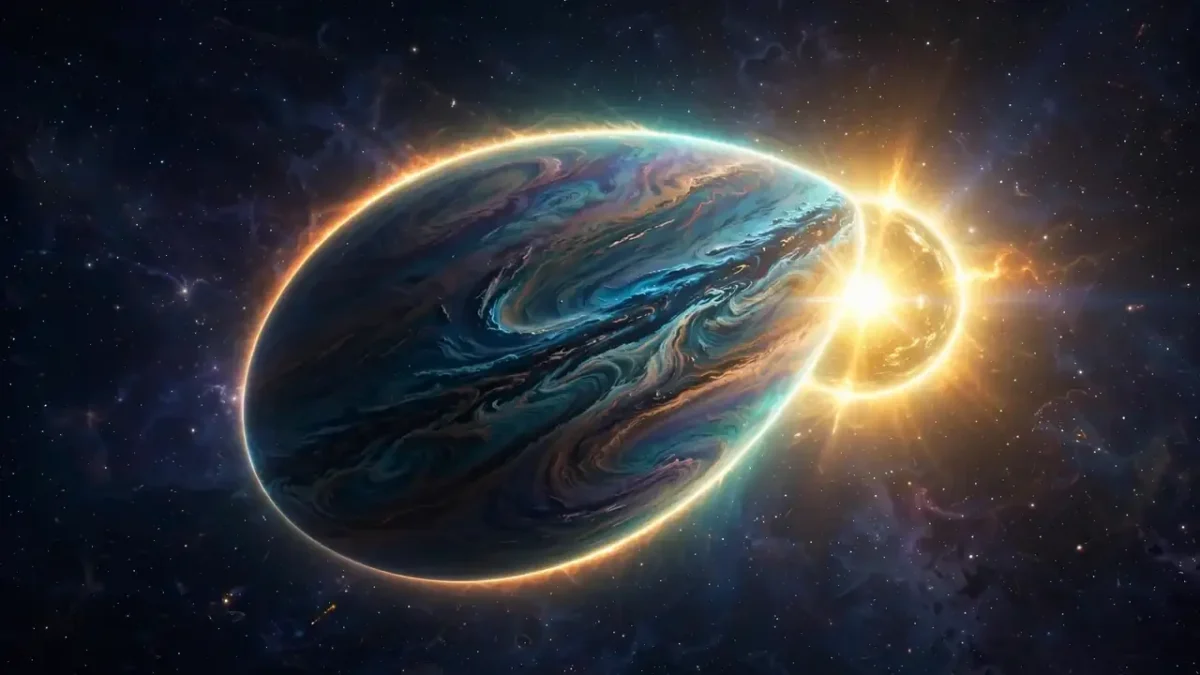
For more than three decades, astronomers studying worlds beyond the solar system have accepted a humbling simplification: every exoplanet, no matter how exotic, was treated in their models as a perfect circle. That assumption has now been swept aside. A Cornell-led international team has, for the first time, resolved the actual, uneven contours of a planet orbiting another star — revealing that the hot Jupiter WASP-17b is subtly egg-shaped, with one side of its atmosphere bulging outward more than the other.
The achievement, published on October 14, 2026, in Nature Astronomy, relies on a new analytical technique called transmission strings, applied to observations from NASA’s James Webb Space Telescope of a giant world more than 1,000 light years from Earth. It is the first time astronomers have mapped the true shape of an exoplanet’s atmosphere rather than assuming one.
The resulting shape is circle-like, of course — but slightly egg-shaped, with one more extended side. That asymmetry is not a curiosity; it details how intense heat and whipping winds sculpt the atmosphere of a world locked in a permanent embrace with its star. For exoplanet science, it is the equivalent of moving from a stick-figure sketch to a portrait.
The team says its findings about the planet’s chemical composition and temperature shifts — from equator to poles, and between permanent day and night sides — are consistent with theoretical predictions. Together, they create one of the most comprehensive three-dimensional views of an exoplanet’s atmosphere among the more than 6,000 exoplanets confirmed to date, making WASP-17b a benchmark for comparisons with others.
How ‘Transmission Strings’ Works
The method, also known as transit mapping, exploits the moments when an exoplanet crosses in front of its host star. During such a transit, starlight filters through the thin annulus of atmosphere around the planet’s edge — the limb — picking up the chemical fingerprints of gases at different altitudes. It is the same principle behind the transmission spectroscopy that has revealed water, carbon dioxide and other molecules on distant worlds.
Conventional transmission spectroscopy, however, collapses all of that information into a single spectrum averaged around the entire limb. It effectively assumes the planet is a circle with the same radius all the way around — a reasonable simplification when the data could support nothing better, but a simplification all the same.
Transmission strings takes a different approach. Instead of averaging, it tracks the planet’s progress across the stellar disk, capturing the composition of light around the limb from different angles as the transit unfolds. By watching how the light changes moment by moment, the technique mathematically reconstructs how the distance from the planet’s centre to its atmospheric edge varies from point to point — effectively tracing the planet’s outline.
Think of it as the difference between a single photograph and a scan. A photograph of WASP-17b’s transit gives one averaged impression; the transmission-strings scan builds up the shape piece by piece, angle by angle, until the true silhouette emerges. The method demands exquisite data — the kind only Webb can deliver — and sophisticated mathematics to turn a flickering light curve into a map.
WASP-17b: An Egg-Shaped Hot Jupiter With a Jet Stream
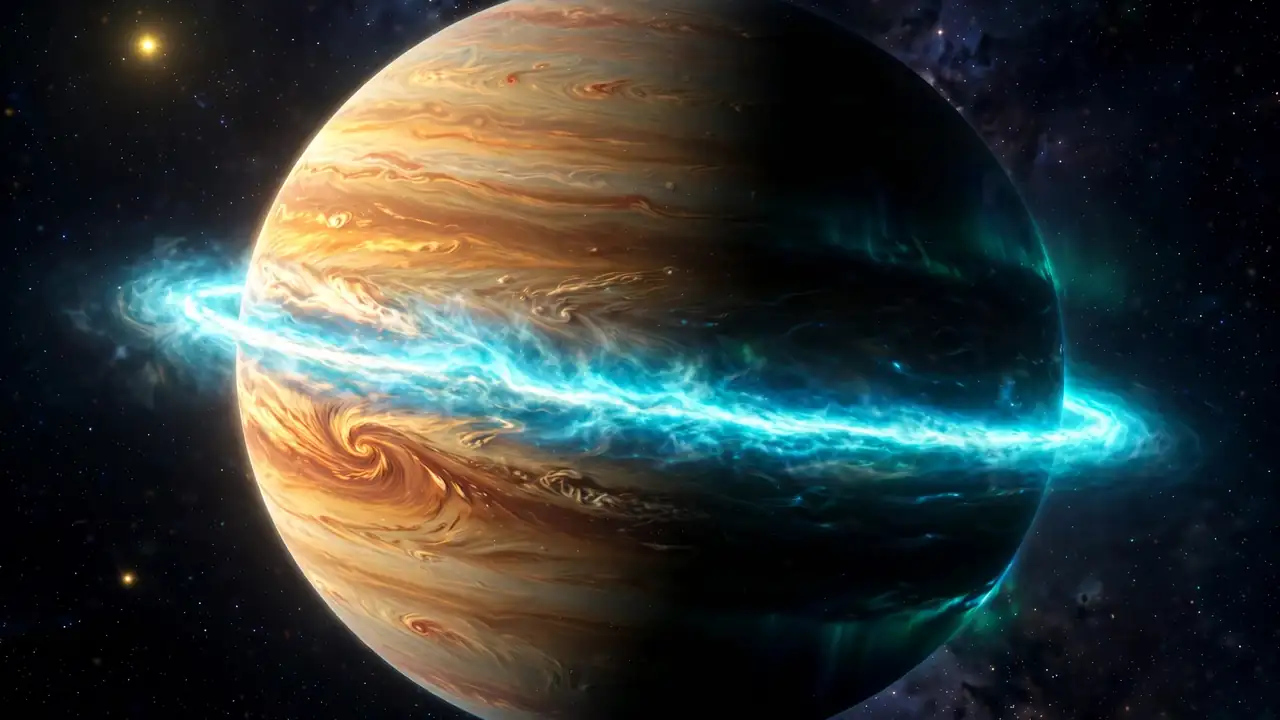
The planet at the centre of this breakthrough is a hot Jupiter — a gas giant orbiting extremely close to its star, with a permanent dayside baked by stellar radiation and a permanent nightside in shadow. WASP-17b’s atmosphere, mapped using the new technique, shows a broad banded jet around the equator with vast wind speeds that transport material and heat from the permanently irradiated dayside to the permanently shadowed nightside.
That jet is the key to the planet’s shape. The intense heating on the dayside drives powerful atmospheric circulation, and the equatorial jet — a river of gas racing around the planet — distorts the atmosphere’s outline, stretching one side further outward than the other. The egg shape is, in effect, a visible signature of the planet’s weather.
The temperature shifts the team measured, from equator to poles and between day and night, match what theorists predicted for such a world. The chemical composition findings align with other modelling techniques too. This consistency matters: it means the new shape-mapping method is not producing artefacts but genuinely revealing the planet as it is.
Hot Jupiters like WASP-17b are natural laboratories for atmospheric physics. Their extreme conditions — temperatures, winds and irradiation far beyond anything in our solar system — test our models in regimes where intuition breaks down. Resolving the actual shape of such a planet’s atmosphere gives theorists a new observable to match, tightening the link between models and reality.
A Benchmark World Among 6,000 Exoplanets
More than 6,000 exoplanets have now been confirmed, ranging from lava worlds to cold Neptunes to potentially rocky planets in habitable zones. Yet for almost all of them, our knowledge remains frustratingly one-dimensional: a mass, a radius, perhaps an averaged atmospheric spectrum. WASP-17b now stands apart as one of the most comprehensively characterised — a three-dimensional benchmark against which other worlds can be compared.
Benchmarks matter because exoplanet science is fundamentally comparative. Astronomers cannot visit these worlds; they learn by placing each new observation in the context of better-understood cases. A planet whose shape, chemistry, winds and temperatures are all mapped becomes a reference point — a Rosetta Stone for interpreting the sparser data from other systems.
The transmission-strings technique itself may prove as important as the WASP-17b result. If it can be applied to other transiting planets observed by Webb, astronomers could begin building a catalogue of true exoplanet shapes — mapping how atmospheric distortion varies with temperature, gravity, rotation and stellar irradiation. That would transform our understanding of exoplanet atmospheres from a collection of averages into a genuine geography of distant worlds.
The Cornell-led team has shown the method works on one of the most favourable targets — a large, hot planet transiting a bright star. Extending it to smaller, cooler planets will be harder, but the principle is now proven.
There is a pleasing symmetry in the advance. Three decades ago, the first exoplanet detections around sun-like stars forced astronomers to accept worlds stranger than theory had predicted. Now, the first true shape measurement forces them to abandon one of their most basic modelling assumptions. With each such step, the distant planets come slightly more into focus — less like points of data, more like places.

Why Shape Matters for Habitability Science
At first glance, the precise outline of a hellish hot Jupiter might seem irrelevant to the search for habitable worlds. But the physics is universal. The same atmospheric dynamics that stretch WASP-17b into an egg — day-night heat transport, jet streams, the interplay of irradiation and circulation — operate on every planet with an atmosphere, including potentially habitable ones.
For rocky planets in habitable zones, atmospheric circulation determines whether heat is distributed evenly or locked into extreme day-night contrasts. A planet with efficient heat transport might be temperate across its surface; one without it could have a scorched dayside and a frozen nightside, with only a narrow twilight band capable of supporting liquid water. Understanding these dynamics on hot Jupiters, where the signals are strong and the physics is laid bare, builds the theoretical foundation for interpreting the fainter signals from Earth-like worlds.
Shape also encodes information about atmospheric escape — the process by which intense stellar radiation strips gas from a planet. An extended, distorted atmosphere may be one that is losing mass to space. For the long-term habitability of any planet, knowing whether its atmosphere is stable or bleeding away is essential.
In short, WASP-17b’s egg shape is a window into the machinery of atmospheres everywhere. The first true silhouette of an exoplanet is also a first glimpse of how alien weather really works.
What’s Next: Mapping More Worlds
The immediate future of transmission strings is more targets. Webb’s observing schedule is packed, but the technique’s power will motivate proposals to apply it to other transiting exoplanets — particularly those with existing high-quality transit data that could be reanalysed with the new method.
Longer term, the approach points toward a new era of exoplanet characterisation. Future observatories designed with exoplanet atmospheres in mind could incorporate transit mapping as a standard tool, routinely resolving shapes rather than assuming circles. Combined with direct imaging advances that are beginning to photograph exoplanets as points of light, astronomy is moving from counting worlds to truly seeing them.
For now, WASP-17b holds a unique distinction: the first exoplanet whose true outline we know. Mathematical models necessarily reduced distant exoplanets to idealised circles — until now. The universe, it turns out, is egg-shaped in places. And we can finally see it.
React to this story