Key Points
Key Points
- Scientists report the first-ever evidence of a second-generation planet, likely a gas giant orbiting the white dwarf HS 0209+0832, 270 light-years away.
- The study, published in Nature Astronomy on 5 October 2026, found unprecedented traces of niobium on the dead star's surface — a first for any white dwarf.
- Lead author Jamie Williams of the University of Warwick says the niobium-rich material implies the planet formed from the ashes of the star as it died.
- NASA's TESS satellite detected a faint brightness signal repeating every 4.4 days, consistent with a giant planet in an extremely tight orbit.
- The discovery suggests planet formation can recur after stellar death, rewriting the life cycle of planetary systems.
On This Page
A Planet That Rose From a Star’s Ashes
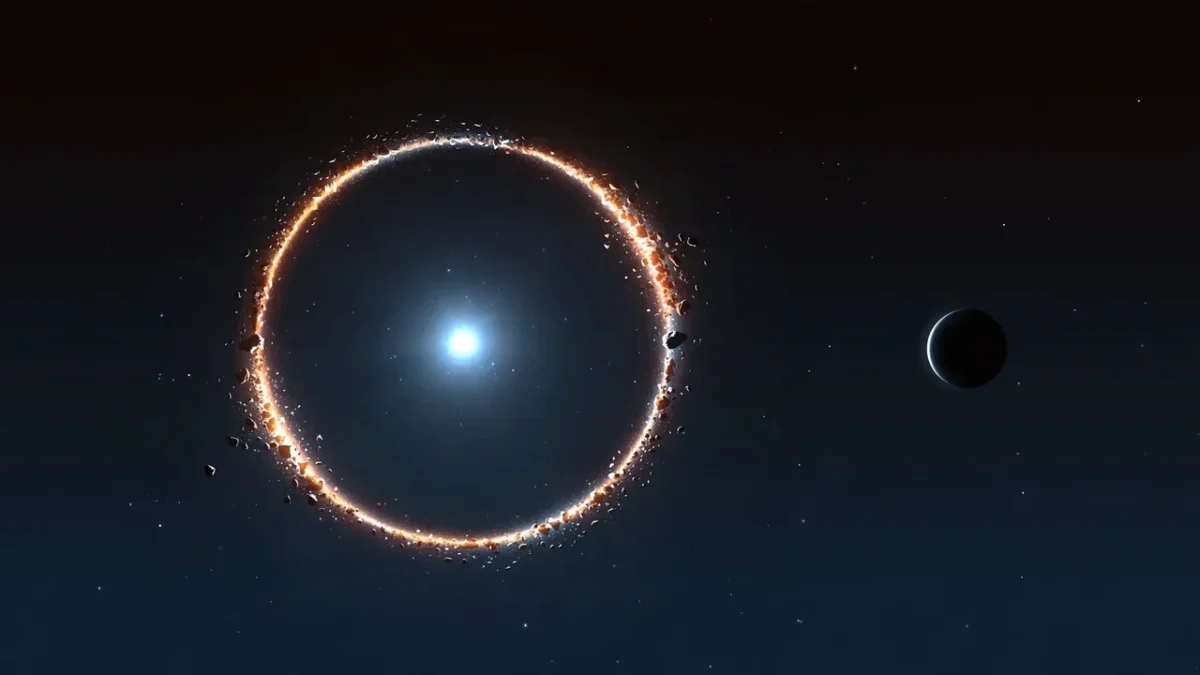
In a cosmic first, scientists say they have detected a planet that may have formed from the burned remains of its dead host star. The planet is likely a gas giant orbiting a white dwarf called HS 0209+0832, located about 270 light-years from Earth, according to a study published on October 5, 2026, in the journal Nature Astronomy.
After analysing observations from NASA’s Hubble Space Telescope and other instruments, the team found chemical evidence suggesting the planet could have condensed from material expelled by the star as it fizzled out of energy and collapsed into a white dwarf. If confirmed, it would be the first-ever recorded example of a so-called second-generation planet — an entirely new world made from a dead star’s debris.
The distinction matters. When a sun-like star dies, it first swells into a red giant and then sheds its outer layers, leaving behind a small but dense, hot core known as a white dwarf. Some of the original planets — those that formed alongside the star — can survive this cataclysm if their orbits are wide enough. Astronomers have observed a handful of such first-generation survivors revolving around white dwarfs. But a second-generation planet, born from the wreckage after the star’s death, has never been seen before.
The discovery, if it holds up, rewrites the life cycle of planetary systems. Death, it seems, is not necessarily the end of planet formation.
The Niobium Fingerprint
The telltale sign that HS 0209+0832 might have birthed a new planet is unusual traces of heavy elements on the white dwarf’s surface — material the study authors believe is planetary debris raining down onto the leftover stellar core.
The smoking gun is an element called niobium. Lead study author Jamie Williams, a doctoral student in the physics department at the University of Warwick in England, explained that the planetary material falling onto the white dwarf is very rich in niobium — and that this is the first time the element has ever been found in a white dwarf. That unprecedented detection, the team argues, implies the material is made from the ashes of the star as it died.
The logic is elegant. A white dwarf’s intense gravity causes heavy elements to sink rapidly out of its visible surface layers, so any metals detected there must have arrived recently — they are the shredded remains of something that wandered too close. The specific chemical mix, rich in niobium in proportions matching the processed ashes of the dead star, points to material that was itself forged from stellar ejecta.
In other words, the white dwarf is polluted by the remains of a planet — and that planet’s chemistry suggests it was built from the star’s own cast-off material. It is forensic astronomy: reading the composition of falling debris to reconstruct a world that may no longer fully exist, or that exists in a form we are only beginning to understand.

How a Second-Generation Planet Forms
The proposed formation story begins with stellar death. As a sun-like star exhausts its fuel, it balloons into a red giant, engulfing its inner planets, then sheds its outer layers in powerful winds. What remains is the white dwarf — Earth-sized, but with roughly the mass of the Sun packed into that tiny volume.
The expelled material does not simply vanish. Some of it can settle into a disk around the white dwarf — a second-generation protoplanetary disk, made from the processed ashes of the star itself. Within such a disk, dust grains can stick together, growing into pebbles, boulders and eventually planets, repeating on a smaller scale the planet-formation process that built the original system billions of years earlier.
This scenario has been theorised for years but never observed. The challenge is that white dwarf systems are faint and their planets — if they exist — are extraordinarily difficult to detect directly. The HS 0209+0832 system offers the first compelling evidence that the theory describes something real.
The chemistry is what makes the case distinctive. A first-generation survivor planet, formed with the star, would have a composition reflecting the original protoplanetary disk. A second-generation world, condensed from stellar ejecta, carries the chemical signature of material that has been through a star’s nuclear furnace — the niobium-rich ashes that Williams and colleagues detected.
The 4.4-Day Heartbeat: TESS Closes the Case
Chemical evidence alone might leave room for doubt. But the team found a second, independent line of evidence: further analysis of observations from NASA’s Transiting Exoplanet Survey Satellite, or TESS, revealed a faint brightness signal repeating every 4.4 days — a rhythmic dimming and brightening consistent with a giant planet orbiting the white dwarf.
The 4.4-day period places the planet extremely close to the white dwarf — far closer than any first-generation planet could have survived the red giant phase. A planet that close today must either have migrated inward after the star’s death or formed there afterward. Combined with the chemical evidence, the tight orbit strengthens the second-generation interpretation: this is a world that came to be after its star died, not one that endured the death.
The convergence of two independent signals — Hubble’s chemical fingerprint and TESS’s orbital heartbeat — is what elevates the finding from intriguing to compelling. Each line of evidence constrains the other, and together they paint a consistent picture of a giant planet circling a stellar corpse, built from that corpse’s own remains.
Confirmation will require further observation, and the researchers are candid that alternative explanations must be ruled out. But as it stands, HS 0209+0832 hosts the best candidate yet for a second-generation planet — a category of world that, until now, existed only in theory.
What First-Generation Survivors Taught Us
The new result builds on a growing body of work on planets around white dwarfs. Astronomers have previously observed a handful of first-generation survivors — planets that formed with their stars and endured the red giant inferno by orbiting at a safe distance. These systems proved that planetary systems can, in some form, outlive their stars.
White dwarf pollution — the heavy elements seen on white dwarf surfaces — has been studied for years as a window into the composition of destroyed planets. Dozens of polluted white dwarfs are known, each one a crime scene where a planet or asteroid was torn apart by the stellar remnant’s gravity. The HS 0209+0832 system is different because the pollution’s chemistry points not to a destroyed first-generation world but to second-generation material.
The distinction opens a new chapter. If second-generation planet formation happens around HS 0209+0832, it likely happens elsewhere too — wherever dying stars leave behind enough material to build anew. The planetary systems of the far future, orbiting the white dwarfs that sun-like stars will become, may be richer and more dynamic than anyone expected.
Our own Sun will one day become a white dwarf, some five billion years from now. The discovery hints that the story of our solar system may not end with the Sun’s death — that from its ashes, new worlds could one day form.

Why This Rewrites Planetary Life Cycles
Textbook accounts of planet formation describe a single act of creation: a cloud collapses, a star ignites, planets condense from the leftover disk, and the system ages toward a quiet end. The second-generation planet upends that narrative. Planet formation, it suggests, can be a recurring process — a phoenix cycle in which stellar death provides the raw material for new worlds.
The implications ripple outward. If dead stars can birth planets, then the census of planets in the galaxy is incomplete in a fundamental way: it misses the worlds that form late, around stellar remnants. Future surveys targeting white dwarfs may find that second-generation planets are not freaks but a genuine population.
There are also implications for the search for life. A second-generation planet forms from processed stellar material — rich in heavy elements, potentially rich in the ingredients of habitability. Whether such worlds could ever host life is unknown, but the question is now on the table in a way it never was before.
For now, HS 0209+0832 stands alone: a white dwarf 270 light-years away, polluted by niobium-rich ashes, orbited every 4.4 days by a giant planet that should not exist — and does. In the words the data seem to whisper, even dead stars can dream of new worlds.
React to this story