

Key Points
Key Points
- TIME's Best Inventions of 2026 recognized NASA's Nancy Grace Roman Space Telescope, announced October 15, 2026.
- Roman launched August 30, 2026, and is on a three-month, million-mile journey to Sun-Earth Lagrange point 2.
- Its 300-megapixel Wide Field Instrument will survey the sky far faster than Hubble with similar sharpness.
- Fuel-efficient cruise suggests a possible 22-year lifetime, more than double the design life.
- The Coronagraph Instrument achieved first light in September 2026; first science images expected by early 2027.
On This Page
NASA’s newest great observatory has not even taken its first science image yet — and it has already been named one of the best inventions of the year. On October 15, 2026, TIME’s annual Best Inventions list honored the Nancy Grace Roman Space Telescope, recognizing the flagship mission that will map the dark universe and hunt for alien worlds like never before.
Roman launched on August 30, 2026, from Kennedy Space Center in Florida, and it is currently on a three-month, million-mile journey to its final observing post at the Sun-Earth Lagrange point 2 (L2), a gravitationally stable spot 1.5 million kilometers from Earth where it can stare deep into the cosmos with minimal interference. Along the way, engineers are putting the telescope through commissioning — a careful sequence of calibrations and tests to prepare it for science operations. NASA anticipates releasing Roman’s first images by early 2027.
The TIME recognition, announced through NASA’s science honors program, places Roman alongside the year’s most groundbreaking products, software and services — the innovations TIME’s editors judge to be shaping the world. For a telescope still en route to its destination, it is an unusually early honor, and a sign of how much astronomers expect from the mission.
What makes Roman special
The Nancy Grace Roman Space Telescope — named for NASA’s first chief astronomer, who is often called the “mother of Hubble” — pairs two capabilities no previous space telescope has combined: a huge field of view and crisp infrared vision. Its Wide Field Instrument is a 300-megapixel infrared camera that can photograph an area of sky 100 times larger than Hubble’s in a single shot, with similar sharpness.
That combination makes Roman a survey machine. Where the James Webb Space Telescope studies small patches of sky in exquisite detail, Roman will sweep across vast swaths of the heavens, cataloging billions of galaxies and stars. Its surveys will generate enormous amounts of data — about 1.4 terabytes a day flowing into a public archive — supporting research far beyond the mission’s core goals, from mapping dark matter to discovering rogue planets wandering between the stars.
Roman’s primary science targets are among the biggest mysteries in physics: dark energy, the unknown force accelerating the universe’s expansion, and dark matter, the invisible scaffolding that holds galaxies together. By measuring the precise shapes and distances of hundreds of millions of galaxies, Roman will trace how cosmic structure has grown over billions of years — and test whether our theories of the universe hold up.
A smooth ride so far
The journey to L2 has gone better than planned. Mission updates report that the first trajectory correction maneuver used only about 18 kilograms of fuel where 200 kilograms had been budgeted. Fuel is the ultimate limit on a space telescope’s life, and this efficiency means Roman could potentially operate for around 22 years — more than double its design lifetime. If that holds, astronomers could gain entirely new science programs that were never in the original plan.
Other milestones have fallen into place on schedule. In September 2026, Roman’s fine-guidance system passed critical tests, demonstrating pointing stability equivalent to focusing a laser on a coin from hundreds of kilometers away for hours at a time — precision essential for both the Wide Field Instrument and the coronagraph. The Wide Field Instrument itself was powered on in mid-September after a 10-day decontamination period, cooled to minus 225 degrees Fahrenheit (minus 143 Celsius), and has already returned test data confirming its electronics work as intended. Early test images showed stars as halos or donuts because the telescope was still out of focus — expected during commissioning — but all systems checked out.
Roman is expected to arrive at L2 in early December 2026. Commissioning will continue through the winter, with first science images expected around the turn of the year and full science operations beginning in 2027. For context on NASA’s other big lunar and deep-space efforts, see our coverage of the 800 GB Artemis II data release, Japan’s MMX mission to the moons of Mars, and the race to return astronauts to the Moon.
The coronagraph: hunting alien worlds directly
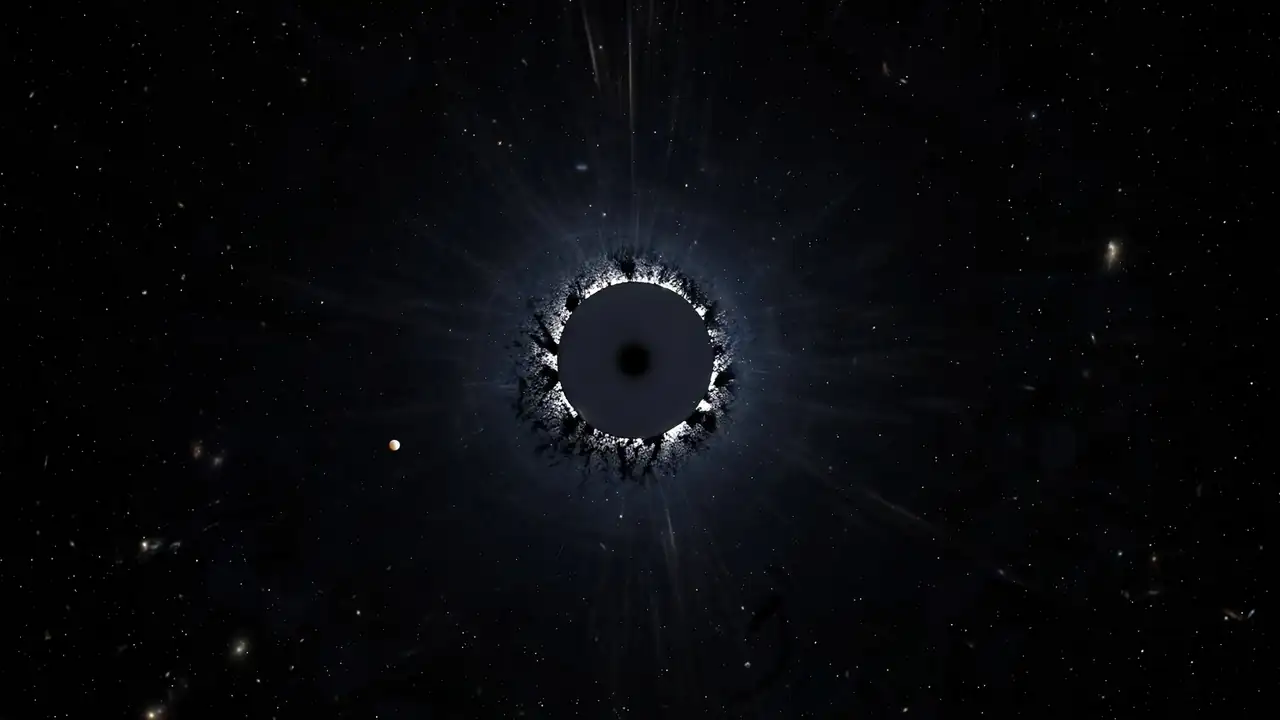
Roman’s most daring technology is its Coronagraph Instrument — a device designed to do something extraordinarily difficult: photograph planets orbiting other stars directly. A planet close to its star is typically a billion times fainter than the star itself, drowned in glare. The coronagraph combines advanced masks that block starlight with deformable mirrors that correct tiny optical imperfections thousands of times per second, suppressing the star’s glare so the faint planet can emerge.
If the technology performs as intended, astronomers could directly image and study gas giants that are older, cooler and orbit closer to their stars than the hot, young planets typically found by direct imaging today. That would open a new window on planetary systems more like our own. The instrument has been described by researchers as the most technically sophisticated device for optical observations ever operated in space for scientific research.
And it is already working. On September 22 and 27, 2026, the Coronagraph Instrument captured its first images of a star in the Large Magellanic Cloud — its “first light.” The instrument is functioning as designed, and the team is proceeding with increasingly complex tests. Every successful test reduces the risk for the ambitious exoplanet observations planned once science operations begin.
Why TIME’s editors noticed
TIME’s Best Inventions list is not a science award — it is a broader cultural recognition of innovations making the world “better, smarter, and more fun.” Roman earned its place because it represents a leap in how humanity observes the universe: faster, wider and deeper than anything before it, with data open to the entire world.
The telescope also carries a remarkable backstory. Its 2.4-meter primary mirror began life as hardware built for a classified satellite program; two such mirror assemblies were transferred to NASA, and one became Roman. It is a striking example of scientific resourcefulness — repurposing powerful optics for peaceful discovery.
Nancy Grace Roman herself, who died in 2018, championed space astronomy for decades and was instrumental in making the Hubble Space Telescope a reality. Naming NASA’s next flagship survey telescope for her connects the mission to a lineage of bold, wide-eyed astronomy.
What to watch next
The next two months are the ones that matter most. Arrival at L2 in early December, final commissioning through the winter, and then — if all goes well — first images that will show the public what a 300-megapixel infrared survey of the cosmos looks like. Full science operations begin in 2027, and the first great surveys will start mapping dark energy’s fingerprints across the sky.
For a mission that has already been declared one of the year’s best inventions before taking a single science image, expectations could hardly be higher. The universe, as always, will have the final word — and Roman is about to give us our widest view of it yet.

Roman’s place in the telescope fleet
Roman completes a powerful trio of NASA observatories. Hubble, now more than 35 years old, still delivers sharp visible-light images. Webb peers deeper than ever in the infrared, studying the first galaxies and exoplanet atmospheres in detail. Roman adds the missing piece: speed. Its survey power will catalog the sky hundreds of times faster than either predecessor, finding the interesting targets that Webb and ground-based giants like the Extremely Large Telescope can then study up close.
The mission’s data policy is equally ambitious. All of Roman’s observations will flow into a public archive, and its huge surveys are designed as community resources — any astronomer on Earth can mine them for discoveries the mission team never imagined. History suggests this openness pays off: some of Hubble’s most famous results came from archival data reanalyzed years later by researchers who never proposed the original observations.
There is also a quiet symbolism in the timing. Roman arrives as astronomy enters the era of mega-surveys, when the bottleneck is no longer collecting light but making sense of torrents of data. Artificial intelligence and machine learning will be essential partners in turning Roman’s petabytes into science — a fitting challenge for a telescope named one of the year’s best inventions before it has even opened its eye.
Sources
- NASA Science: TIME Best Inventions of 2026
- SciTechDaily: NASA’s New Space Telescope Could Bring Alien Worlds Into View Like Never Before
- Memesita: NASA Activates Wide Field Instrument on Nancy Grace Roman Space Telescope
React to this story




1 Comment