On This Page
- Contents
- The launch: orbit on the second try in a row
- Subscribe to CAAW News
- The booster catch: aborted minutes after separation
- Ship 42: in orbit, with the hard part still ahead
- What the double catch was supposed to be
- The road to Flight 15
- Why this flight still matters
- What happens next
- Frequently asked questions
- Final thoughts
- React to this story
SpaceX’s Starship Flight 15 is halfway to history. The world’s largest rocket lifted off from Starbase, Texas on Friday, 13 November 2026, put its upper stage into Earth orbit for only the second time ever, and deployed 26 Starlink satellites. But the mission’s headline goal — catching both halves of the rocket back at the launch tower — is already half gone. Minutes after liftoff, flight controllers aborted the planned catch of the Super Heavy booster and sent it into the Gulf of Mexico instead. The spacecraft, Ship 42, is still in orbit, circling the Earth, and its own attempt to return to the tower comes on Saturday afternoon. This article explains what happened, what went wrong with the booster, what the ship still has to do, and why the flight still matters.
Contents
- The launch: orbit on the second try in a row
- The booster catch: aborted minutes after separation
- Ship 42: in orbit, with the hard part still ahead
- What the double catch was supposed to be
- The road to Flight 15
- Why this flight still matters
- What happens next
- Frequently asked questions
- Final thoughts
The launch: orbit on the second try in a row
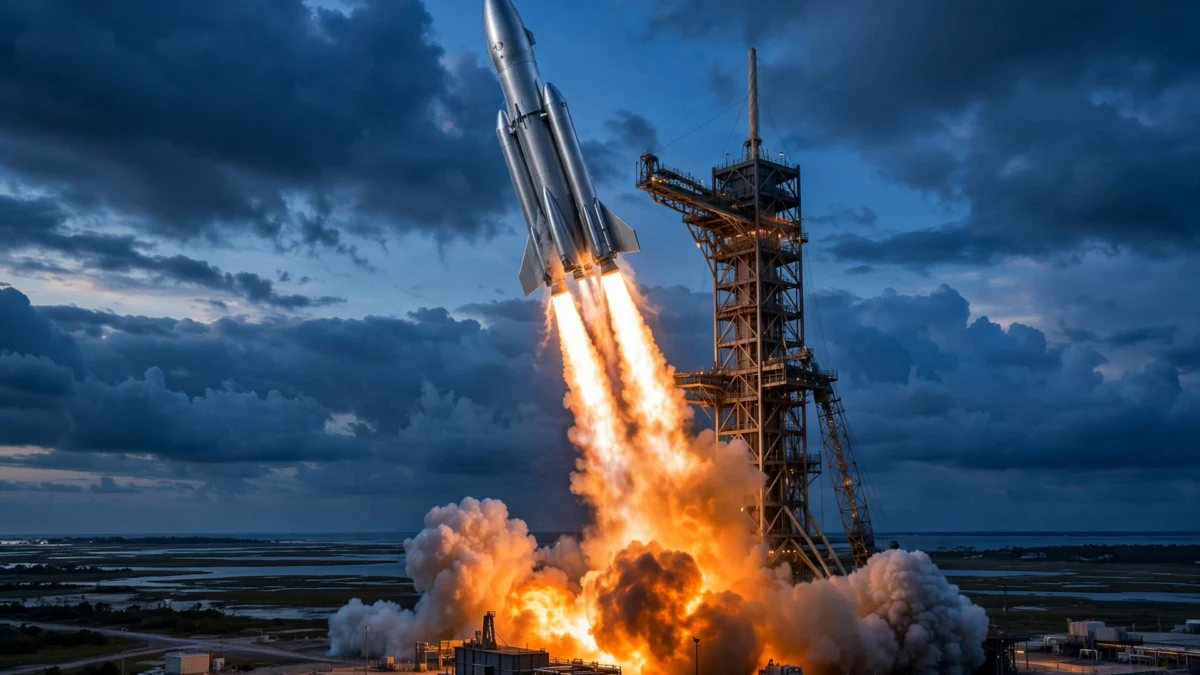
Starship lifted off from Starbase, on the South Texas coast near Brownsville, at about 4:47 p.m. Central Time on Friday, 13 November — about 3:47 a.m. PKT on Saturday, 14 November for readers in Pakistan. The 124-metre-tall vehicle — the largest and most powerful launch system ever built — rose on 33 Raptor engines producing about 8,200 tonnes of thrust, according to SpaceX. All 33 engines worked properly on ascent, the BBC reported.
About 26 minutes and 10 seconds after liftoff, Ship 42 completed a second engine burn lasting about 20 seconds and entered low Earth orbit at an altitude of about 275 kilometres. SpaceX’s Dan Huot said on the launch broadcast that Starship had reached Earth orbit for the second time in history. The first time was Flight 14, on 28 September 2026, when Ship 41 reached orbit and flew for about three hours before splashing down in the Pacific Ocean. Flight 15 is the second Starship to reach orbit in a row — and the second flight in a row to carry a working payload.
That payload is 26 Starlink V3 satellites, SpaceX’s next-generation internet satellites. Ship 42 began releasing them about 36 minutes into the flight, in a deployment operation expected to take less than an hour. Flight 14 carried the same number of the same satellites, and they were expected to raise their orbits and begin serving customers weeks after deployment. The Starlink deployment is now a routine part of Starship test flights: each mission does real work alongside the experiments.
The booster catch: aborted minutes after separation
The trouble came early. Shortly after stage separation, flight controllers detected an unspecified problem with the Super Heavy booster — designated Booster 22 — and gave up on catching it at the launch tower. Instead, the booster was diverted to a splashdown in the Gulf of Mexico, about six and a half minutes after launch. SpaceX did not immediately say what the problem was.
Observers at Starbase could hear the sonic boom and see the fiery plunge as the booster came down over the water instead of back to the tower. Reuters reported that the booster was diverted to a fixed point over the Gulf of Mexico, hovered briefly in the air, and then exploded a short distance above the sea surface. SpaceX itself has not confirmed that account, and the exact cause of the abort was not known in the hours after the launch.
The aborted catch matters because the booster return was supposed to be the routine half of the mission. SpaceX has already caught its Super Heavy booster back at the launch site three times since October 2024, using the launch tower’s mechanical arms — nicknamed “chopsticks”. Flight 15 was the first attempt to catch the booster at the launch site since March 2025, and it was meant to be the easy part of a much harder plan. That it failed on a problem detected just after separation is a reminder that the tower catch is still a probabilistic manoeuvre, not a routine one — and that even the proven half of the system can still go wrong.
Ship 42: in orbit, with the hard part still ahead
While the booster went into the sea, the upper stage carried on as planned. Ship 42 is now in orbit, and the mission plan calls for it to stay there for more than 21 hours, circling the Earth about 14 times, before attempting to come home. SpaceX set three checkpoints during the orbital phase: about 10 minutes after satellite deployment, about 7 hours 15 minutes after launch, and about 20 hours 41 minutes after launch. If there is no anomaly, the ship will perform a 10-second deorbit burn about 21 hours 36 minutes after launch and return to Starbase at about 2:45 p.m. Central Time on Saturday — about 1:45 a.m. PKT on Sunday, 15 November.
The return is the part of the mission that has never been done. No spacecraft returning from orbit has ever been caught by a launch tower. SpaceX has said the catch will only be attempted if flight controllers decide it is safe — they will check attitude control during re-entry, the landing burn and the systems needed to close in on the tower. If any of those checks fails, the mission team can end the flight early and send Ship 42 to a controlled ocean splashdown instead. That option stays open until the final approach.
It is also worth remembering that the ship’s return was always the harder half of the plan. The booster catch uses a vehicle that never leaves the atmosphere; the ship must survive re-entry heating, steer itself back to the launch site after 14 orbits, and arrive at the tower at exactly the right speed and angle. SpaceX has said the ship catch depends on the vehicle performing well in flight, and the company will only commit to a landing approach if the checks support it.
What the double catch was supposed to be
Flight 15 was built around an idea no one has ever tried: recovering both stages of an orbital rocket at the same launch site on the same day. The Super Heavy booster was to be caught by the tower’s arms about six and a half minutes after liftoff. The Starship upper stage was to be caught by the same tower about 22 and a half hours later, after its long orbital cruise. SpaceX described the prize in plain terms on its website: “If successful, this will mark the first full recovery of an orbital launch system and a breakthrough moment in making Starship a reliable, rapidly reusable rocket.”
The full double catch is now impossible on this flight, because the booster is gone. But the second half is still alive. If Ship 42 is caught on Saturday, SpaceX will still have done something no one has done before — brought a spacecraft back from orbit and caught it in mid-air — even though the booster was lost. If the ship goes to the ocean instead, the flight will still have proved that Starship can reach orbit twice in a row and deploy a full set of satellites.
Both stages fly the newest and largest version of Starship, known as Block 3 (or V3). Flight 15 is the fourth Block 3 pair to fly. The booster is 233 feet tall and carries 33 Raptor engines; the Ship is 171 feet tall; fully stacked, the vehicle stands about 407 feet. The whole design exists for one purpose: full reusability, with both the rocket and the spacecraft returning to the ground and flying again.
The road to Flight 15
Every Starship flight in 2026 has set a new milestone, and Flight 15 is the next step in a fast-moving sequence. In May 2026, SpaceX introduced an upgraded Starship prototype intended to become the design that goes into operation. In July, the upper section of the rocket landed intact in the Indian Ocean, allowing SpaceX for the first time to recover a Starship vehicle that had flown in suborbital space. Then, at the end of September 2026, Flight 14 became the first Starship to reach orbit. Its upper stage, Ship 41, flew in orbit for about three hours before splashing down in the Pacific Ocean. SpaceX had no plans to recover that vehicle: it landed nose-up, tipped onto its side and ignited in a large fireball.
Flight 15 builds directly on that result. The plan was for the upper stage to reach orbit for the second time in a row — which it has now done — and this time to come home. The story of how rockets learned to land themselves is worth reading alongside this flight: our explainer How Rockets Land Themselves in 2026 covers the technology behind the tower catch. For the wider picture of what the 2026 test flights mean for the Mars goal, see SpaceX Starship in 2026: What the Latest Test Flights Mean for Mars. SpaceX’s cargo missions to the space station run on a different vehicle, the Cargo Dragon, which flew most recently on SpaceX CRS-35 on 13 October.
Why this flight still matters
The flight still matters for the same reason the double catch mattered: it is the difference between a rocket that is partly reusable and one that is fully reusable. SpaceX already reuses its Falcon 9 boosters, and it has caught Super Heavy three times. But the upper stage — the part that actually goes to orbit — has always been thrown away or lost until now. If Ship 42 is caught and can fly again, the entire orbital launch system comes back. That changes the economics of spaceflight: instead of building a new spacecraft for every launch, SpaceX could refuel, inspect and relaunch the same one, which is how the cost of reaching orbit falls far enough for a lunar base and Mars missions to become practical.
It also matters for NASA’s Artemis programme. The Human Landing System version of Starship is meant to carry astronauts to the lunar surface, and it depends on the same vehicle proving it can fly, return and fly again. NASA is counting on SpaceX to provide a Starship-based system for landing astronauts on the Moon by as early as 2028, and NASA Administrator Jared Isaacman took note of the flight on X, including video sent down from orbit via the Starlink network. A successful ship catch on Saturday would be strong evidence that the design is maturing from an experiment into a working transport system. A failed catch would still produce data: every Starship test so far, including the ones that ended in fireballs, has fed directly into the next design change. For background on where the Moon programme stands, see Artemis II in 2026: Where NASA’s Moon Mission Stands Now.
The booster abort is a setback, but it is a useful one. It shows exactly where the remaining risk sits: not in getting to orbit, which Starship has now done twice in a row, but in bringing the hardware home. The booster has been caught before and will be caught again; the question now is whether the ship can do what no spacecraft has done.
What happens next
The next milestone is the ship’s return, planned for about 2:45 p.m. Central Time on Saturday, 14 November — about 1:45 a.m. PKT on Sunday, 15 November. SpaceX will decide during the flight whether the catch is attempted, based on the in-flight checks. If the catch is called off, Ship 42 will splash down in the ocean instead. Either outcome will be reported in a follow-up article on caawnews.com.
Beyond this flight, SpaceX has said it expects to reach a pace of weekly Starship launches by the first half of 2027, and it could begin launching Starship from a new Florida launchpad by the end of 2026. The programme’s next steps will depend heavily on what happens with Ship 42 on Saturday: a caught ship accelerates everything; a lost ship means another attempt, with the data from this flight folded into the next design.
Frequently asked questions
Did Starship Flight 15 reach orbit?
Yes. Ship 42 entered low Earth orbit at about 275 kilometres, about 26 minutes after liftoff on 13 November 2026. It is the second time a Starship has reached orbit, after Flight 14 on 28 September 2026.
What happened to the booster?
The planned tower catch of Super Heavy Booster 22 was aborted after an unspecified problem was detected shortly after stage separation. The booster was diverted to a splashdown in the Gulf of Mexico about six and a half minutes after launch. Reuters reported it hovered briefly and then exploded a short distance above the sea; SpaceX has not confirmed that account or given a cause.
Did the flight carry satellites?
Yes. Ship 42 deployed 26 Starlink V3 internet satellites into orbit, starting about 36 minutes after liftoff.
When does Ship 42 come back?
The plan is for the ship to return to Starbase at about 2:45 p.m. Central Time on Saturday, 14 November (about 1:45 a.m. PKT on Sunday, 15 November), after about 22 hours and 14 orbits. The tower catch will only be attempted if flight controllers judge it safe; otherwise the ship will splash down in the ocean.
What was the double catch?
SpaceX planned to catch both parts of the rocket back at the launch tower: the Super Heavy booster minutes after liftoff, and the Starship upper stage about 22 hours later. The booster half has already failed, so a full double catch is no longer possible on this flight — but the ship catch is still to come.
Has SpaceX caught a Starship before?
It has caught the Super Heavy booster three times since October 2024, but it has never attempted to catch the upper-stage spacecraft returning from orbit. In July 2026, an upper stage landed intact in the Indian Ocean, which was the first recovery of a Starship that had flown in suborbital space.
Why does full reusability matter?
If both stages come back and fly again, the cost of each launch falls sharply, which is what makes a sustained Moon programme and eventual Mars missions practical. It is also central to NASA’s Artemis lunar lander plans.
Final thoughts
Flight 15 is already a mixed result, and that is exactly what a test flight is for. The good news is solid: Starship reached orbit for the second time in a row, all 33 engines worked, and 26 satellites are now in space doing real work. The bad news is equally clear: the booster catch — the part of the plan SpaceX had already done three times — failed on a problem nobody has yet explained. The flight’s real verdict now rests on Ship 42, still circling the Earth as this article is published. If it comes home to the tower on Saturday, Flight 15 will still make history. If it goes into the ocean, SpaceX will have the data to try again — and the programme has never been short of next attempts. Either way, the next chapter is written in the early hours of Sunday morning in Pakistan. It is worth staying up for.
React to this story