Key Points
Key Points
- Home strength training works with bodyweight and bands, no gym required.
- The 2026 expert framework is all major muscle groups at least twice a week.
- Five move families cover the whole body: squat, push, hinge, pull, and core.
- A 20-minute beginner routine twice a week is a complete starting point.
- Progress one small step at a time: reps, sets, tempo, or a harder version.
- Rest days and good form matter more than training hard every day.
On This Page
- What You Will Learn
- Why I Stopped Waiting for a Gym
- Subscribe to CAAW News
- The Five Moves That Cover Your Whole Body
- My Simple 20-Minute Beginner Routine
- How to Get Stronger Without Buying a Gym
- Mistakes I Made, So You Do Not Have To
- Staying With It When Motivation Fades
- Frequently Asked Questions
- Can I really get strong at home without a gym?
- How many days a week should I train?
- How long should a home strength session last?
- Do I need equipment to start?
- What if I have bad knees or a sore back?
- How fast will I see results?
- Should I stretch after strength training?
- Final Thoughts
- React to this story
I used to believe that getting strong meant joining a gym, and that belief kept me weak for years. I would look at gym memberships, feel shy about the machines, worry about the cost, and then do nothing at all. My back ached when I carried shopping bags. My knees complained on the stairs. I felt tired after simple jobs around the house, and I told myself that this was just getting older. Then one winter morning I tried ten minutes of simple moves in my living room, in my old clothes, with no equipment at all. I did chair squats, wall push-ups, and a short plank, and I felt proud in a way I had not felt in a long time. That small start changed everything for me, and it is why I am writing this guide. In this article I will show you how strength training at home works in 2026, what the newest expert guidance actually says, and how you can build a simple plan that fits your life. If you are scared of gyms, short on money, short on time, or simply starting late, this guide is for you, and we will move forward one easy step at a time.
Trust nudge: I am not a doctor, and this is general information, not medical advice. The guidance I quote comes from public expert sources I checked during my research, and I link to them so you can read the originals. If you have a health condition, an injury, or pain that worries you, please talk to a qualified professional before you start.
What You Will Learn
- Why home strength training works, even with no gym and no fancy gear
- What the new 2026 expert guidance says about how often to train
- The five basic moves that cover your whole body
- A simple 20-minute beginner routine you can start today
- How to make moves harder as you get stronger, without buying a gym
- The common mistakes that slow beginners down, and how I avoid them
- Answers to the questions I hear most from new starters
Why I Stopped Waiting for a Gym
I waited for the perfect time for a long time. I waited until I had more money, more time, and more confidence, and none of those things arrived on their own. What finally worked was removing the barriers instead of waiting for them to disappear. At home, there is no commute, no monthly fee, and no one watching me. I can train in the morning before work, or in the evening while dinner cooks, and a short session still counts. That freedom is the reason I stuck with it, and it is the reason so many people do better at home than in a gym they never visit. A gym membership you do not use builds nothing, while a living-room routine you actually do builds real strength, week after week.
The science now backs up what I felt in my own body. The American College of Sports Medicine published new resistance training guidance in 2026, its first major revision since 2009, and the message is refreshingly simple. The review, based on 137 systematic reviews with more than 30,000 participants, found that resistance training improved strength, muscle mass, endurance, power, walking speed, balance, and everyday function compared with no exercise. For healthy adults, the basic framework is to work all major muscle groups at least twice a week, with demands that rise gradually over time. Best of all for people like me, the guidance explicitly supports home workouts, resistance bands, circuit programs, and bodyweight exercises as effective options. You can read the summary of that landmark update in the ACSM 2026 announcement, and a plain-language report on the same guidance in this report on two sessions a week.
I love that the experts say the biggest gains come from going from nothing to something regular. You do not need to be perfect. You need to be regular. Chair squats, wall presses, band rows, and toe raises can all form a reasonable entry-level program, as long as the movements are controlled and challenging enough for you. That sentence freed me, because it meant my simple living-room routine was not a poor substitute for a gym. It was real training, and my stronger legs and steadier balance soon proved it.
The Five Moves That Cover Your Whole Body
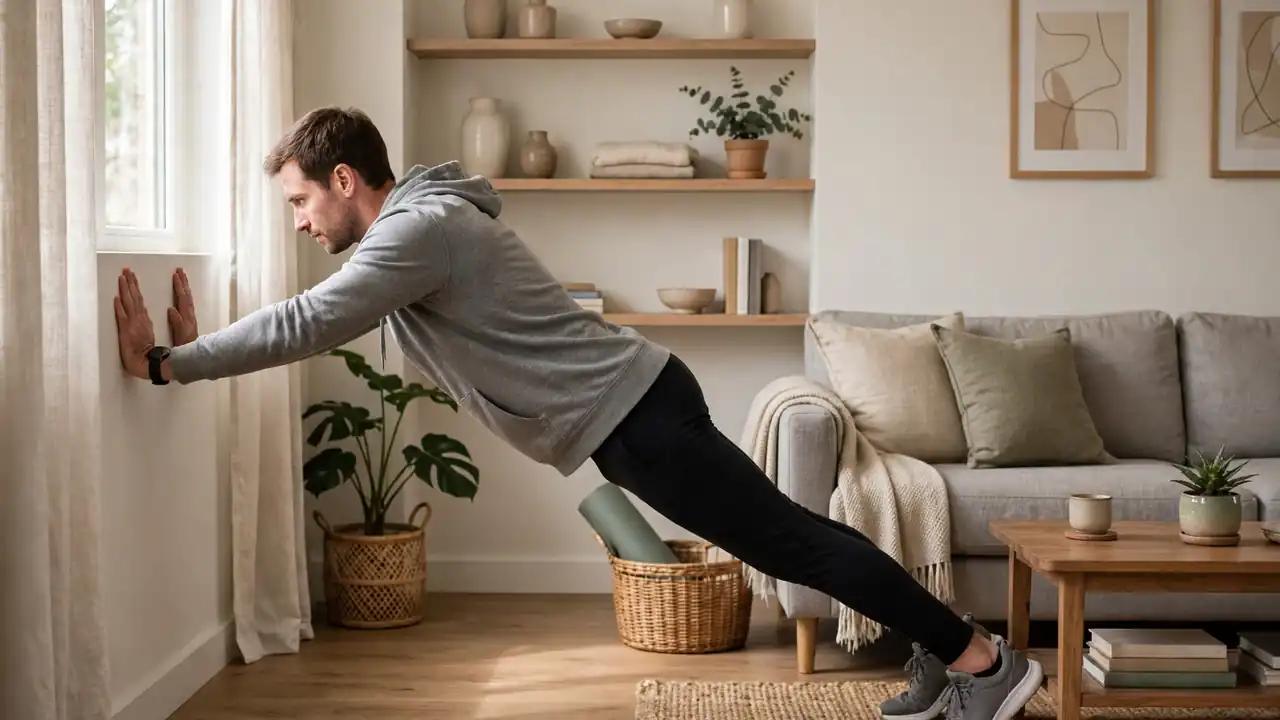
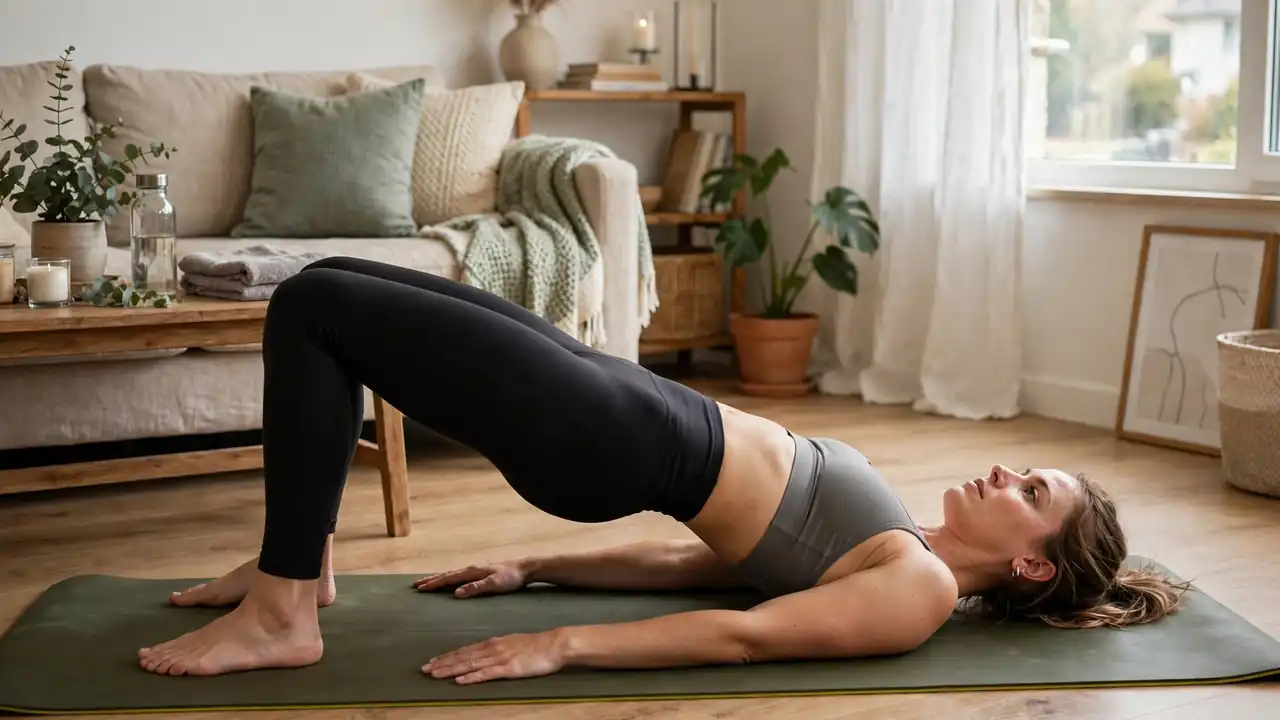
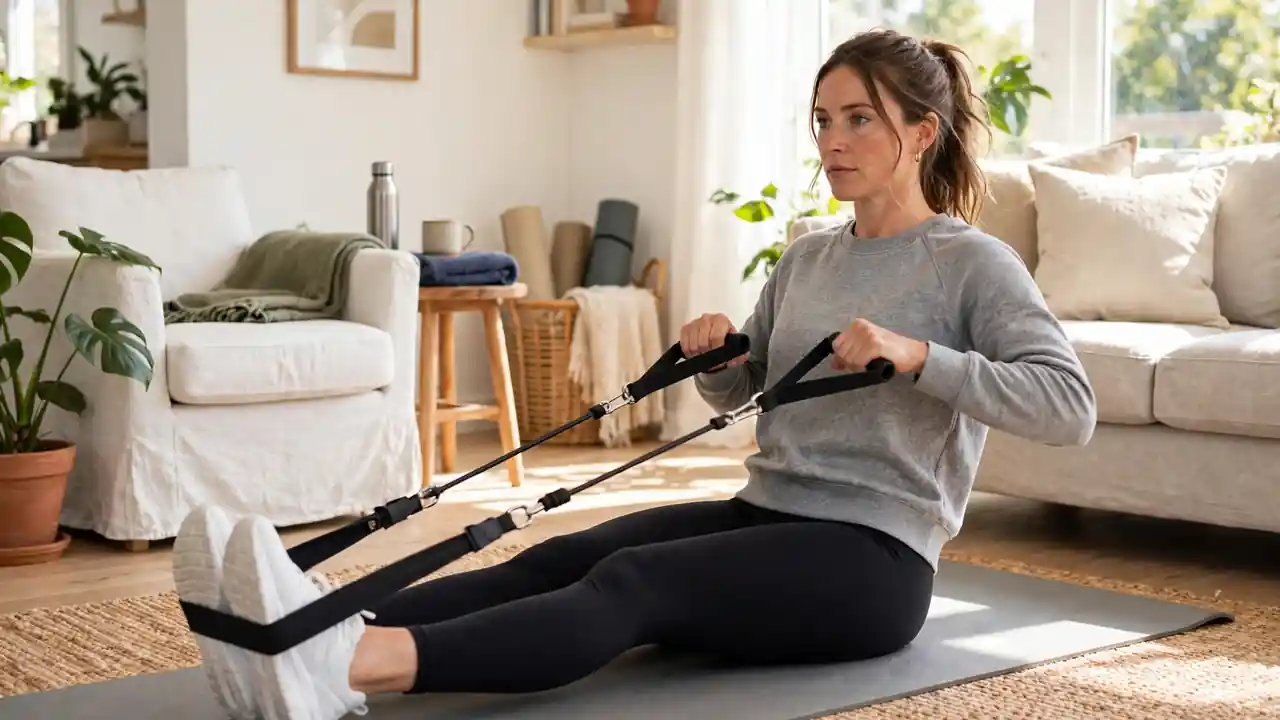
I keep my training simple on purpose, because simple is what I repeat. Every session I choose one move from each of five families, and that covers almost everything. First, a squat pattern, like a chair squat, works my legs and hips. Second, a push pattern, like a wall push-up or a knee push-up, works my chest, shoulders, and arms. Third, a hinge pattern, like a gentle hip hinge or glute bridge, works the back of my legs and my bottom muscles. Fourth, a pull pattern, like a band row or a table row, works my upper back and arms. Fifth, a core move, like a short plank or a dead bug, steadies my middle. When I do those five families, I do not worry about missing a muscle, because the families overlap and cover the whole body together.
I learned to judge effort by a simple rule. A set should feel hard in the last two or three repetitions, but my form should stay neat. If I can chat easily through the whole set, it is too easy, and I need a harder version. If my back rounds, my knees collapse, or I feel sharp pain, it is too hard or my form has slipped, and I step back to an easier version. That middle ground, challenging but controlled, is where strength grows. It is also where I feel safest, because I am never fighting the move. I am guiding it, slowly, with full control, and that control is a skill in itself.
For readers who want a gentle entry point, I often point to our guide to strength training after 60 and our honest look at home workouts, which both show how little equipment a good routine really needs. I also pair strength days with easy movement on other days, and our walking guide helped me see walking as a partner to strength work, not a rival to it.
My Simple 20-Minute Beginner Routine
Here is the routine I started with, and the one I still give to friends who ask me where to begin. Warm up for five minutes first, with marching in place, arm circles, and slow bodyweight squats, just to raise your heart rate and loosen your joints. Then do two rounds of the following, resting about a minute between moves. Chair squats, eight to twelve repetitions, sitting back to a sturdy chair and standing tall. Wall push-ups, eight to twelve repetitions, hands on the wall, body in one straight line. Glute bridges, ten to twelve repetitions, lying on your back with knees bent and lifting your hips. Band rows or table rows, eight to twelve repetitions, pulling your elbows back and squeezing your shoulder blades. A plank, twenty to thirty seconds, on your knees if you need to. Finish with slow breathing and a gentle stretch, and you are done.
Do this two or three times a week, on days that are not back to back, and you will meet the basic framework the experts describe. In my first month, I did it twice a week, and that was enough to feel a difference. Stairs felt easier. Shopping bags felt lighter. I stood up from low chairs without using my hands, and that small victory made me smile every time. After a month, I added a third day, and later I added a third round to each session. Small steps, taken on time, beat big plans that never start, and I say that from my own repeated experience.
How to Get Stronger Without Buying a Gym
The question every beginner asks me is what happens when the easy version gets easy, and the answer is pleasingly simple. You change one thing at a time. You can add repetitions, add a set, slow the lowering part of the move, increase the range, or move to a harder version. A wall push-up becomes an incline push-up on a table, then a knee push-up on the floor, then a full push-up. A chair squat becomes a free squat, then a squat with a pause at the bottom, then a split squat. A band row becomes a stronger band, or a slower, more controlled row. This idea, called progressive overload, simply means asking your muscles for a little more over time, and it is the engine of all strength gains.
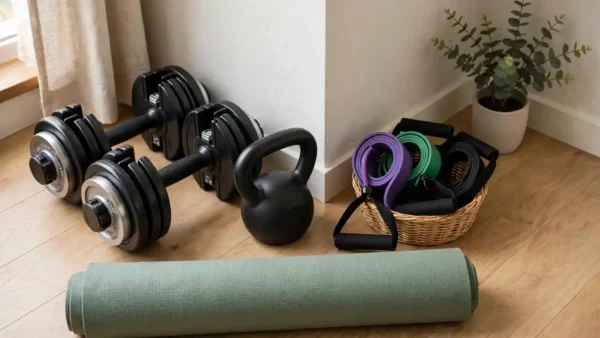
When I was ready for a little equipment, I bought one set of resistance bands first, because they cost little, store in a drawer, and add adjustable load to almost every move. Later I added a pair of light dumbbells, and that was enough for a long time. You do not need to buy everything at once, and you should not. Buy one tool, learn it well, and only add another when your progress genuinely asks for it. If you want a next step for older beginners, our starter plan for strength training after 40 shows the same gentle progression in more detail.
Mistakes I Made, So You Do Not Have To
My first mistake was going too hard on day one. I did too many repetitions, felt sore for four days, and almost quit. Soreness after a new routine is common, but pain that is sharp, or in a joint, is a warning, not a badge of honour. Start easy, finish feeling like you could have done a little more, and let your body ask for more next time. My second mistake was skipping the warm-up because I was in a hurry. Five minutes of gentle movement makes the whole session feel better, and it helps me move well from the first set. My third mistake was training every day without rest. Muscles need rest days to recover and grow stronger, and two or three sessions a week, spread out, worked far better for me than daily exhaustion.
My fourth mistake was copying advanced routines from videos. A routine made for an athlete will not fit a beginner, and trying to copy it only teaches bad form. I learned to choose the version I could do well, even if it looked less impressive, because good form on an easy move beats sloppy form on a hard one, every single time. My fifth mistake was measuring progress only by weight or appearance. Strength shows up first in daily life, in easier stairs, steadier balance, and less tiredness, and those wins deserve celebrating. When I started tracking my sessions with simple ticks in a notebook, one tick per session, my motivation grew, because I could see the chain of days I had kept.
Staying With It When Motivation Fades
Motivation fades for everyone, including me, and that is normal, not failure. What keeps me going is not willpower, but a routine tied to something I already do. I train after my morning coffee, in the same corner of the same room, with the same short playlist, and after a few weeks it felt stranger to skip it than to do it. I also keep my equipment visible, because a mat rolled in a cupboard is easy to forget, while a mat on the floor is an invitation. On low-energy days I do a shorter version, just one round instead of two, and I count it as a win, because a short session protects the habit, while a skipped session breaks it.
I also train with kindness toward myself. If I miss a week because of illness, travel, or a busy patch at work, I do not try to make up for it with a punishing session. I simply return to the easy version and rebuild over a week or two. Strength comes back faster than you fear, and the habit comes back faster when the return feels gentle. I have restarted three times now, and each restart taught me the same lesson. The people who get strong are not the people who never miss a session. They are the people who always come back after missing one.
Related reading on CAAW News: our beginner yoga guide, our beginner running plan, and how much protein you really need to support your training.
Frequently Asked Questions
Can I really get strong at home without a gym?
Yes, for general strength and everyday function, the 2026 expert guidance supports home-based training, bodyweight moves, and resistance bands as effective options. A gym offers heavier weights and more machines, which matter for advanced lifting goals, but they are not required to become meaningfully stronger, steadier, and more capable in daily life.
How many days a week should I train?
Start with two sessions a week on non-consecutive days, working all major muscle groups. That meets the basic framework described in the new guidance. When two sessions feel comfortable for a few weeks, you can add a third day if your schedule and recovery allow it.
How long should a home strength session last?
A beginner session of 20 to 30 minutes, including a warm-up, is plenty. Short, regular sessions beat long, rare ones, because regularity is what builds the habit and the strength. You can lengthen sessions later as your fitness and interest grow.
Do I need equipment to start?
No. Bodyweight moves like chair squats, wall push-ups, glute bridges, and planks are a complete starting point. A set of resistance bands is a useful first purchase when bodyweight moves start to feel easy, because bands add adjustable resistance without taking up space.
What if I have bad knees or a sore back?
Choose gentle versions, move slowly, and stop if you feel sharp or joint pain. Chair squats, glute bridges, and wall push-ups are often kinder than deep or loaded moves, but this is general information only. If you have an ongoing condition, please get advice from a qualified professional who can check your individual situation.
How fast will I see results?
Many beginners notice daily tasks feeling easier within three to four weeks of regular training, even before visible muscle changes appear. Visible changes usually take longer, often two to three months of steady work. Track your repetitions, your form, and your daily-life wins, not just the mirror.
Should I stretch after strength training?
A short, gentle cool-down feels good for most people, and slow breathing helps me settle after a session. Stretching is a personal preference rather than a magic recovery tool, so keep it comfortable, never forced, and skip any stretch that causes pain.
Final Thoughts
I started this guide with my own years of waiting, and I want to end it with the truth that finally set me free. You do not need a gym, a perfect body, or a perfect plan to become stronger. You need a corner of a room, twenty minutes, and the courage to do a few simple moves badly at first, then a little better each week. I did it in my living room, in old clothes, with no audience, and it changed how I move through my whole day. I am proud of that, and I want you to feel the same quiet pride. Start today, even if today means just the warm-up and one round. Then come back in two days and do it again. Tell me in the comments which move you tried first, and how it felt, because your first step might be the encouragement another reader needs to take theirs.
React to this story