Key Points
Key Points
- Enceladus is about 500 kilometres across and hides a global salty ocean beneath its ice.
- Cassini flew through the south pole plumes in 2008 and sampled ocean grains directly.
- In September 2026, an Earth microbe survived a lab copy of the alkaline, oxygen-poor seafloor at pH 11.
- Cassini's 961 salt-rich grains vary widely, suggesting the moon sorts its ocean chemistry as it sprays.
- Fresh organic compounds from the ocean show a chemically rich, life-friendly environment, not proof of life.
- NASA's InvOW project, starting in 2026, links 16 labs to learn how to read organic life signals correctly.
- A future mission could detect life signs by flying through the plume with existing technology.
On This Page
- What You Will Learn in This Article
- A Tiny Moon With a Global Ocean
- Subscribe to CAAW News
- The 2026 Microbe Experiment That Changed the Odds
- Salt Grains That Sort Themselves
- Fresh Organics Straight From the Ocean
- NASA’s New Project: Learning to Read the Signals
- Frequently Asked Questions
- Has life been found on Enceladus?
- How big is Enceladus, and where is it?
- What did Cassini actually do there?
- What was the 2026 microbe experiment?
- Why do salt grains matter for finding life?
- What is NASA’s Investigating Ocean Worlds project?
- When will we actually know if life is there?
- Final Thoughts
- React to this story
I stayed up far too late one night reading about a tiny moon of Saturn, and I could not sleep afterwards. The moon is called Enceladus, it is only about 500 kilometres across, smaller than many countries, and it sprays its own ocean into space through cracks at its south pole. Somewhere under that ice, in dark, salty water, there may be life. Not little green people. Microbes, perhaps, living off chemical energy near warm vents on the seafloor, the way microbes live in Earth’s deep oceans without any sunlight at all. In this article, I will show you the search for life on Enceladus in 2026, from the spacecraft that flew through its plumes to the laboratory microbes that just survived a copy of its ocean. If you have ever looked at the night sky and wondered whether we are alone, this is the most exciting place in the solar system to look. By the end, you will know what we have found, what we have not, and what happens next.
Trust nudge: I am not an astrobiologist, and I will not claim we have found life. Every finding below comes from peer-reviewed studies and NASA-backed reporting I checked during my research, and I say plainly where the evidence stops and the hope begins.

What You Will Learn in This Article
- Why a tiny moon became one of the best places to search for life
- What Cassini found when it flew through the ocean plumes
- How Earth microbes survived a laboratory copy of Enceladus’s seafloor
- Why the moon’s salt grains sort themselves, and why that helps future missions
- What NASA’s new Investigating Ocean Worlds project will do from 2026
- How a future spacecraft could detect life by flying through a plume
- Answers to the questions readers ask most about Enceladus
A Tiny Moon With a Global Ocean
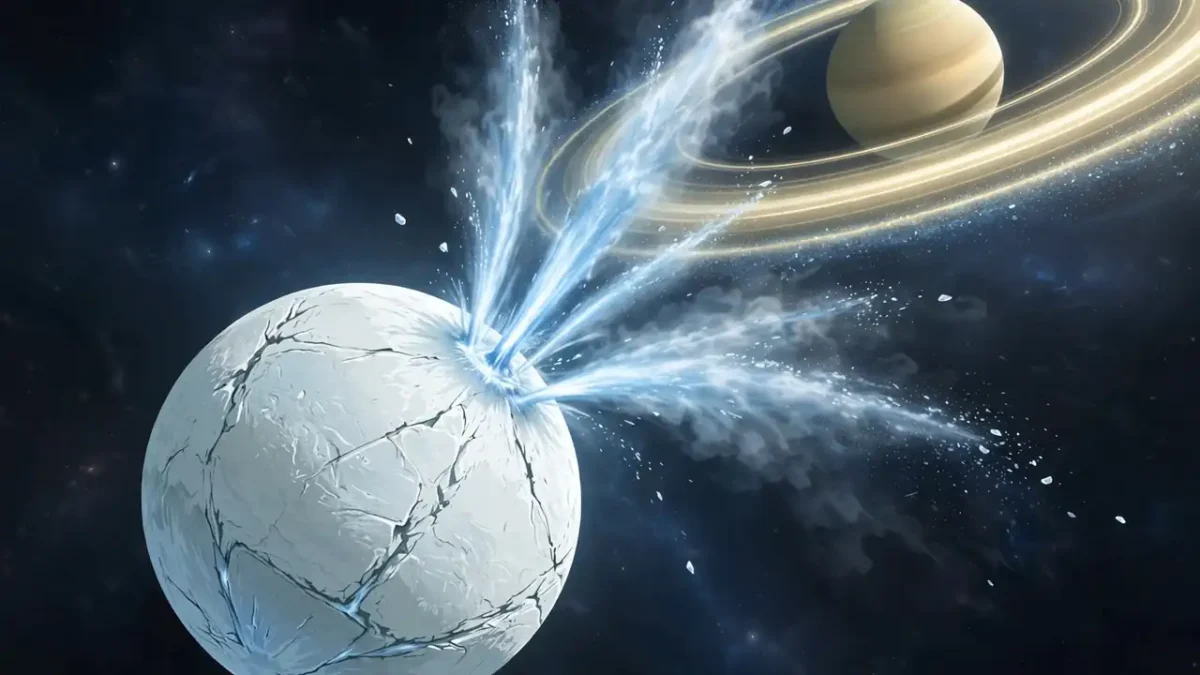
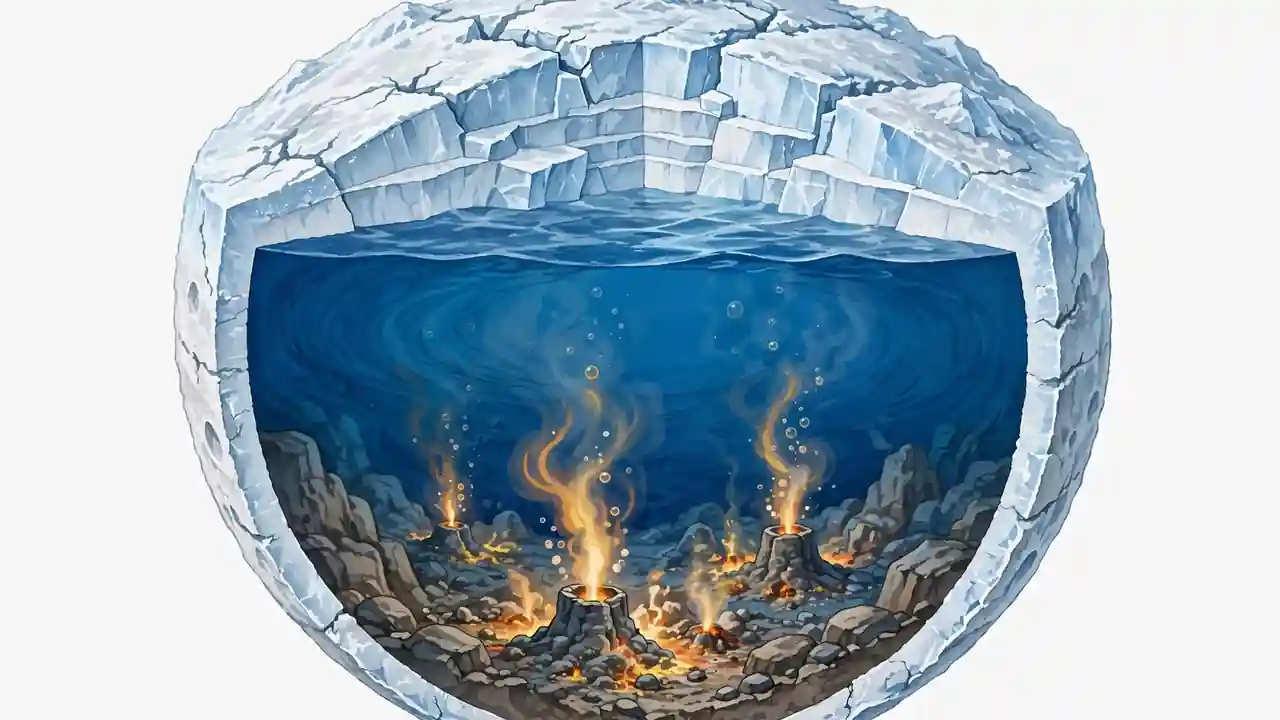
Enceladus is easy to underestimate. It is only about 500 kilometres across, it orbits Saturn, and from a distance it looks like a bright, frozen snowball. But under its icy crust lies a global salty ocean, and at its south pole, long cracks nicknamed “tiger stripes” vent plumes of water vapour and ice grains into space. That is the miracle of this moon: its ocean delivers samples to space for free. A spacecraft does not need to drill through kilometres of ice. It can simply fly through the spray and catch what comes out. NASA’s Cassini spacecraft did exactly that. It operated at Saturn from 2004 to 2017, and during a close flyby in 2008 it passed directly through the erupting spray, letting its instruments sample grains as they burst apart on impact.
Why does this moon rank so high for life? Because it has the ingredients life needs: liquid water, chemistry, and energy. The ocean touches a rocky seafloor, where warm vents could drive chemical reactions, the same kind of reactions that feed microbial life in Earth’s deep oceans without sunlight. As Smithsonian Magazine puts it, Enceladus is one of astrobiologists’ favourite places in the solar system, because its geysers hint at an underground ocean that might have the ingredients to spawn life. I remember the first time I understood that sentence fully. We are not guessing that the ocean exists. We have flown through its spray. The question is no longer “is there water?” It is “is anything living in it?”
The 2026 Microbe Experiment That Changed the Odds
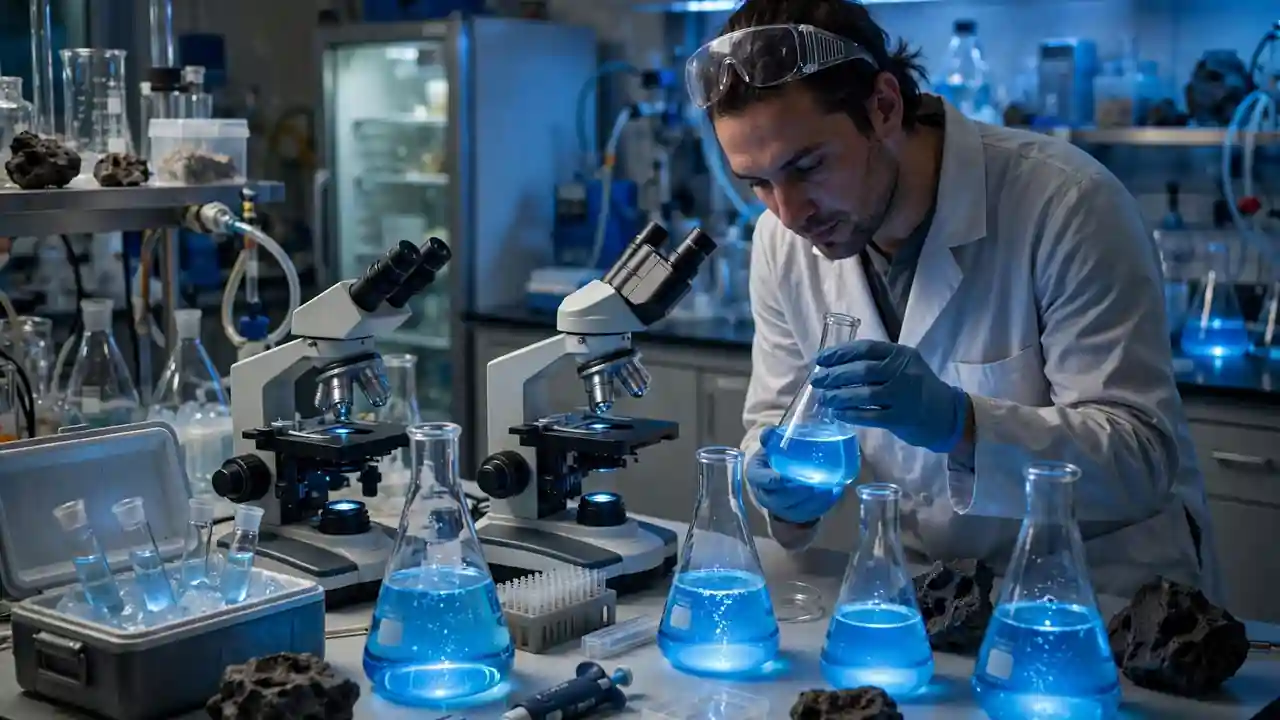
In September 2026, two studies published in the journal Science Advances gave the search a real boost, and I read both summaries twice to make sure I understood them. In the first, researchers built a laboratory copy of Enceladus’s seafloor environment: water, salts, carbonates, and powdered rock, with little oxygen and a pH of 11, meaning highly alkaline, a condition most known organisms cannot endure. Then they put an Earth microbe into it. The microbe was Methanothermococcus okinawensis, a methane-producing, heat-loving archaeon found in deep-sea hydrothermal vents on Earth. The result was striking: the Earthly microbe could survive in conditions simulating the distant moon’s ocean. Lead author Vanessa Helmbrecht said the experiments show the moon’s geochemistry could create conditions even more favourable for microbial life than previously thought.
Let me be precise about what this does and does not prove. It does not prove life exists on Enceladus. No microbe from Enceladus has ever been seen. What it proves is habitability: the chemistry of that ocean is not a deal-breaker for life as we know it. An Earth organism, built for Earth’s vents, can handle the alkaline, oxygen-poor, salty conditions of the simulated seafloor. That matters because it removes one of the main doubts. If even Earth’s microbes can survive there, then a microbe that evolved there would have an even better chance. Co-author Frank Postberg of the Free University of Berlin called it great news for the search for life, and I agree. The bar for “could life live here?” just got lower, in the best possible way.
Salt Grains That Sort Themselves
The second September 2026 study is subtler, but for future missions it may matter even more. Researchers analysed 961 salt-rich ice grains recorded by Cassini’s Cosmic Dust Analyzer, and they found the grains vary widely in chemistry. Some grains are rich in sodium chloride, while others are dominated by carbonates, phosphates, hydroxides, or potassium-bearing salts. The researchers propose that ocean spray droplets freeze slowly as they rise through the vents, separating salts into different regions, and then shatter into smaller grains with different compositions. In plain words, the moon sorts its ocean chemistry for us as it sprays.
Here is why that excites mission planners. If biological molecules exist in the ocean, they may be concentrated in a small number of grains rather than spread evenly. That suggests spacecraft should analyse many individual grains rather than bulk samples, which could make rare compounds easier to detect. Postberg’s comment on this point is the one I keep quoting to friends: a future spacecraft that collects plume particles could identify signs of life relatively easily with already available technology. We do not need a miracle instrument. We need a spacecraft that flies through the plume, catches many grains one by one, and reads their chemistry carefully. That is an engineering job, not a fantasy, and it is within reach.
Fresh Organics Straight From the Ocean
There is one more Cassini result I want you to know, because it ties the whole story together. A recent re-analysis of Cassini data focused on “fresh” grains, particles released from the ocean just minutes before Cassini intercepted them. Because they had little time to be altered by radiation or chemistry in space, they offer a pristine snapshot of the chemistry beneath the ice. That analysis reveals that complex organic compounds are emerging directly from the moon’s subsurface ocean, the clearest evidence yet that Enceladus hosts a chemically rich environment capable of supporting prebiotic reactions, and possibly life itself. Organics are not life. They are carbon-rich molecules, the building blocks life uses. Finding them fresh from the ocean means the ocean is chemically active, not sterile and dead.
I think of it like smelling bread from a bakery door. The smell does not prove anyone is baking inside, but it proves the ovens are warm and the ingredients are there. Enceladus has warm chemistry, liquid water, and organic building blocks. Every ingredient on the list is now checked except the last one: the life itself. That is why scientists are careful and excited at the same time. Careful, because organics can form without life. Excited, because a dead ocean would not be this interesting. If you love this kind of exploration, you will also enjoy our Europa Clipper story about the mission heading to another ocean moon in 2030, our MMX mission story about grabbing a sample from Mars’s moon, and our Roman Telescope story about beating its own image target. If you enjoy big-picture science, you may also like our supernovae explainer, our story on AI drug discovery, our fusion energy story, and our CRISPR therapies explainer.
NASA’s New Project: Learning to Read the Signals
So what happens next? In 2026, NASA’s Investigating Ocean Worlds project, known as InvOW, begins. The Woods Hole Oceanographic Institution was selected by NASA to lead a five-year project, valued at about $5 million, linking 16 laboratories across the United States, to study how physical, chemical, and possibly biological processes on ocean worlds affect the organic signatures spacecraft detect. Led by WHOI senior scientist Chris German, the team will study three zones: the rocky seafloor, the ocean itself, and the icy outer shell, tracking how organic materials change as they move through each zone before a spacecraft detects them.
The point of InvOW is to avoid a costly mistake: misreading a signal. A molecule that looks like life might be made by plain chemistry, and a molecule made by life might be changed beyond recognition by the time it reaches space. By combining lab experiments, fieldwork, and modelling, InvOW will teach future missions how to tell the difference. German’s quote is the one I want to leave with you: “If you are alive today, this is the first generation where the question of whether there is life elsewhere in the universe could be answered in your lifetime.” That sentence gave me goosebumps when I first read it. For all of human history, this question was philosophy. In our lifetime, it is becoming an experiment. Europa Clipper arrives at Europa in 2030, and the lessons from InvOW will shape how we read whatever it finds, and how we design the Enceladus mission that must follow.
Frequently Asked Questions
Has life been found on Enceladus?
No. No study has reported any sign of life on Enceladus. What scientists have found is habitability: liquid water, energy, chemistry, and organic molecules, plus Earth microbes surviving simulated seafloor conditions. Life itself remains unproven.
How big is Enceladus, and where is it?
Enceladus is only about 500 kilometres across, and it orbits Saturn. It is one of Saturn’s many moons, and its south pole cracks, called tiger stripes, spray ocean water into space.
What did Cassini actually do there?
Cassini operated at Saturn from 2004 to 2017. During a close 2008 flyby, it flew directly through the plumes at high speed, and its instruments sampled ice grains that burst apart on impact, giving us a taste of the ocean without landing.
What was the 2026 microbe experiment?
Researchers placed Methanothermococcus okinawensis, a heat-loving methane-producing archaeon from Earth’s deep-sea vents, into a lab mixture copying Enceladus’s seafloor: salty, carbonate-rich, oxygen-poor water at pH 11. It survived and adapted, showing the ocean’s chemistry is survivable for known life.
Why do salt grains matter for finding life?
Because the grains vary widely in chemistry, and biological molecules, if present, may be concentrated in a few grains. Analysing many individual grains, rather than one bulk sample, gives a future mission a much better chance of spotting rare life-related compounds.
What is NASA’s Investigating Ocean Worlds project?
InvOW is a five-year, roughly $5 million NASA project starting in 2026, led by Woods Hole Oceanographic Institution with 16 US laboratories. It studies how organic signals change as they travel from seafloor to space, so future missions read them correctly.
When will we actually know if life is there?
Nobody can promise a date. Europa Clipper arrives at Europa in 2030, and its lessons will shape a dedicated Enceladus mission. The honest answer is: within this generation, if we build the plume-sampling mission the science now supports.
Final Thoughts
I started this article with a sleepless night, and I will end with why I could not sleep. Somewhere out there, under the ice of a moon smaller than many countries, an ocean is spraying itself into space, carrying chemistry that Earth microbes can survive and organic molecules fresh from the deep. We have tasted that ocean without landing, and the taste says: look closer. The search for life on Enceladus is no longer a dream for science fiction. It is a plan with a spacecraft design, a NASA research project, and a detection method that already exists. Congratulations for joining me on this journey: you now understand why scientists call this little moon one of the best places to answer humanity’s oldest question. Tell me in the comments: do you think we will find life on Enceladus in our lifetime? I read every answer, and I love how differently people answer the same question.
React to this story