Key Points
Key Points
- A study of ovaries from 28 women found the organs remain biologically active for decades after menopause, continuing to remodel with age.
- Postmenopausal ovaries showed increased inflammation and structural changes, plus a molecular link to cancer vulnerability.
- The research, published in Aging Cell on 14 October 2026, was led by Northwestern University and the Buck Institute for Research on Aging.
- The findings challenge the long-held assumption that the ovary becomes dormant and irrelevant once egg production ends.
- Researchers say the ovary may actively influence how women age, with connections to the brain, bone and chronic disease.
On This Page
An Organ We Thought Had Retired
For decades, medical textbooks have treated the postmenopausal ovary as a spent organ — a reproductive structure that, once its eggs are gone, quietly fades into irrelevance. A paradigm-shifting new study suggests that picture is wrong. Published on October 14, 2026, in the journal Aging Cell, research on ovaries from 28 women shows that the organ remains biologically active for decades past menopause, continuing to remodel with age in ways that may influence both ageing and cancer risk.
The study was conducted by scientists at Northwestern University’s Feinberg School of Medicine and the Buck Institute for Research on Aging. Using advanced molecular analysis, the team found that postmenopausal ovaries are not dormant at all: they continue to restructure their tissue, generate inflammation, and undergo molecular changes with a direct link to cancer vulnerability.
Women now routinely live for decades after menopause, making the biology of this long post-reproductive period increasingly important. Yet research has historically paid little attention to what the ovary is doing during those years. The new findings argue that this neglect has been a mistake — and that the ovary may be a far more active player in women’s long-term health than anyone suspected.
What the 28 Ovaries Revealed
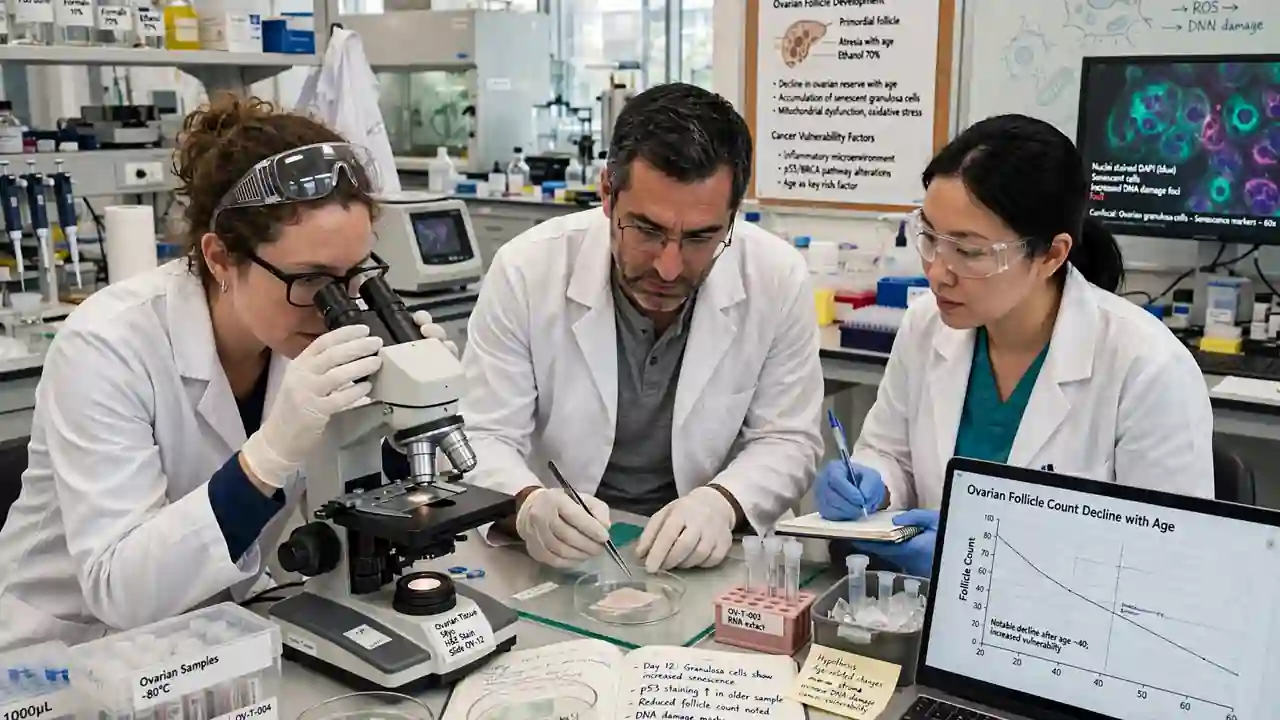
The researchers examined ovarian tissue from 28 women spanning the postmenopausal years. What they found overturned the notion of a quiet, inactive organ. Even in the decades well past menopause, the ovary continues to remodel: its tissue structure changes with age, inflammation increases, and the molecular signature of the organ shifts in ways that suggest ongoing biological activity.
Crucially, the team identified a molecular link between ovarian ageing and cancer. The remodelling process — the same changes that mark the organ’s continued activity — appears connected to an elevated vulnerability to cancer. The finding is significant because ovarian cancers overwhelmingly strike after menopause, and their origins have remained frustratingly obscure.
The study’s co-corresponding author, Francesca Duncan, an associate professor of reproductive science in medicine at Northwestern’s Feinberg School of Medicine, captured the surprise at the heart of the work. She noted that most people assume the postmenopausal ovary is doing nothing — sitting idle like an appendix once its reproductive job is done. The data, she said, tell a very different story.
The inflammation finding is particularly noteworthy. Chronic inflammation is a known driver of cancer and of age-related disease more broadly. That the ageing ovary generates increasing inflammation suggests a mechanism by which the organ could influence disease risk not just within itself but across the body.
The Link to Cancer
The molecular connection between ovarian remodelling and cancer vulnerability is the study’s most clinically provocative result. Ovarian cancer is among the deadliest gynaecological cancers precisely because it is usually detected late, when it has already spread. Understanding what makes the postmenopausal ovary vulnerable could open new avenues for early detection or prevention.
The researchers are careful not to overclaim: the study establishes a link, not a proven causal chain. But the direction of the evidence is clear enough to change how scientists think about the organ. Rather than an innocent bystander in post-reproductive life, the ovary emerges as a tissue whose ongoing biological activity carries risks that medicine has barely begun to map.
The findings also raise questions about whether the ovary’s postmenopausal activity could influence cancers elsewhere in the body. If the organ continues to signal to other tissues — as the researchers believe it does — then its inflammatory and molecular output could shape disease risk far beyond the pelvis.
For women’s health research, the implication is that the ovary deserves sustained scientific attention long after fertility ends. Cancer screening strategies, prevention research and even drug development may need to account for an organ that most of medicine had written off.
The Ovary as an Organ of Ageing
Perhaps the most far-reaching idea in the study is that the ovary is not merely a reproductive organ but an organ of ageing itself. Birgit Schilling, co-corresponding author and professor and director of the Mass Spectrometry Center at the Buck Institute, put it directly: the ovary, she said, is not just a reproductive organ — it really influences how somebody ages, because it communicates with other organs, including the brain and the bone.
The connections she described are concrete. Women after menopause frequently experience bone problems, including osteoporosis. Cognitive changes and shifts in brain health are also common in the postmenopausal years. If the ovary continues to signal to bone and brain tissue throughout this period, then its biology could be part of the explanation for how and why these changes unfold.
This reframing has deep roots in endocrinology. The ovary’s production of oestrogen has long been understood to protect bone and influence brain function — which is why menopause, with its sharp drop in oestrogen, raises the risk of osteoporosis and is associated with cognitive shifts. The new study extends that logic: even without producing eggs or much hormone, the ageing ovary may remain in conversation with the rest of the body.
Viewed this way, the decades after menopause are not a period in which the ovary has exited the stage, but one in which it plays a different, poorly understood role — one that science is only now beginning to investigate.

Beyond Cancer: Bones, Brain and the Whole Body
The cancer link is the study’s headline, but the researchers’ vision is broader. If the postmenopausal ovary continues to signal to other organs — as Schilling’s description of its conversations with brain and bone suggests — then its biology could help explain some of the most familiar features of postmenopausal ageing.
Consider bone. Women after menopause frequently experience bone problems, including the progressive bone loss of osteoporosis that leads to fractures. The standard explanation centres on the loss of oestrogen, which had protected bone density. The new findings add a layer: an actively remodelling, increasingly inflammatory ovary could be an additional influence on bone health — one that persists for decades and varies between women.
The brain connection is equally intriguing. Cognitive changes — from the brain fog many women report around menopause to the longer-term risk of cognitive decline — have been linked to hormonal shifts. If the ageing ovary continues to communicate with neural tissue, understanding that signalling could open new ways of thinking about brain health in later life.
None of this diminishes the importance of oestrogen; it enriches the picture. The postmenopausal body is not simply a body minus a hormone, but a body in which a supposedly retired organ remains an active participant. That reframing could eventually reshape how medicine approaches healthy ageing in women — not as managing a deficiency, but as understanding an ongoing biology.
Why This Changes Women’s Health Research
The study lands at a moment of growing attention to the gaps in women’s health research. Historically, medical research has under-studied female-specific biology, and the postmenopausal years have been especially neglected. The average woman now spends roughly a third of her life after menopause — a span of decades during which, as the new research shows, a supposedly retired organ is still biologically active.
The findings could reshape several areas of medicine. In oncology, understanding the ovary’s postmenopausal biology may improve risk assessment for ovarian and related cancers. In gerontology, the ovary joins a growing list of tissues whose age-related changes ripple outward to affect the whole organism. In drug development, the inflammatory and molecular pathways identified in the study could become targets for interventions aimed at healthy ageing.
The research also underscores the value of looking at familiar organs with fresh eyes. The assumption that the ovary’s story ends with fertility was never based on evidence — it was based on the absence of evidence, on nobody having looked closely. Now that scientists have looked, the organ turns out to have a second act.
Questions the study raises but does not yet answer include how the ovary’s postmenopausal activity varies between women, whether lifestyle or medical factors modify it, and how its signals interact with the hormonal changes of menopause. Each of these is now a live research question.
What Comes Next for the Science
The path from a 28-woman study to clinical application runs through replication and scale. Larger studies will be needed to confirm the findings across diverse populations and to pin down exactly which molecular changes carry the greatest cancer risk. Biomarkers — measurable signals of dangerous remodelling — would be a natural next target, potentially enabling earlier detection of ovarian disease.
The Northwestern and Buck Institute teams have opened a door rather than finished a journey. But the direction is clear: the postmenopausal ovary is biologically alive, medically relevant, and scientifically underexplored. For the millions of women living decades beyond menopause, that is news that matters.
As Duncan’s observation suggests, the most important result may be the simplest one: an organ that medicine assumed was doing nothing turns out to be doing a great deal. In science, few things are more productive than discovering that a settled question was never really settled at all.
React to this story