

Key Points
Key Points
- OPGx-BEST1 improved retinal sensitivity in 3 of 4 evaluable participants (75%) in the low-dose Cohort 1 of the Phase 1/2 BIRD-1 trial.
- OPGx-LCA5 showed sustained improvements in visual acuity and light sensitivity through 24 months in adults; pediatric participants regained cone-mediated vision through 6 months.
- Patients reported real-world gains: recognizing family members, navigating without a cane, identifying objects and seeing colors.
- OPGx-LCA5 advanced to Phase 3 with dosing expected in Q4 2026 using the low dose, without further dose escalation.
- Data presented at Retina in Rio 2026 in Rio de Janeiro, Brazil, on October 15, 2026.
On This Page
Imagine slowly losing your vision from childhood, knowing that no treatment exists because the problem is written into your DNA. For families affected by inherited retinal diseases — rare genetic conditions that steadily destroy the light-sensing cells of the eye — that has been the reality for generations. Gene therapy, which aims to fix the broken gene itself, has long promised to change this.
On October 15, 2026, the North Carolina company Opus Genetics reported encouraging progress on two fronts. At the Retina in Rio 2026 meeting in Rio de Janeiro, Brazil, the company presented clinical findings from its gene therapy programs OPGx-BEST1 and OPGx-LCA5, targeting two different inherited causes of blindness. The results: improved retinal sensitivity in three quarters of evaluable patients in one trial, and sustained vision improvements through 24 months in adults in the other — with children regaining enough sight to recognize family members and navigate without a cane.
Opus Genetics is a clinical-stage biopharmaceutical company focused on developing one-time gene therapies for inherited retinal diseases, or IRDs. Its pipeline includes seven programs based on adeno-associated virus (AAV) delivery, led by the two candidates presented in Rio. The company is listed on Nasdaq and based in Research Triangle Park, North Carolina.
What are inherited retinal diseases?
Inherited retinal diseases are a group of rare genetic disorders that cause progressive vision loss, and in many cases complete blindness. They are caused by mutations in genes that are essential for the retina — the light-sensitive layer at the back of the eye — to function. More than 270 different genes have been linked to these conditions, which is why progress has been slow: each genetic cause may need its own treatment.
Because the eye is a small, enclosed and relatively immune-privileged organ, it is considered one of the most promising targets for gene therapy. A single injection can deliver a working copy of a gene directly to the retinal cells, and the treatment does not need to travel through the whole body. The landmark approval of Luxturna in 2017 for a different retinal disease proved the concept; Opus is now extending it to diseases that have never had a treatment.
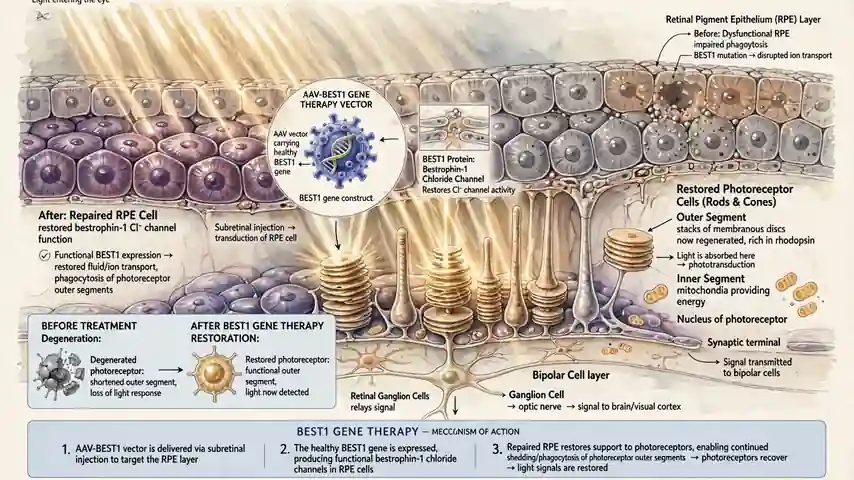
OPGx-BEST1: early signs of restored light sensitivity
The first program targets diseases caused by mutations in the BEST1 gene, which produces a protein called bestrophin-1. Mutations in this gene cause conditions including Best vitelliform macular dystrophy (BVMD) and autosomal recessive bestrophinopathy (ARB) — disorders in which fluid builds up in the retina and light-sensing cells gradually fail.
Opus presented findings from the low-dose Cohort 1 of its Phase 1/2 BIRD-1 trial. Among five participants treated in the initial low-dose group, with follow-up ranging from three to six months, four could complete retinal sensitivity testing — and three of those four, or 75 percent, showed improvements. The gains were measured with microperimetry, a test that maps the retina’s ability to detect light at precise locations.
The improvements appeared in what researchers call the transitional zone — the ring of tissue surrounding the damaged area where light-sensitive cells are still alive and may respond to treatment. In the patients who responded, increased retinal sensitivity was also associated with reductions in the intraretinal fluid that characterizes BEST1-related disease. In other words, the therapy appeared to be doing two things at once: helping surviving cells work better and calming the disease’s damaging fluid buildup.
Equally important for future trials, new analyses linked retinal structure to visual function. Using optical coherence tomography (OCT) and other imaging techniques, the researchers identified structural characteristics that predict which retinal regions are most likely to respond. Natural-history data showed that sensitivity declines most noticeably in that transitional zone even when whole-retina measurements look stable — a finding that will help the company measure treatment response more precisely in later studies. The OPGx-BEST1 Phase 1/2 trial has completed enrollment in its high-dose Cohort 2 with 11 participants.
OPGx-LCA5: children regaining vision
The second program may be even more striking. OPGx-LCA5 is an investigational gene therapy for Leber congenital amaurosis type 5, or LCA5 — a rare inherited retinal disease that causes severe vision loss beginning in childhood. Mutations in the LCA5 gene disrupt production of lebercilin, a protein critical for normal retinal function. The therapy uses an adeno-associated virus serotype 8 (AAV8) vector to deliver a functional copy of the LCA5 gene to the eye’s photoreceptors.
Findings from the ongoing Phase 1/2/3 trial, presented by Rodrigo Jorge, MD, of the Ribeirão Preto Medical School at the University of São Paulo, covered six participants treated at a low dose of 1E10 vector genomes per eye — three adults and three adolescents. In the adults, improvements in visual acuity and light sensitivity were sustained through 24 months. In the pediatric participants, the therapy restored cone-mediated vision — the daylight, color and detail vision handled by cone cells — with sensitivity improvements reaching normal ranges through six months of follow-up.
Both groups also showed improved light sensitivity compared with their untreated eyes, measured by full-field stimulus testing. Microperimetry showed increased retinal sensitivity and a shift of visual fixation toward the central retina, the region responsible for sharp, detailed vision.
But the numbers only tell half the story. Participants reported meaningful improvements in everyday life: recognizing family members, navigating independently without a cane, identifying objects, seeing colors, and taking part in activities that had previously been difficult because of severe vision loss. For children who had lived with profound visual impairment since early life, these are life-changing gains — the difference between dependence and independence.
Phase 3 is next
Based on the encouraging Phase 1/2 findings, Opus has advanced OPGx-LCA5 into Phase 3 development using the low dose, without requiring further dose escalation — a sign of confidence in the results. The Phase 3 trial’s natural-history and treatment cohorts are fully enrolled, with dosing expected to begin in the fourth quarter of 2026. The trial’s primary efficacy endpoint will assess improvements in retinal sensitivity across 16 central retinal test locations.
Phase 3 is the final and largest stage of testing before a company can apply for regulatory approval, so the coming year will be decisive for the program. Opus says its pipeline extends beyond these two leads to five more AAV-based candidates targeting the RDH12, MERTK, RHO, CNGB1 and NMNAT1 genes.
What the company’s CEO said
George Magrath, MD, Chief Executive Officer of Opus Genetics, said the Rio data showed meaningful progress across the company’s gene therapy pipeline, with sustained improvements in visual function through 24 months in adults treated with OPGx-LCA5 and encouraging early evidence of improved retinal sensitivity in participants receiving OPGx-BEST1. He added that the findings strengthen the company’s understanding of how to measure treatment response in these diseases — a practical but crucial advance for designing the trials that will follow.

Why gene therapy for blindness matters
Vision research is having a remarkable run. The 2026 Nobel Prize in Medicine honored scientists who taught us to control brain cells with light — a technique with direct applications in vision science — and our health coverage has tracked everything from breakthrough cancer drug designations to cancer vaccine breakthroughs. But gene therapy for inherited blindness holds a special place: these are often one-time treatments for diseases that begin in childhood, where even partial vision restoration compounds over a lifetime.
Caution remains appropriate. The Opus trials are small — single-digit participant numbers — and the data are interim, from ongoing studies. The company itself notes that as monitoring continues and more follow-up data arrive, reported outcomes may change. Small early trials can overstate benefits, and gene therapy carries its own risks, including immune reactions and inflammation in the eye.
Still, the pattern across both programs is consistent: light sensitivity improves, structure-function relationships are being mapped, and patients report real-world gains. For families living with inherited retinal disease, the message from Rio de Janeiro is one of genuine, evidence-based hope — and the Phase 3 readout for OPGx-LCA5, expected after dosing begins late this year, will be one of the most-watched moments in ophthalmology.
The road ahead for inherited blindness
Gene therapy for the eye is still a young field. Each approved or late-stage program covers only one genetic cause, and hundreds of disease genes remain without any treatment. Researchers are working on larger gene deliveries, treatments that work regardless of the specific mutation, and ways to treat both eyes safely. The Opus results add to a growing body of evidence that one-time genetic treatments can produce durable vision gains — and each success makes the next program easier to design, fund and test.
Sources
- Opus Genetics via GlobeNewswire: Opus Genetics Presents Positive Clinical Data from OPGx-BEST1 and OPGx-LCA5 Gene Therapy Programs at Retina in Rio 2026
- Opus Genetics: Official company website
React to this story






1 Comment