On This Page
- Arrival: a welcome, then a message to Milei
- Subscribe to CAAW News
- The Mass and the crowds: two figures, both attributed
- The survivors’ meeting: an hour behind closed doors
- The Milei tension: austerity and an old quarrel
- Francis’s shadow: the visit that never happened
- What is confirmed and what is not
- What happens next
- Frequently asked questions
- When was the last papal visit to Argentina before Pope Leo?
- How many people attended the Buenos Aires Mass?
- Who did Pope Leo meet after the Mass?
- What did Pope Leo say to President Milei?
- Where does Pope Leo go next?
- React to this story
Pope Leo XIV has drawn one of the largest crowds of his papacy to the streets of Buenos Aires, on the first visit by a pope to Argentina in 39 years. The outdoor Mass on Monday, November 9, 2026, was the centrepiece of a four-day stay that combined huge public celebrations with a private meeting with abuse survivors and a pointed message to President Javier Milei.
Leo, 71, the first United States-born pope, arrived in Buenos Aires on Sunday, November 8, from Uruguay. He is on a 12-day, three-country tour of South America that also takes in Peru, with about 50 events planned, and he is travelling less than a month after undergoing surgery for lung cancer. No pope has set foot in Argentina since Pope John Paul II in 1987, and Leo’s Argentine predecessor, Pope Francis, never returned home during his 12-year papacy.
Arrival: a welcome, then a message to Milei
Leo landed at Buenos Aires’s Jorge Newbery airport on Sunday, where Milei and his sister, presidential secretary Karina Milei, greeted him at a welcome ceremony. Al Jazeera reported that the greeting came amid growing tensions between the government and Argentina’s Catholic Church over Milei’s austerity programmes. He then visited Plaza San Martín, attended a ceremony at the Casa Rosada, and met Milei there.
His first public address, at a meeting with politicians, civil society and the diplomatic corps at the Palacio Libertad, was a carefully worded but unmistakable intervention in Argentina’s political debate. Leo urged Milei and the country’s political leaders to safeguard democracy and to show a careful use of words
“Democracy, then, is also a part of Argentina’s heritage that needs to be safeguarded. Democracy is also strengthened by the daily conduct of public life: through willingness to listen, through careful use of words, through the patient search for agreement, and through the ability to see those who think differently as fellow citizens with whom we share a common future.”
He returned to the theme of power and its limits more than once. “Authority is most authentic when it is exercised as service,” he said, adding that those who exercise authority have a duty to act with prudence and to acknowledge the limits of the power entrusted to them. On the economy, he was equally direct: “The economy must serve the person, not the person the economy,” he said, according to Al Jazeera, urging policies that benefit “the unemployed, retirees and all those who, despite hard work, nonetheless struggle to meet their household’s needs”.
The Mass and the crowds: two figures, both attributed
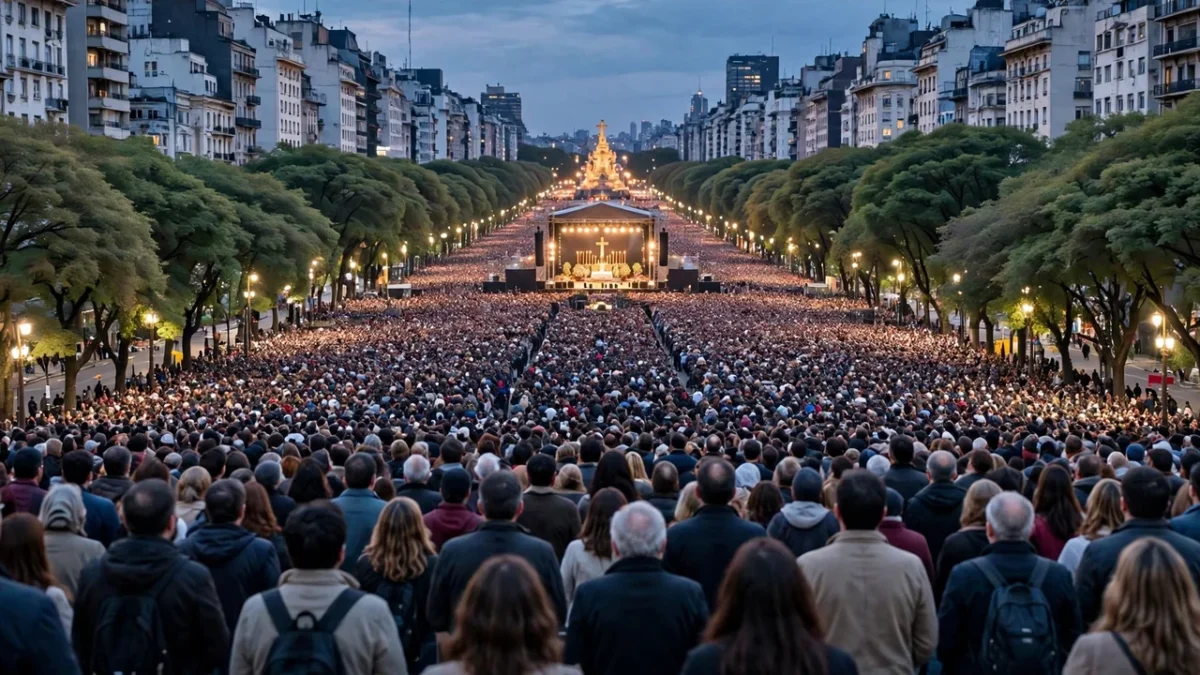
Monday’s outdoor Mass at the Monumento de los Españoles, on the Avenida del Libertador, was the largest public event of the visit so far, and the reporting on its size needs care, because the figures published so far do not agree.
Reuters, reporting through GMA News, said city officials had said the Mass could draw more than 1.5 million people. CNN, reporting after the Mass, said it drew a crowd of roughly 2.5 million people, according to official estimates, making it the largest event of Leo’s papacy so far. Neither figure should be presented as a settled fact on its own: the first was an expectation given before the Mass, and the second is an official estimate reported by one outlet. Argentines stretched for miles down the Avenida del Libertador, waving white-and-yellow flags and pressing against security barriers, Reuters reported. Chants of “Long live Pope Leo!” echoed down the tree-lined street as the pope was driven by in an open-top popemobile under sunny skies.
Reuters noted some 1.2 million turned out in Madrid in June, the previous largest event of his papacy. Claudia Pardo, 37, waiting with her husband and two young children, told Reuters: “I love that [Leo] is visiting us. It’s a unique, historic moment, and we should listen to his message.”
Before the Mass, Leo visited the Don Orione “Little Cottolengo” care centre for people with disabilities in Claypole, on the southern outskirts of Buenos Aires, where thousands had also gathered. The centre’s religious director, Jorge Silanes, said Milei’s cuts have reduced disability benefits. Leo said centres like theirs “have much to say to our societies, which are often driven solely by the pursuit of economic success”, adding: “A nation’s progress is also measured by how it welcomes all people with disabilities and particular needs.”
The survivors’ meeting: an hour behind closed doors
After the Mass, on Monday, Pope Leo met with five victims of sexual abuse by Catholic clergy in Buenos Aires, the Vatican said. The meeting lasted more than an hour, Reuters reported via DZRH. No names were published, and none should be added to this account.
The Vatican said it was the first of several expected meetings with survivors during the pope’s 12-day trip to South America. Its statement said the pope spoke individually with each of them, listening to their words, their painful personal stories, and their proposals for strengthening paths of healing within the Church. “To them, and through them to the other victims whom it was not possible to meet, the Pope expressed his closeness and his desire to strengthen paths of protection, goodness, welcome, and support within the Church,” the statement said.
The meeting should be reported plainly and without sensationalism. Abuse scandals have damaged the Catholic Church across Latin America, a region that has long been a stronghold for the faith but where it has been losing ground to fast-growing evangelical denominations, Reuters noted. Some survivors credit him with pushing for the Vatican to dissolve the Sodalitium Christianae Vitae, a Peru-based community that faced abuse allegations; Francis dissolved it in 2025. The meeting announces no new policy: it was a private, pastoral encounter.
The Milei tension: austerity and an old quarrel
The tension between the pope’s message and the president’s programme is the political story of the visit. Milei, a libertarian seen as a close ally of US President Donald Trump, has pushed an austerity agenda that the Church has strongly criticised for cutting social services, Reuters reported. CNN noted Milei has equated state-led social justice programmes with communism. Al Jazeera reported that under Milei the government slashed public spending to combat inflation and eliminate the fiscal deficit. While Milei has delivered a budget surplus and reduced inflation, real wages remain lower than they were when he took office, and about 300,000 formal jobs have been lost since the reforms began, Al Jazeera reported.
The economic picture resists a simple reading: official poverty figures fell from 52.9 percent in the first half of 2024 to 28.2 percent in the second half of 2025, but rose again to 32.3 percent in the first half of 2026, according to UCA News. Before winning the presidency in 2023, Milei repeatedly insulted Francis, calling him an “imbecile” for defending social justice; he later apologised. On Sunday, Milei called the arriving pontiff an “exceptional figure”, Al Jazeera reported.
Francis’s shadow: the visit that never happened
No account of this visit makes sense without Pope Francis. He was born in Buenos Aires in 1936, became the first pope from the Americas, and served as Archbishop of Buenos Aires before his election in 2013 — yet he never visited Argentina as head of the Catholic Church during his 12-year papacy. He died in 2025. CNN reported that even his closest friends were unable to explain his decision not to return home, and that some have suggested his reluctance was linked to Argentina’s polarised political culture, with Francis wary that his presence could be weaponised.
“Leo is going to make the visit that Francis never did,” said Reverend Lorenzo “Toto” de Vedia, who works with poor communities in Buenos Aires, according to Al Jazeera. A Pew Research Center survey found that self-identifying Catholics in Argentina slipped from 71 percent in 2013–2014 to 58 percent a decade later, Al Jazeera reported. The itinerary’s encounters with vulnerability are distributed across a disability centre, a prison, a meeting focused on labour and the Luján Mass, UCA News noted — but unlike in Uruguay, the Argentine schedule includes no visit to one of Buenos Aires’ villas, or informal settlements.
What is confirmed and what is not
Confirmed: Pope Leo arrived in Buenos Aires on Sunday, November 8, was greeted by Milei and Karina Milei at Jorge Newbery airport, and met the president at the Casa Rosada. Confirmed: in his first address he urged leaders to safeguard democracy and said the economy must serve the person. Confirmed: on Monday, November 9, he visited the Don Orione centre in Claypole, celebrated an outdoor Mass at the Monumento de los Españoles, and then met five survivors of clergy abuse for more than an hour. Confirmed: the tour is a 12-day, three-country visit — Uruguay, Argentina and Peru — with about 50 events, ending on November 17, less than a month after his lung cancer surgery. The surgery and diagnosis were reported earlier on caawnews.com.
Not confirmed: a single settled crowd figure for Monday’s Mass. City officials said before the event that it could draw more than 1.5 million people, according to Reuters via GMA, while CNN reported afterwards that roughly 2.5 million attended, according to official estimates. Neither is presented as the final count. Not announced: any new safeguarding policy arising from the survivors’ meeting, described by the Vatican as a private pastoral encounter.
What happens next
On Tuesday, November 10, Leo travels to Córdoba, where he will celebrate Mass at the Military Aviation School and meet clergy, religious, seminarians and lay pastoral workers at the city’s cathedral, according to UCA News. Leo returns to Buenos Aires on Tuesday evening for a youth vigil.
On Wednesday, November 11, his final day in Argentina, he will visit the Devoto federal prison and celebrate the “Mass of Charity” at the Basilica of Our Lady of Luján, the country’s national Marian shrine, before leaving for Peru. UCA News reported that authorities are preparing for as many as 1.7 million people in Luján, a city of approximately 95,000 residents, with about 11,000 police officers and cadets deployed. Elsewhere in the region, political upheaval continues, with Paraguay’s president impeached this year.
Frequently asked questions
When was the last papal visit to Argentina before Pope Leo?
Pope John Paul II visited in 1987, 39 years before Pope Leo’s arrival on 8 November 2026. Pope Francis, who was born in Buenos Aires, never returned home during his 12-year papacy.
How many people attended the Buenos Aires Mass?
The figures conflict. City officials said before the Mass that it could draw more than 1.5 million people, according to Reuters via GMA News. CNN reported afterwards that roughly 2.5 million people attended, according to official estimates. Neither figure is a final, independently verified count.
Who did Pope Leo meet after the Mass?
He met five victims of sexual abuse by Catholic clergy in Buenos Aires, the Vatican said. The meeting lasted more than an hour, and the Vatican said it was the first of several expected meetings with survivors during his 12-day South America tour. No names were published.
What did Pope Leo say to President Milei?
At the Palacio Libertad, he urged Milei and political leaders to “safeguard democracy” and show a “careful use of words”, said authority is most authentic when exercised as service, and said the economy must serve the person.
Where does Pope Leo go next?
On Tuesday 10 November he goes to Córdoba for Mass and meetings with clergy, then returns to Buenos Aires for a youth vigil. On Wednesday 11 November he visits the Devoto federal prison and celebrates the “Mass of Charity” at Luján, before leaving for Peru. The tour ends on 17 November.
React to this story