
On This Page
A new COVID variant is spreading around the world, and it has a feature that has caught scientists’ attention: an unusually heavily mutated spike protein, the part of the virus that lets it attach to human cells. The variant, called PJ.2.1, was first found in Canada in May 2026 and has since been detected in eight countries. The World Health Organization is watching it closely. But the most important thing experts say about it is what it does not do: there is currently no evidence that it causes more severe illness than the variants already circulating.
That distinction — spreading faster, but not making people sicker — is the story of PJ.2.1 so far. It is a reminder that a new variant is not automatically a new crisis, and that the numbers that matter are hospitalisations and deaths, not just the count of countries on a map.
What is PJ.2.1?
PJ.2.1 is a descendant of the Omicron family of SARS-CoV-2, the virus that causes COVID-19. It was first documented in Ontario, Canada, on 2 May 2026, and has since been logged in the United States, Spain, France, Singapore, Australia, New Zealand and Israel.
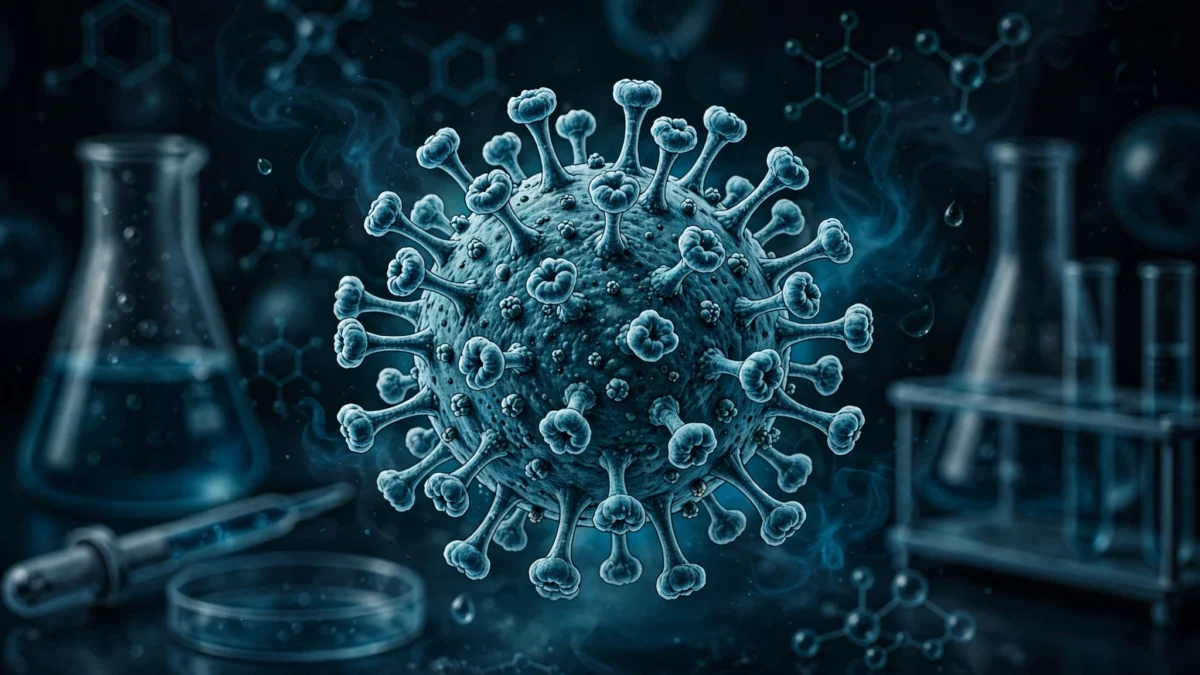
Health tracking networks classify it as a “saltation variant” — a lineage with an unusually high concentration of mutations in its spike protein compared with its parent lineage. The spike protein is the part of the virus that attaches to human cells, so changes there can affect how efficiently the virus enters cells. A study published in the Journal of Infection in October 2026 examined exactly that: the variant’s genetic mutations, its ability to enter human cells, and its response to vaccine-induced antibodies. It found that PJ.2.1 has an enhanced binding affinity for ACE2, the human cellular receptor the virus uses to enter cells.
A preprint study by researchers from the German Primate Center and Hannover Medical School, published on 8 October 2026, reported that PJ.2.1 was spreading in the United States, Canada and Spain. The variant is being investigated, and some of the available findings are still preliminary — which is why the careful language matters: what the science shows so far is a variant that may spread more easily, not one that makes people more ill.
Where it has spread — and how fast
After its first detection in Ontario, PJ.2.1 turned up elsewhere in Canada, then in New York City on 30 June 2026, followed by several other US states. Outside North America it has been detected in Australia, Singapore, Spain, France, Israel and New Zealand — eight countries in total.
The clearest measure of its growth comes from Ontario itself. Public Health Ontario’s genomic surveillance data showed that PJ.2.1 made up 25.2 percent of sequenced SARS-CoV-2 samples from 20 September to 17 October 2026, rising from 16.9 percent in the previous four-week period. In other words, in the place where it was first found, it now accounts for about a quarter of all sequenced cases, and its share is growing.
That growth is what put the variant on the WHO’s radar. But growth alone does not make a variant dangerous. As Dr Amit Saraf, director of internal medicine at Jupiter Hospital in Thane, put it: “a variant spreading faster does not necessarily mean it causes more severe disease.” The study he was discussing did not find that PJ.2.1 is much better at dodging the immunity built up from vaccines, either.
What are the symptoms?
There is no confirmed symptom profile that distinguishes PJ.2.1 from other COVID-19 variants. Infected people may experience the commonly reported COVID-19 symptoms: fever or chills, cough, sore throat, runny or blocked nose, headache, muscle and body aches, fatigue and weakness, shortness of breath, and changes in smell or taste, with gastrointestinal symptoms in some cases.
According to the World Health Organization, symptoms associated with PJ.2.1 may resemble those of the common cold or influenza. Two symptoms have particularly stood out, according to Russian infectious disease specialist and virologist Elena Malinnikova: severe sore throat and prolonged fatigue. But the overlap with seasonal flu and the common cold is so heavy that symptoms alone cannot confirm whether a person has PJ.2.1. Testing is necessary to identify COVID-19, and genomic sequencing is needed to identify the particular variant.
That is an important practical point. A sore throat and a fever this winter could be PJ.2.1, a cold, or seasonal flu — and only a test can tell which one. The WHO has highlighted the overlap between COVID-19 and other respiratory infections, and the importance of testing when the diagnosis could influence treatment decisions.
Is it more dangerous?
This is the question that matters, and the answer so far is reassuring. There is currently no convincing evidence that PJ.2.1 causes more severe illness, higher hospitalisation rates or more deaths than other circulating COVID-19 variants. That finding is consistent across the reporting: the variant is being investigated, the findings are preliminary, but nothing in the clinical evidence so far points to worse outcomes.
The Journal of Infection study that examined the variant’s genetics and cell-entry efficiency did not establish an increase in disease severity among infected patients. Laboratory findings about how a virus interacts with human cells cannot, on their own, establish whether infected people are more likely to develop pneumonia, require hospitalisation or face life-threatening complications. That requires clinical evidence — and the clinical evidence, so far, shows no increase.
The WHO has not classified PJ.2.1 as a variant of concern, or even as a variant of interest. It was not included among the variants of interest or variants under monitoring in the WHO’s July 2026 update, which lists JN.1 as a Variant of Interest and XFG, NB.1.8.1, PQ.16.1.1 and BA.3.2 as Variants Under Monitoring. For scale, the WHO’s COVID-19 dashboard shows that XFG accounted for 52 percent of submitted sequences globally in the week ending 4 October 2026, followed by JN.1 at 22 percent and NB.1.8.1 at 7 percent. PJ.2.1 is being watched — it is not, at this point, leading the field.
Vaccines, and what to do
The WHO continues to advise COVID-19 vaccination for those most vulnerable to severe illness, including older people and individuals with certain underlying health conditions. The available evidence does not suggest that PJ.2.1 escapes vaccine-built immunity to any meaningful degree, and vaccination remains the main protection against severe disease from any variant.
For most people, the practical advice is the same as it has been for every variant: if you develop respiratory symptoms, test; if you test positive, follow your local health guidance on isolation and care; and if you are in a vulnerable group, make sure your vaccination is up to date. There is no confirmed evidence of widespread transmission of PJ.2.1 in India as of 11 November, according to reports citing available surveillance information — but surveillance, not assumption, is what will establish that.
Outbreak surveillance has been in the news for other diseases too: Bangladesh’s measles outbreak has passed 1,150 deaths, overwhelming its health system. The lesson of both stories is the same — that the systems which track, sequence and report new variants and outbreaks are the difference between an early warning and a late surprise.
What to watch next
Three things will decide whether PJ.2.1 matters. First, whether its share of sequenced cases keeps growing in more countries, or plateaus. Second, whether hospitalisation and death rates among its cases stay in line with other variants — the clinical evidence, not the laboratory data, is what counts. And third, whether the WHO formally adds it to its monitoring list, which would signal that the global health body sees a reason for closer attention.
None of those three has yet gone the worrying way. PJ.2.1 is a variant worth watching, not a variant worth fearing — and the distinction is exactly what the evidence, as it stands, supports.
Frequently asked questions
What is the new COVID variant PJ.2.1? A descendant of the Omicron family, first found in Ontario, Canada, on 2 May 2026. It is classed as a “saltation variant” because of an unusually high concentration of mutations in its spike protein.
Where has PJ.2.1 been detected? In eight countries: the United States, Canada, Spain, France, Israel, Singapore, Australia and New Zealand. It made up 25.2% of sequenced samples in Ontario from 20 September to 17 October 2026.
What are the symptoms of PJ.2.1? The same as other COVID variants and similar to a cold or flu: sore throat, fever, cough, runny nose, congestion, fatigue, headache and muscle aches. Severe sore throat and prolonged fatigue have stood out in some reports. There is no symptom that uniquely identifies it.
Is PJ.2.1 more dangerous than other variants? There is currently no convincing evidence that it causes more severe illness, higher hospitalisation or more deaths than other circulating variants.
Has the WHO classified PJ.2.1 as a variant of concern? No. The WHO is closely monitoring it, but it was not included as a variant of interest or under monitoring in the WHO’s July 2026 update.
Do current vaccines work against PJ.2.1? The available evidence does not suggest the variant escapes vaccine-built immunity to any meaningful degree. The WHO continues to advise vaccination for those most vulnerable to severe illness.
Key takeaways
- PJ.2.1, a new Omicron-descendant COVID variant, was first found in Ontario, Canada, on 2 May 2026 and has since spread to eight countries.
- It is a “saltation variant” with an unusually heavily mutated spike protein and enhanced ACE2 binding, per an October 2026 Journal of Infection study.
- In Ontario it made up 25.2% of sequenced samples from 20 September to 17 October 2026, up from 16.9% in the previous four weeks.
- There is no convincing evidence it causes more severe illness, higher hospitalisation or more deaths than other circulating variants.
- Symptoms overlap a cold or flu; severe sore throat and prolonged fatigue have stood out. Only testing plus genomic sequencing can confirm PJ.2.1.
- The WHO is closely monitoring it but has not classified it as a variant of concern or interest; vaccination remains advised for the most vulnerable.
React to this story