On This Page
Four million Spanish workers downed tools on Wednesday in the country’s first general strike in 14 years, turning a long-running argument about the cost of a home into the biggest protest Spain has seen in more than a decade. The 24-hour walkout, on 11 November 2026, shut down public transport, slowed factories and filled the streets of Madrid, Barcelona and dozens of other cities — less than three weeks before a snap general election in which housing has become the central issue.
The strike was called by Spain’s two largest unions, the General Union of Workers (UGT) and the Workers’ Commissions (CCOO), together with tenants’ associations angry about rising rents and evictions. Its slogan was simple: “Salaries. Housing. Prices.” The unions said about 4 million people had joined by the end of the day, and the tenants’ union expected the figure to reach 5 million. In a country of around 23 million workers, that is roughly one in five of the entire workforce.
A strike about rent, not austerity
Spain has held general strikes before, but not like this one. The last was in 2012, against austerity measures during the eurozone debt crisis. This is the first general strike whose main cause is housing — the price of a roof over your head.
The numbers explain why. The average rent in Spain is now €1,176 a month — about $1,315 — which the Youth Council of Spain says is equal to about 98.7 percent of a young person’s average monthly salary. In other words, a young worker on an average wage would need almost everything they earn just to pay the rent, before food, transport or anything else. The country’s average gross monthly salary is about €2,460, and renting a 50-square-metre apartment in Madrid cost an average of €1,170 a month in October.
The shortage behind those prices is structural. Spain has a deficit of about 750,000 homes, according to the central bank, and that shortfall is set to grow to more than a million by 2028. Too few homes, too many people chasing them, and rents that rise faster than wages — that is the arithmetic the strikers were protesting.
What stopped, and what did not
The walkout began at midnight and ran for 24 hours. Public transport was disrupted across the country, and businesses, factories and shops scaled back operations or closed entirely. The unions reported significant stoppages in strategic sectors, including 90 percent in the automotive and port sectors. Participation varied widely by region: between 41 percent in Castilla-La Mancha and Extremadura and more than 80 percent in Catalonia and Andalusia, in the first figures reported after the night shift ended.
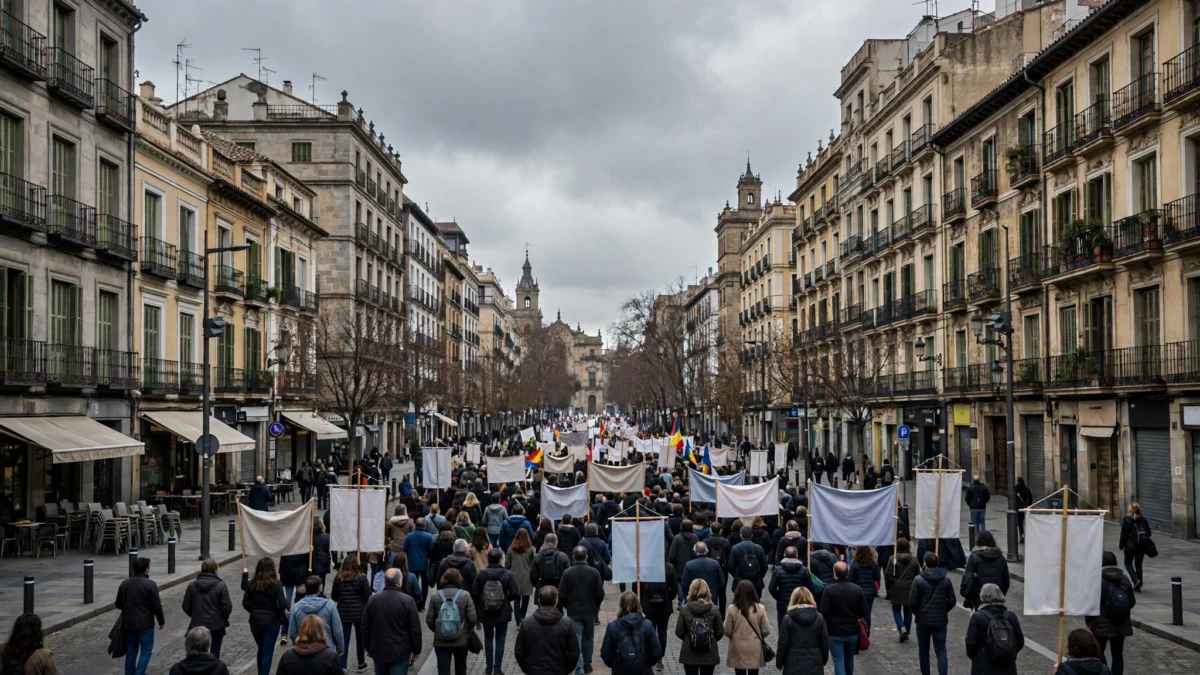
Workers braved stormy weather to man picket lines. In Madrid, police clashed with union members picketing at the entrance to Mercamadrid, Spain’s main wholesale market for fresh produce. Huge marches of tens of thousands of workers and ordinary citizens filled downtown Barcelona and Madrid, along with gatherings in other cities.
The strike was mostly peaceful, but by the evening clashes had erupted in some areas of Barcelona and Madrid, and police used pepper spray against protesters in the capital. There was also a legal fight behind the scenes: Madrid’s High Court of Justice suspended the minimum service levels the regional government had decreed for education, justice and transport, ruling that those levels made it impossible to exercise the right to strike.
The election in 18 days
The timing is not an accident. Spain votes in a snap general election on 29 November 2026, and housing is the issue that will decide it. Prime Minister Pedro Sánchez called the election after his minority government failed to secure parliamentary approval for a package of housing measures proposed in response to months of protests over access to housing.
Sánchez hopes to harness voter resentment over housing to shift the political narrative away from corruption cases involving his inner circle and a deadly train crash last month. The strike puts him in an awkward position: it is a protest against a crisis his government has not solved, but it is also a protest that keeps housing — his chosen election issue — at the top of the news.
The risk for Sánchez is that the strike’s energy belongs to the unions and the tenants’ movement, not to his party. The risk for his opponents is that the election becomes a referendum on who can fix housing, rather than on the scandals they want voters to focus on. Either way, the 4 million workers who stayed home on Wednesday have made sure housing cannot be ignored for the remaining 18 days of the campaign.
Why this matters beyond Spain
Spain is the eurozone’s fourth-largest economy, and its housing crisis is not unique. Across Europe, rents have risen faster than wages for a decade, young workers are priced out of the cities where the jobs are, and governments have struggled to build enough homes. What makes Spain different is the scale of the response: a general strike, called by the mainstream unions, with housing — not wages, not pensions, not austerity — as the cause.
If the strike moves votes on 29 November, other European governments will notice. A housing protest that can stop a country’s transport and factories is a warning that the issue has moved from the margins of politics to the centre. And if the election produces a government that acts on housing, the strike of 11 November will be remembered as the day the issue became impossible to ignore.
Frequently asked questions
What was the Spain general strike about? Housing affordability. Workers and tenants protested rising rents, evictions and a shortage of homes, under the slogan “Salaries. Housing. Prices.” It was backed by the UGT and CCOO unions and tenants’ associations.
How many people took part? The unions said about 4 million workers took part, and the tenants’ union expected the figure to reach 5 million by the end of the day. Spain has around 23 million workers.
When was Spain’s last general strike? In 2012, against austerity measures during the eurozone debt crisis. The 11 November 2026 strike is the first in 14 years, and the first whose main cause is housing.
Why is housing so expensive in Spain? There are too few homes: a deficit of about 750,000, set to top a million by 2028. Average rent of €1,176 a month equals about 98.7% of a young person’s average monthly salary.
Was the strike peaceful? Mostly, yes. But by the evening there were clashes in some areas of Barcelona and Madrid, and police used pepper spray against protesters in Madrid.
What happens next? Spain votes in a snap general election on 29 November 2026, with housing as the central issue. The strike’s political effect will be measured at the ballot box.
Key takeaways
- About 4 million workers joined Spain’s first general strike in 14 years on 11 November 2026, protesting the housing affordability crisis.
- Average rent of €1,176 a month equals about 98.7% of a young person’s average monthly salary; Spain has a housing deficit of about 750,000 homes.
- The strike was backed by the UGT and CCOO unions and tenants’ associations, under the slogan “Salaries. Housing. Prices.”
- Public transport was disrupted and factories slowed, with 90% stoppages reported in the automotive and port sectors; the strike was mostly peaceful, with evening clashes in Barcelona and Madrid.
- A snap general election is set for 29 November 2026, with housing as the central issue, after Sánchez’s government failed to pass a housing measures package.
- It is the first Spanish general strike whose main cause is housing, not austerity or wages.
React to this story