On This Page
- What is happening
- Subscribe to CAAW News
- Who is at the table
- What is on the agenda
- The Europe question
- What is at stake
- What is confirmed and what is not
- What happens next
- Frequently asked questions
- When and where are the talks taking place?
- Who is leading each delegation?
- What are security guarantees, and why are they the main issue?
- Are European countries taking part in the talks?
- Will the talks end the war?
- React to this story
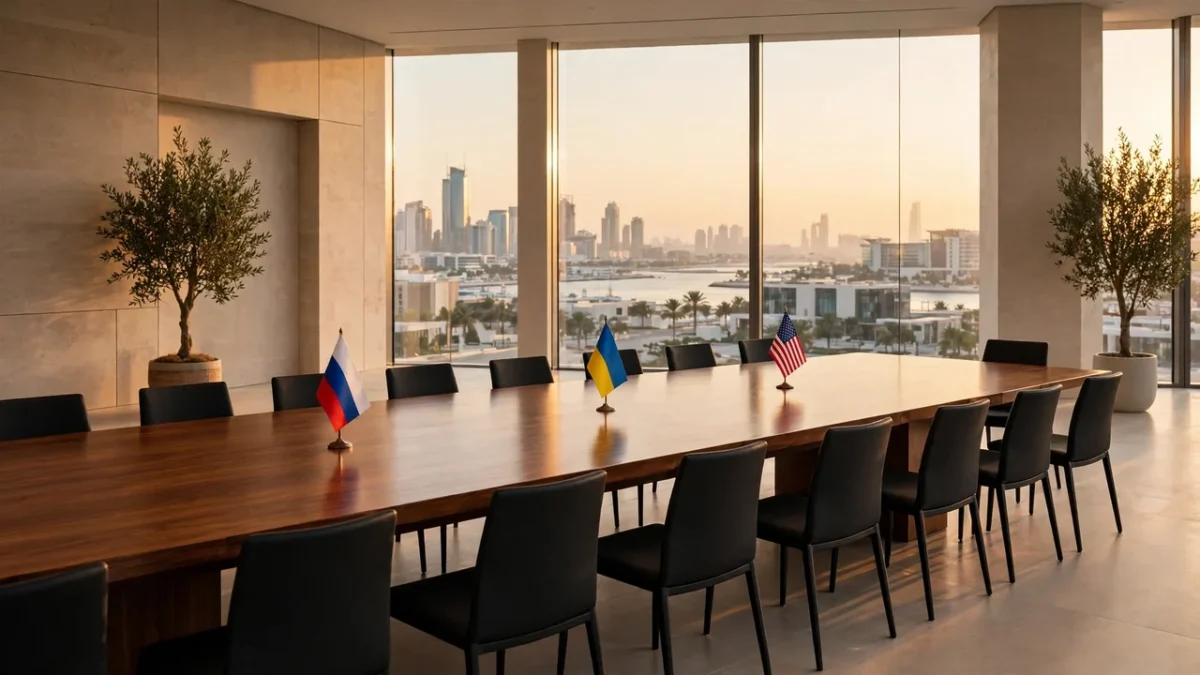
Negotiators from Russia, Ukraine and the United States meet in Abu Dhabi on Tuesday and Wednesday, November 10–11, 2026, for the first trilateral talks on ending the war since February. The two-day session follows earlier rounds this year that produced no visible progress toward ending a war now in its fifth year.
The talks are scheduled to begin at around 06:30 GMT on Tuesday, according to officials in Kyiv quoted by Reuters — 10:30 in the morning in Pakistan. Security guarantees are at the top of the agenda. The meeting opens amid continued fighting along a front line of about 1,200 kilometres, and escalating long-range attacks by both sides. No outcome is settled: the talks have not happened yet.
What is happening
The two sides have held three rounds of US-mediated talks this year, including two in Abu Dhabi, Al Jazeera reports — making this the fourth round of 2026. Reuters notes negotiations have picked up again after months in which Washington’s attention was focused on the war in Iran. That shift is itself part of the story: only now is the Ukraine file back at the centre of American diplomacy. Russia has also intensified strikes on Ukraine’s power system as winter sets in, The Hindu reports.
Last month, a localised truce around the Russian-occupied city of Oleshky in southern Ukraine was brokered with the help of US first lady Melania Trump, The Hindu reports. The weeklong ceasefire allowed evacuations and the delivery of humanitarian supplies, and both Moscow and Kyiv called it a positive model. But fighting continued elsewhere — a local pause, not a path to peace. An energy-targets truce announced by Trump last month also quickly fell apart, Reuters reports: Ukraine has escalated its strikes on Russian oil refineries, and Moscow has pounded Ukraine’s power grid and cities.
Who is at the table
The United States is represented by special envoy Steve Witkoff and Jared Kushner, the president’s son-in-law. Both spoke with Zelenskyy by telephone for 90 minutes on November 4, The Hindu reports. Kushner wrote on X that the aim was practical arrangements addressing “the security concerns of all sides.”
Russia’s delegation is again led by Kremlin aide Vladimir Medinsky, Moscow’s chief negotiator. Medinsky led Russia’s delegation at the first direct talks in Istanbul in March 2022, and is known for hard-line views. His delegation this time is a heavier one: according to Reuters and Khaama Press, it includes Deputy Foreign Ministers Sergey Ryabkov — attending the talks for the first time — and Mikhail Galuzin, military intelligence chief Igor Kostyukov, and General Staff officer Yuri Zhigarlovsky.
Ukraine’s delegation is led by Rustem Umerov, the head of the Foreign Intelligence Service, who announced on Telegram on November 9. “Our goal is lasting and sustainable peace, guaranteed security for Ukraine,” Umerov wrote. His delegation also includes Presidential Office head Kyrylo Budanov, Serhiy Kyslytsia, Vadym Skibtsky and Davyd Arakhamia, per Interfax-Ukraine, cited by Khaama Press. Zelenskyy said on the eve of the talks that Ukraine’s leverage was increasing.
What is on the agenda
Security guarantees are the centrepiece. The Hindu reports the talks will focus on them, and Zelenskyy has noted that Ukraine and its allies have discussed guarantees similar to NATO’s Article 5 — an attack on one member treated as an attack on all. He put the question plainly: “If Russia starts again, what will happen? Who will do what, with what means, and when?” Witkoff has said the talks would cover post-war security agreements, de-escalation and humanitarian measures, per Khaama Press.
The gaps are wide. Putin wants Ukraine to pull its troops back from the four regions Moscow illegally annexed but never fully captured, The Hindu reports. He also demands Ukraine abandon its NATO bid, accept strict limits on its military, and drop restrictions on the Russian language and the Moscow-affiliated Orthodox Church. He wants a comprehensive deal on those conditions, and will not agree to a general halt in hostilities. Zelenskyy rejects Putin’s demands to voluntarily cede Ukrainian territory, and Ukraine argues that an immediate ceasefire is the first step toward a wider settlement. Kyiv says a direct meeting between Putin and Zelenskyy is the only way territorial issues can be settled.
A US official told Reuters that negotiators believe Zelenskyy and Putin may compromise on territory, each ceding a little — but a senior Ukrainian official strongly denied that the government would consider any such concessions, saying territory could be discussed only at leaders’ level, and only with appropriate security guarantees. Reuters adds there has been no public sign Putin will drop his insistence that Ukraine surrender the entire Donbas. The Kremlin also insists any deal should offer security guarantees for Russia as well. Some European nations have discussed deploying troops to Ukraine after a deal; Russia rejects that, warning it would view any European troops on Ukrainian soil as legitimate targets.
The Europe question
Whether Europe is in the room is the most confused part of this story. French Foreign Minister Jean-Noel Barrot said on November 8 that Europe would be represented, with France speaking for its position, per The New Voice of Ukraine. Kremlin spokesman Dmitry Peskov said the opposite: European representatives would not participate directly. Kremlin adviser Yuri Ushakov was blunter still. “No one is going to invite them to the negotiating table,” he said, adding that if they fly there, they won’t be allowed into the room, The Hindu reports.
An EU official told AFP that bloc, NATO, French, German and UK security officials would be on site — but their role was unclear, Al Jazeera reports. Umerov said the same: the E4 group — the UK, France, Germany and Italy — plus NATO and the European Commission will also be in Abu Dhabi, and Ukraine will hold separate coordination meetings with them. In short: Europeans will be in Abu Dhabi, but not, on the Kremlin’s account, in the negotiating room.
That tension matters: Trump has widened the frame beyond Ukraine itself. After meeting Putin’s envoy Kirill Dmitriev at the White House on November 4, he said some kind of grand deal about European security was in the works. “It’s going to be a big agreement and it’s going to involve more than Ukraine,” Trump said, adding that it might include all of Europe. His comments prompted a backlash from some European officials, Reuters reports, who said any negotiations on European security needed direct involvement by the relevant governments.
What is at stake
Russia occupies roughly 20 percent of Ukraine, including Crimea and parts of the eastern Donbas region, Al Jazeera reports. The occupation has not been recognised by the international community, but Trump has urged Kyiv to cede territory for a deal to end a war that has killed thousands and displaced millions. That is the hard core of the negotiation: land for guarantees.
The analysts quoted by Al Jazeera are not hopeful. “I don’t expect any tangible progress in the Abu Dhabi talks. The reason is simple and remains the same — Putin has absolutely no intention to negotiate seriously,” Ukrainian MP Oleksandr Merezhko told Al Jazeera. Former US diplomat Matthew Boyse, of the Hudson Institute, agreed the hardest sticking points are territory and security guarantees: “So far Putin has not budged from his ‘my way or the highway’ position.” Political scientist Arkady Moshes said Ukraine’s sovereignty is at stake, and restoring territorial integrity, including Crimea, may already be beyond reach.
The analysts agreed that the future of European security as a whole is at stake, and Moshes warned that if Ukraine capitulates, Belarus, Moldova, Georgia and Armenia “will definitely be under threat.” Anders Olofsgard, of the Stockholm Institute of Transition Economics, added that Trump, now a lame duck after his party’s midterm losses, may lean harder on Ukraine to make concessions. Olofsgard called it reassuring that Kushner had said NATO would remain central to European collective defence, with no veto over another country’s alliance choices. Since Trump took office, Reuters reports, the US has slashed direct aid to Kyiv, while Europe has become Ukraine’s main foreign funder.
What is confirmed and what is not
Confirmed: a two-day trilateral session in Abu Dhabi on November 10–11, 2026, the first since February, with Witkoff and Kushner for the US, Medinsky for Russia, and Umerov for Ukraine. Confirmed: the agenda is security guarantees, post-war security arrangements, de-escalation and humanitarian measures. Confirmed: the two sides remain far apart on territory, and previous rounds produced no visible progress. Confirmed: European officials will be in Abu Dhabi, but whether they enter the negotiating room is disputed.
Not confirmed: any outcome — no deal, ceasefire or joint statement, because the talks have not yet taken place. Not confirmed: that Putin will compromise on territory — Reuters reports no public sign of it, and a senior Ukrainian official denied Kyiv would consider concessions. Not confirmed: the reported possibility that Trump, Chinese President Xi Jinping and Putin may hold three-way talks at the APEC summit in Shenzhen on November 18–19 — reported, not confirmed by any of the three governments. All the analysts told Al Jazeera no peace accord would emerge. What might be negotiable, per Ukrainian professor Olexiy Haran, are technical issues — grain supplies, a Black Sea ceasefire, an energy ceasefire and perhaps another prisoner exchange.
What happens next
The first signals will come from what the delegations say — or refuse to say — when they emerge. Watch for three things: whether a date is set for a further round or a leaders’ meeting; whether anything is agreed on the technical items, such as a Black Sea or energy ceasefire or a prisoner exchange; and whether European officials are brought into the room or kept in separate briefings.
For now, the honest position is the sources’ own: a meeting that matters because it is happening, not because anyone expects it to end the war. The delegations are heavier than last time. But the demands on the table have not moved, the fighting has not stopped, and the analysts who know this negotiation best expect no breakthrough. Even a technical agreement — a pause in energy strikes that holds, or another prisoner exchange — would be more than previous rounds managed.
Frequently asked questions
When and where are the talks taking place?
In Abu Dhabi, the capital of the United Arab Emirates, on Tuesday and Wednesday, November 10–11, 2026. They are the first trilateral talks since February 2026, scheduled to begin at around 06:30 GMT on Tuesday.
Who is leading each delegation?
The US is represented by Steve Witkoff and Jared Kushner. Russia’s delegation is led by Vladimir Medinsky, with Sergey Ryabkov, Mikhail Galuzin, Igor Kostyukov and Yuri Zhigarlovsky. Ukraine’s is led by Rustem Umerov, with Kyrylo Budanov, Serhiy Kyslytsia, Vadym Skibtsky and Davyd Arakhamia.
What are security guarantees, and why are they the main issue?
Security guarantees are what Ukraine’s allies commit to do if Russia attacks again after a peace deal. Ukraine and its allies have discussed guarantees similar to NATO’s Article 5, under which an attack on one member is treated as an attack on all. Zelenskyy has framed the question directly: if Russia starts again, who will do what, with what means, and when?
Are European countries taking part in the talks?
The sources disagree. French Foreign Minister Jean-Noel Barrot said Europe will be represented; Kremlin spokesman Dmitry Peskov said Europeans will not take part directly, and Kremlin adviser Yuri Ushakov said they would not be allowed into the room. An EU official told AFP that bloc, NATO, French, German and UK security officials would be on site, but their role was unclear.
Will the talks end the war?
Almost certainly not this week. All the analysts quoted by Al Jazeera were certain no peace accord would emerge from the talks, and previous rounds produced no visible progress. What they might deliver is narrower: technical agreements on grain, a Black Sea or energy ceasefire, or another prisoner exchange.
React to this story