Key Points
Key Points
- Sahibzada Farhan scored 238 runs in three T20Is against Sri Lanka, breaking India's Abhishek Sharma's record for a bilateral three-match T20I series among full members.
- Farhan became the first Pakistani and eighth player overall to score three consecutive half-centuries in such a series, and was named player of the series.
- Pakistan sealed the series 2-1 with wins on October 9 (four wickets) and October 11 (82 runs) before Sri Lanka took the final match by eight wickets.
- Sri Lanka captain Kusal Mendis struck an unbeaten 87 off 48 balls in the final T20I, his career-best in the format.
- The series was Farhan's first as full-time T20I captain, giving his tenure a winning start ahead of a busy schedule.
On This Page
A Captain’s Statement Series
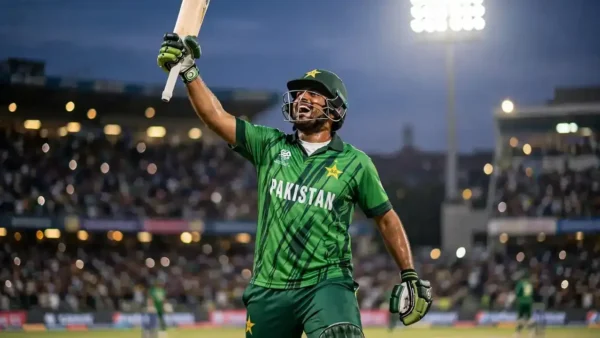
Sahibzada Farhan could hardly have asked for a better start to his tenure as Pakistan’s full-time T20I captain. The opener finished the three-match series against Sri Lanka in Rawalpindi with 238 runs — the highest aggregate ever recorded by a batter from a full-member nation in a bilateral three-match T20I series — as Pakistan sealed a 2-1 series victory on October 13, 2026.
Farhan’s 238 runs surpassed the previous mark of 229 held by India’s Abhishek Sharma, rewriting a record that had stood as the benchmark for short-format consistency in a bilateral series. Even more remarkably, the Pakistan captain scored half-centuries in all three matches — 89 off 53 balls in the series opener, 73 in the second match, and 76 off 47 in the finale — becoming the first Pakistani and only the eighth player overall to achieve the feat in a bilateral three-match T20I series. He joins former India captain Virat Kohli and six other players on that exclusive list.
Pakistan had already clinched the series before the final match, winning the opener by four wickets on October 9 and then registering an emphatic 82-run victory on October 11. Sri Lanka avoided a whitewash with a commanding eight-wicket win in the third T20I at the Rawalpindi Cricket Stadium on Tuesday.
How the Series Was Won
The first two matches showcased Pakistan’s growing confidence under their new captain. In the opener on October 9, Pakistan chased down Sri Lanka’s 182 for 8, reaching 187 for 6 in 18.5 overs to win by four wickets. Farhan’s 89 off 53 balls anchored the chase and announced his intent for the series.
The second T20I on October 11 was even more one-sided. Pakistan posted 215 for 3 — a total built on another Farhan masterclass of 73 — before bowling Sri Lanka out for 133 for 7 to win by 82 runs and seal the series with a game to spare.
Sri Lanka had won the toss and chosen to bowl first in the second game, a decision that backfired spectacularly as Pakistan’s top order, led by Farhan, dominated the Rawalpindi surface. The 82-run margin was Pakistan’s statement of the series: comprehensive, aggressive, and built around their new captain’s bat.
The Final Hurdle
The third T20I on October 13 belonged to Sri Lanka. Batting first, Pakistan posted 168 for 8 in their allotted 20 overs, with Farhan again leading the way through a fluent 76 off 47 balls, including seven fours and three sixes. Arafat Minhas provided valuable late-order support with an unbeaten 34 off 20 deliveries, striking two fours and two sixes.
Pakistan made a brisk start, but Eshan Malinga dismissed Fakhar Zaman (12) and Maaz Sadaqat (0) in the fourth over to leave the hosts at 34 for 2. Farhan and Hasan Nawaz then added 33 runs for the third wicket before Hasan departed for 16. Sri Lanka tightened their grip through Dasun Shanaka, who removed Khawaja Nafay (3), Mohammad Imran (6) and Abdul Samad (15) to reduce Pakistan to 102 for 6. Shanaka finished as the pick of the bowlers with figures of 3 for 21 and a stellar economy of 5.25.
The chase, however, was where the night turned. Set 169 to win, Sri Lanka knocked off the runs for the loss of just two wickets, winning with 17 balls to spare — a consolation victory, but a commanding one.
Mendis Stars in Defeat
Sri Lanka’s hero was their captain, Kusal Mendis, whose unbeaten 87 off 48 balls was his career-best score in the format. Walking in at No. 3 after Lahiru Udara fell for one, Mendis rebuilt the innings first alongside Sineth Jayawardene (38 off 26) in a 59-run second-wicket stand, and then with Kamindu Mendis (40 not out off 27) in an unbroken 98-run partnership that took Sri Lanka home.
Mendis struck nine fours and four sixes in a sublime display of clean hitting, and was adjudged player of the match. The innings also carried a milestone of its own: Mendis became Sri Lanka’s highest run-scorer in T20I history with 2,791 runs, going past Pathum Nissanka’s tally of 2,784.
For Sri Lanka, the series offered genuine positives despite the 2-1 defeat. Their young batting core showed fight, Shanaka’s bowling was outstanding in the finale, and the consolation win means they leave Rawalpindi with momentum rather than a whitewash.
A New Era Under Farhan
The broader significance of the series lies in what it signals for Pakistan’s T20I future. Farhan, elevated to the captaincy after the axing of Babar Azam and Shaheen Afridi from the format’s leadership picture, has now delivered a winning series, a player-of-the-series award, and two national records in his first assignment as full-time skipper.
His 238-run aggregate is the kind of performance that changes the conversation around a player. Consistency across three matches — rather than one explosive innings — is what separates good T20 batters from great ones, and Farhan has now demonstrated it at international level. That he did so while captaining the side adds another layer to the achievement.
Pakistan’s next assignments include a home ODI tri-series involving England and Sri Lanka starting October 18, followed by the road to the T20 World Cup. The selectors will be encouraged by more than just Farhan’s runs: Arafat Minhas’s finishing, the bowling depth shown in the second T20I, and the emergence of new faces in Maaz Sadaqat and Mohammad Imran all point to a squad in transition finding its feet.
What the Numbers Say
Beyond the headline 238, the series statistics underline Farhan’s dominance. Three innings, three half-centuries, a strike rate consistently above 140, and the player-of-the-series award. Among full-member nations, no batter had ever aggregated more in a three-match bilateral T20I series — the record he took from Abhishek Sharma’s 229 is unlikely to fall quickly.
For Sri Lanka, Mendis’s 87 not out and his new national record provide a foundation. The visitors will be disappointed with the series result but encouraged by their captain’s form and the emergence of Kamindu Mendis and Eshan Malinga as genuine contributors.
What Comes Next
Pakistan’s 2-1 series win, built on their captain’s record-breaking bat, is exactly the start the new leadership wanted. The challenge now is translating bilateral success into tournament performances, with the T20 World Cup cycle entering its decisive phase. Sri Lanka, meanwhile, take a consolation win and a captain in career-best form into their next fixtures.
The Rawalpindi series will be remembered for Farhan’s 238 — a number that now sits atop the record books, and a standard against which Pakistan’s next generation of T20 batters will be measured.
The Record in Context
To appreciate what Sahibzada Farhan has done, consider the company he has joined. Scoring three consecutive half-centuries in a bilateral three-match T20I series had previously been achieved by only seven players in the history of the format. Farhan is the eighth, and the first from Pakistan, a country whose T20 batting lineage includes some of the format’s greatest accumulators. That none of his celebrated predecessors managed the feat only sharpens its significance.
The aggregate record is arguably even more impressive. Abhishek Sharma’s 229, set for India, was itself a mark of extraordinary consistency, compiled against high-quality opposition. Farhan’s 238 does not merely edge past it; it redefines what a bilateral T20I series can yield for an opener. His scores, 89, 73 and 76, show a player operating at a level where fifty is the floor rather than the ceiling, across three matches in five days, while carrying the additional burden of the captaincy.
Records in T20 internationals tend to fall quickly in an era of ever-improving batting. This one may prove unusually durable: it requires not just three big innings but three big innings in the compressed window of a bilateral series, with no dead rubbers to pad the numbers and no weak attack to exploit. Farhan earned every run of it.
A Team in Transition
Farhan’s emergence as captain and record-breaker has unfolded against the backdrop of the most significant overhaul of Pakistan’s T20 setup in years. The decision to drop Babar Azam and Shaheen Afridi for the Sri Lanka series signalled a decisive break with the past, and the elevation of Farhan to the full-time captaincy placed the team’s future squarely on the shoulders of a new generation.
The early returns suggest the selectors’ gamble is paying off beyond just the captain’s own runs. Maaz Sadaqat arrived in the series on the back of a stunning run of domestic form, 451 runs in seven T20 games, and though his international returns in this series were modest, his presence symbolises the depth of batting talent now pushing through. Arafat Minhas’s unbeaten 34 in the final T20I and Mohammad Imran’s contributions with ball and bat point to a squad discovering new contributors in real time.
Transitions are fragile things in Pakistan cricket, where patience is rarely the default setting. A 2-1 series win, a record-breaking captain and a glimpse of the next wave may buy this project the most precious commodity of all: time.
What Rawalpindi Witnessed
There is something fitting about the records falling in Rawalpindi, a venue that has witnessed some of Pakistan cricket’s most emotional modern moments. Across the three matches, the crowds saw their new captain bat with an authority that recalled the great Pakistani openers, watched Sri Lanka’s captain respond with a career-best innings of his own, and experienced the full arc of a bilateral series: dominance, consolidation and a final-day twist.
For the neutral, the series was a reminder of what bilateral T20 cricket can offer when both sides compete with intensity: individual brilliance, tactical battles and a finale that mattered even with the series decided. For Pakistan, it was the perfect start to a new era. For Sri Lanka, it was a defeat softened by a final-day statement. And for Sahibzada Farhan, it was five days that changed his career, and possibly his country’s T20 future, forever.
React to this story