Key Points
Key Points
- The Nasdaq fell 5.5% on Thursday in its worst day since April 2025, wiping out more than $2.5 trillion in market value. Nvidia lost 9.3%, Tesla fell 11%, and the rout spread to Asia on Friday. The trigger: the midterm election results and a growing fear that AI spending will slow.
On This Page
The numbers
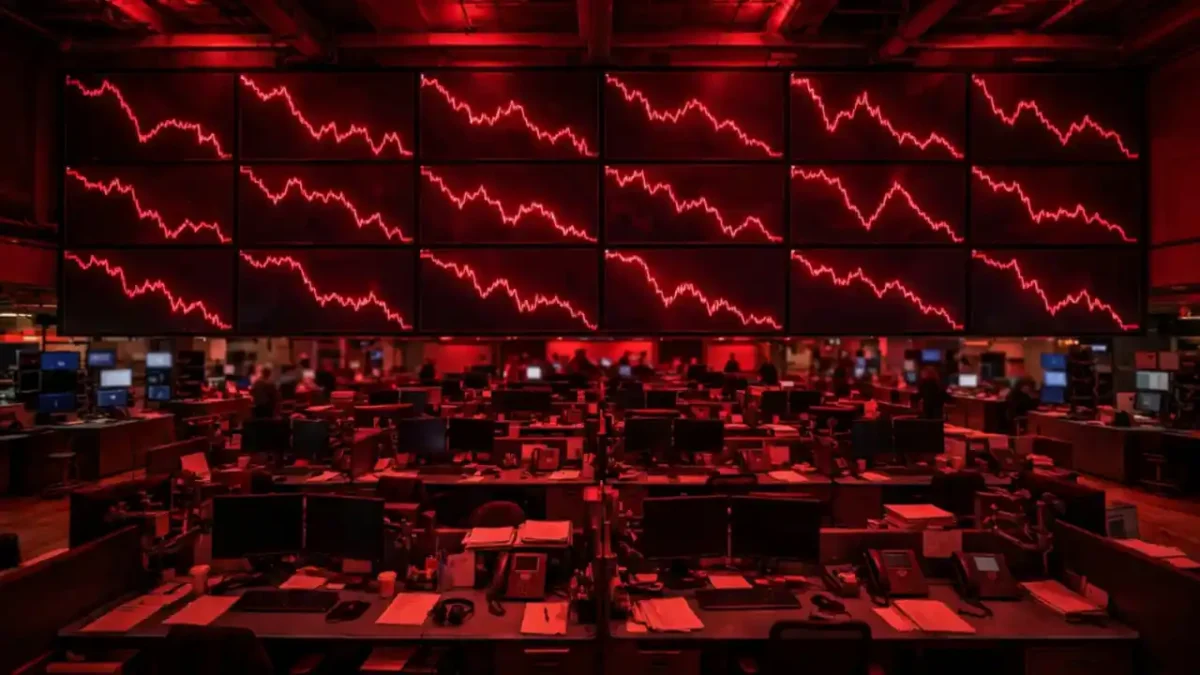
Thursday was the worst day for tech stocks in more than a year. The Nasdaq fell 5.52% in a single session — its worst day since April 2025 — and more than $2.5 trillion in market value was wiped from global shares. The Nasdaq is now in correction territory, more than 10% below its record high on 6 October. The S&P 500 fell 4.4%, and the Dow Jones dropped 3.4%, or 1,833 points in a day. Fear, measured by the VIX index, surged by about 70% — its biggest one-day jump in almost two years, to its highest level in eight months.
The damage was worst at the top. The seven biggest US tech companies — the Magnificent Seven — lost about $1 trillion in a single day. Nvidia fell 9.3%, wiping out more than $400 billion of its value. Tesla fell 11%, and SpaceX fell 8%. The Philadelphia Semiconductor Index fell 12.3%, its worst day in about six and a half years. I will explain what set it off, how far it spread, and whether this is the AI bubble bursting.
Why you can trust this post: the figures come from the BBC, CNN and Deutsche Welle, all reporting the same core numbers. Where one source differs on a figure, I name the source I used.
In this post
The numbers; what set it off; the rout went global; the reversal from Wednesday; bubble or correction; what to watch next; your questions; my final thoughts.
What set it off
The trigger was politics, not a company result. The Democrats won both the Senate and the House in the midterm elections, and investors began to worry about what that means for the artificial intelligence boom. The biggest fear is about data centres — the huge buildings full of computers that power AI. For months, the market has priced in a world where companies keep spending hundreds of billions of dollars on AI infrastructure, with few limits.
Now that assumption is being questioned. Gina Hinojosa, the governor-elect of Texas, campaigned on a moratorium on new data centres and on ending their tax breaks. Texas matters because it has become one of the biggest data centre hubs in America, and voters in several other states also backed measures to slow data centre growth. If data centres cannot be built as fast, or as cheaply, the companies that sell the chips, the servers and the power will earn less than the market expected. That is what Thursday’s selling was really about.
The selling was made worse by how crowded the trade had become. For months, almost everyone owned the same AI stocks, and prices had risen so far that any bad news hit hard. When Nvidia falls 9.3% in a day, it is not just one company falling — it is a signal that the whole bet on AI is being repriced.
The rout went global
By Friday morning, the selling had crossed the Pacific. Japan’s Nikkei fell 6.3%. South Korea’s Kospi fell about 9% at the open, triggering a 20-minute trading halt, and closed down about 6%. SK Hynix fell more than 10%. In Japan, Kioxia fell 11.5% and Tokyo Electron 5.8%. Europe opened lower too: the FTSE down 1.6%, the DAX down 1.3%.
Crypto fell with it. Bitcoin had already crashed below $76,000 on Thursday, with about $1.1 billion in positions liquidated in 24 hours. When markets panic, they sell everything risky at once — and right now, AI stocks, chip makers and crypto are all in the same basket. Even CoreWeave, the AI cloud company, fell 10%, and Nebius fell 15%. There was almost nowhere to hide on Thursday.
The reversal from Wednesday
What makes Thursday so striking is what happened the day before. On Wednesday, the day after the midterms, markets rallied. The Dow jumped 1,569 points, and the Nasdaq rose 1.44%. Investors cheered the election result, betting that a divided government would mean stability. Big Tech stocks jumped on the news, and the mood was optimistic.
Thursday wiped all of it out, and then some. The Dow’s 1,833-point fall was bigger than Wednesday’s 1,569-point rise. In 24 hours, the market went from celebrating the midterms to fearing them. That whiplash is the story of the week: nobody yet knows whether the new Congress will help or hurt the AI boom.
Bubble or correction?
Is this the AI bubble bursting? That is the question every investor is asking, and the honest answer is that nobody knows yet. Here is what we do know. The Nasdaq is now more than 10% below its record high, which meets the usual definition of a correction. But it is still up about 4.6% so far this year, and it is still higher than it was a year ago. A correction is not a crash — it is a fall of 10% or more, and markets have them regularly.
It is also worth remembering that no new law has been passed. The data centre moratorium in Texas is a campaign promise, not yet a law. No tax break has been taken away. What changed on Thursday was the market’s belief about the future, not the future itself. Beliefs can change back, and fast. The same traders who sold on Thursday could buy again on Monday if the news improves.
One more number puts the week in perspective. Elon Musk spent about $450 million backing Republican candidates in the midterms, according to reports, and the party still lost both houses of Congress. The market’s reaction was not about one person. It was about a whole industry discovering that politics can move its share price as much as any product launch.
What to watch next
Three things matter now. First, Monday’s open: if the selling continues, the correction could deepen. Second, Tuesday’s US inflation data, which will shape the Federal Reserve’s December rate decision. Third, any signal from the new Congress about data centres, AI regulation or tech taxes — the first concrete proposal will tell investors whether Thursday’s fear was justified. Until then, the numbers say it all: $2.5 trillion can disappear in a day, and the market that took it away can give it back just as fast.
Frequently asked questions
How much did the Nasdaq fall? 5.52% on Thursday, its worst day since April 2025. It is now more than 10% below its record high of 6 October, which puts it in correction territory.
Why did tech stocks fall after the midterms? Investors fear the new Democratic Congress, and state moves like the Texas data centre moratorium, will slow the AI infrastructure boom. Data centres are the backbone of AI spending, and anything that slows their growth hits chip and tech stocks.
How much did Nvidia lose? Nvidia fell 9.3% in a day, wiping out more than $400 billion of its value. Tesla fell 11%, and the Magnificent Seven together lost about $1 trillion.
Is this the AI bubble bursting? Too early to say. The Nasdaq is in a correction, but it is still up about 4.6% this year and higher than a year ago. No new law has been passed yet — the market is reacting to what it fears might happen, not to what has happened.
Did markets fall everywhere? Yes. Asia fell hard on Friday — the Nikkei down 6.3%, the Kospi down about 9% at the open — and Europe opened lower too. Bitcoin also fell below $76,000.
Final thoughts
Thursday was a reminder of a simple truth: the market does not need a company to fail for its shares to fall. It only needs to change its mind about the future. The AI boom was built on a bet that spending would grow without limits, and on Thursday the market questioned that bet for the first time in a serious way. The question now is whether the doubt lasts. If the new Congress leaves AI alone, this week will be remembered as a buying opportunity. If it does not, Thursday was the first day of something bigger.
React to this story