Key Points
Key Points
- Falcon 9's booster separates after about two and a half minutes, then flips engines-first.
- The boostback burn steers it toward land or a droneship; the re-entry burn protects it from heat.
- Grid fins steer the booster through supersonic descent like a steering wheel.
- The hoverslam times the final burn so speed hits zero exactly at touchdown, because the booster cannot hover.
- Super Heavy skips legs and is caught by the launch tower's chopstick arms.
- One Falcon 9 booster has flown 37 times, proving reuse at scale.
On This Page
- What You Will Learn
- Why Throwing Rockets Away Was Crazy
- Subscribe to CAAW News
- Step One: Separation and the Flip
- Step Two: The Boostback Burn
- Step Three: Falling Through Fire, Steered by Grid Fins
- Step Four: The Hoverslam, or Why It Cannot Hover
- Landing on a Ship in the Middle of the Ocean
- Starship and the Tower Catch: No Legs at All
- What Happens After the Landing
- Frequently Asked Questions
- Why does the booster land tail-first?
- What are grid fins?
- Why can’t the rocket just hover down gently?
- What is a droneship?
- How is Starship’s landing different from Falcon 9’s?
- How many times can a Falcon 9 booster fly?
- What happens if a landing fails?
- Final Thoughts
- React to this story
I still remember the first rocket landing I watched live. I was on my sofa, eating late, half expecting a splash in the ocean. Then the booster came down tail-first, legs opened, and it stood up on a ship like it had always known how. I laughed out loud, because my brain refused to believe it. I am not a rocket engineer, but I have followed every Falcon 9 landing I could since then, reading SpaceX explainers and flight coverage, and I finally understand the trick. In this guide I will walk you through each step of a self-landing rocket, in plain words, so you can watch the next landing and know exactly what you are seeing. If you love space but hate jargon, this one is for you. Stay with me, and the impossible will start to look like good engineering.
Trust nudge: I am describing published flight sequences, not guessing at secret technology. The burns, fins, and landing steps below match public SpaceX flight descriptions and 2026 reusable-rocket reporting I checked during my research, and where a detail is still changing, I say so.
What You Will Learn
- Why rockets used to be thrown away after one flight, and why that was so wasteful
- The four phases of a Falcon 9 booster landing, in order
- What grid fins do, and why they look like waffle irons
- Why the final landing burn is called a hoverslam
- How a droneship catches a rocket in the middle of the ocean
- How Starship’s tower catch is different, and why SpaceX is trying it
- What happens to a booster after it lands
- Answers to the questions I get asked most
Why Throwing Rockets Away Was Crazy
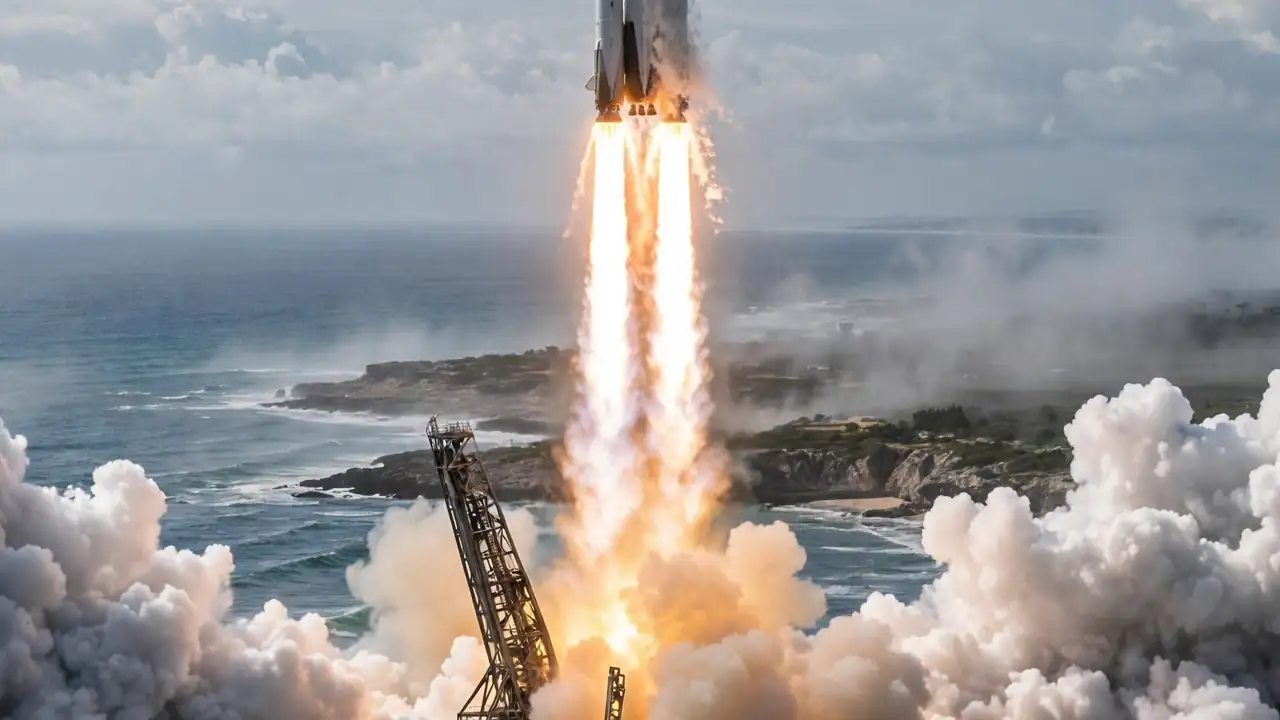
I want to start with the waste, because it explains the whole idea. For decades, rockets were like aeroplanes you threw away after one flight. You built a huge, expensive machine, flew it once, and let the first stage fall into the ocean. I used to accept that as normal, because that was all I had ever seen. Then someone asked me a simple question: would you throw away a jumbo jet after one flight from London to New York? Of course not. The jet is the expensive part. The fuel is cheap by comparison. Rockets were the same, but nobody had figured out how to get the jet back.
The first stage, the booster, is the biggest and most expensive part of a rocket like Falcon 9. It holds nine Merlin engines and most of the fuel, and it does the hard work of the first two and a half minutes, pushing the rocket through the thickest air and up to high speed. After that, its job is done, but it is still a perfectly good machine, falling back toward Earth at thousands of kilometres per hour. The old answer was to let it burn up or splash down. The new answer, the one SpaceX proved, is to fly it home and use it again.
The payoff is real. Public 2026 reporting notes that one Falcon 9 booster has now flown 37 times, which means 36 brand-new first stages that SpaceX never had to build. Think about that. One machine, 37 flights. That is why launch prices could fall and why rockets now fly several times a week instead of a few times a year. Reuse did not just save money. It changed how often we can go to space at all.
Step One: Separation and the Flip
I always watch this moment with my breath held. About two and a half minutes after liftoff, the booster’s engines shut down. This is called main engine cutoff. Then the second stage separates and lights its own engine to carry the payload toward orbit. The booster is now alone, still travelling very fast, and pointing the wrong way for landing. It has to turn around.
It does this with small thrusters, puffs of cold gas that nudge it over until it is flying engines-first, tail toward Earth. I love this image, because it feels backwards. A rocket normally flies nose-first. A landing booster flies tail-first, like a dart falling backwards. That is deliberate. The engines need to point down so they can slow the fall later, and the heat shield at the base needs to face the rushing air first during re-entry. The flip looks simple on video. In reality, it is a precise manoeuvre done while falling at supersonic speed.
Step Two: The Boostback Burn
Here is where the booster decides where it is going. If it is landing back near the launch site, it fires some of its engines in a boostback burn, cancelling its downrange speed and starting it back toward land. If it is landing on a droneship far out at sea, it may skip a long boostback and aim for the ship instead, because the ship is waiting downrange where the booster was already heading. Either way, the computer is now flying the booster to a target, not just letting it fall.
I find it helpful to think of the booster as a falling building that can steer. It has no wings, but it has a guidance computer, GPS, and small thrusters, and it knows exactly where its landing pad is. The boostback burn is short, just enough to change the trajectory from a long arc into the ocean to a controlled arc back to the target. If this burn fails, there is no landing. That is why SpaceX watches it so closely, and why a failed boostback usually means the booster is lost at sea.
Step Three: Falling Through Fire, Steered by Grid Fins
This is my favourite part, because it looks like magic and it is really just clever metal. As the booster falls back into thicker air, it heats up from friction, just like a meteor. To survive, it fires a short re-entry burn, using three engines to slow down and push a cushion of gas ahead of it, which keeps the worst heat away from the body. Then it deploys its grid fins, four panels near the top that look like waffle irons.
Grid fins are the steering wheel of the falling booster. They tilt in the supersonic airflow and nudge the whole 14-storey machine left, right, and around, the way ailerons steer an aeroplane. They work at speeds where normal fins would melt or snap, because their grid shape lets air flow through them instead of piling up against a flat surface. Public flight reporting describes them steering the booster all the way down through the atmosphere, making tiny corrections again and again until the landing pad is directly below. I have watched landing videos frame by frame, and you can see those fins moving. It is the booster thinking with its hands.
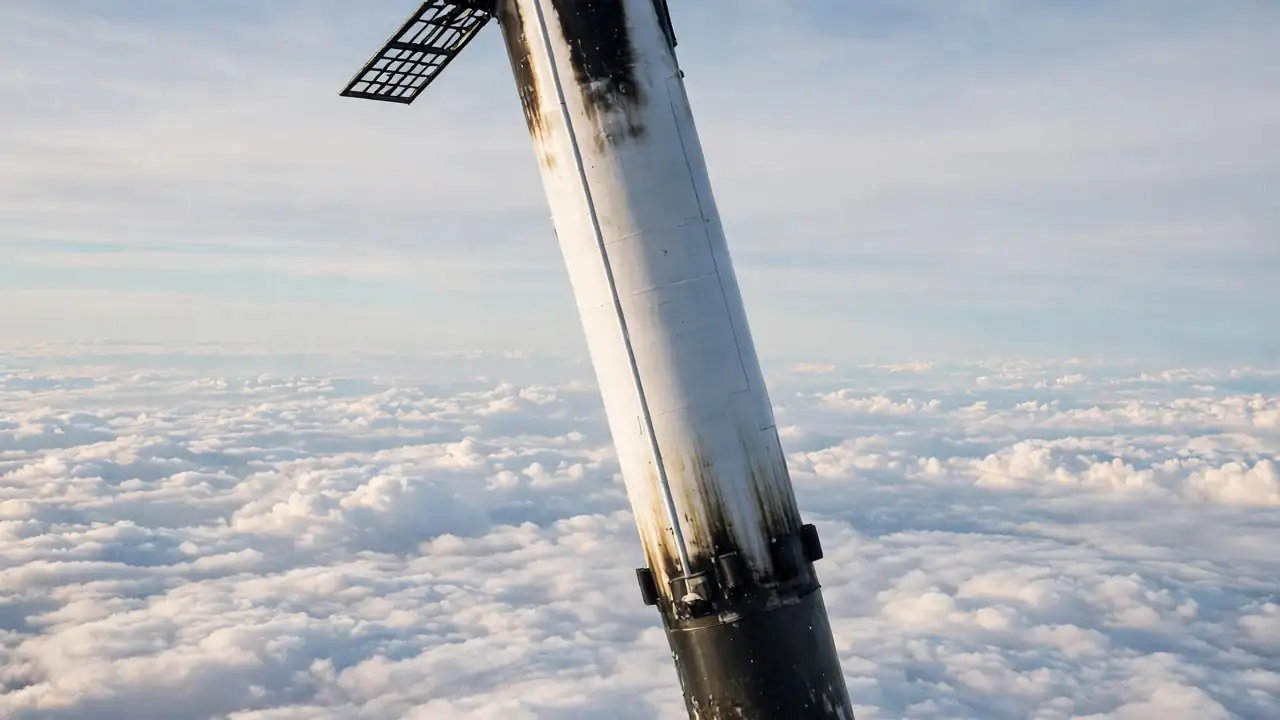
There is a second, quieter job happening here too. The booster is falling engines-first, so its base takes the heat, and its body is built to handle it. It is not comfortable. It is violent, loud, and hot. But it is controlled violence, measured by sensors hundreds of times per second, with the computer adjusting the fins constantly. When people ask me why rockets did not land themselves sooner, this is my answer: we needed computers fast enough, fins strong enough, and engines that could restart reliably in mid-air. All three arrived together.
Step Four: The Hoverslam, or Why It Cannot Hover
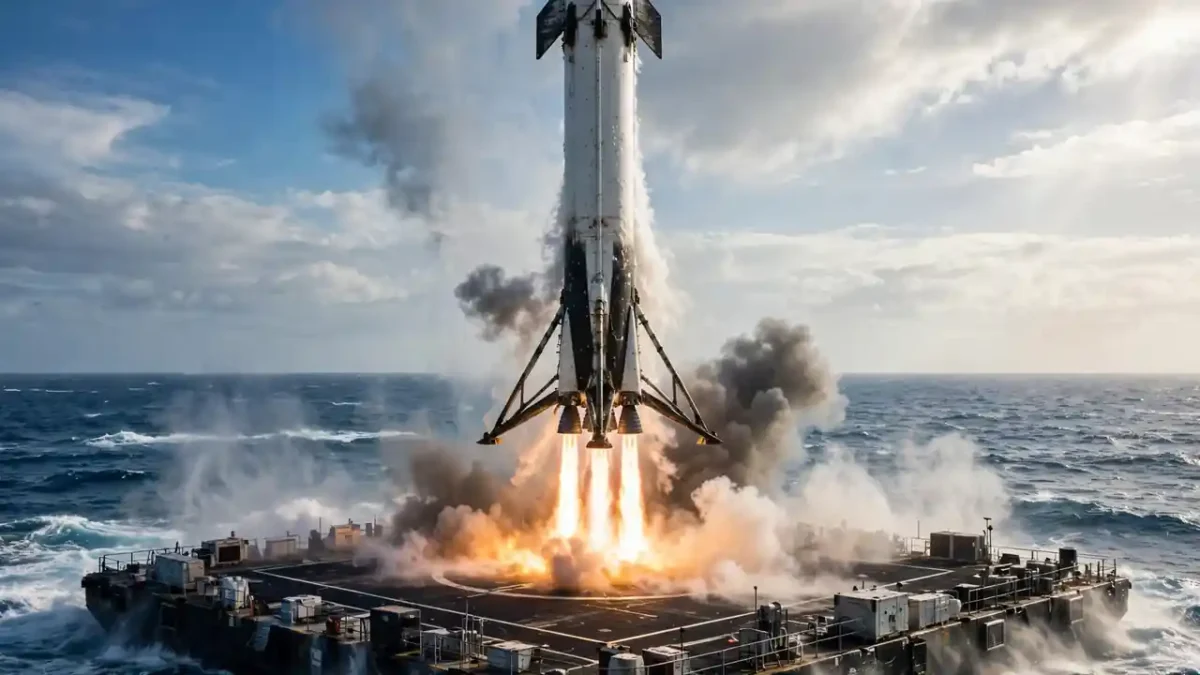
Now we reach the moment that made me gasp the first time. In the last minute, the booster is still falling fast, and it has to reach zero speed at exactly the moment its legs touch the ground. Here is the problem: even one Merlin engine at its lowest throttle pushes harder than the nearly empty booster weighs. That means the booster cannot hover. If it lights the engine too early, it will climb back up. If it lights it too late, it will crash. So the computer waits until the last possible moment and lights the engine so that speed hits zero exactly at touchdown. Engineers call this a hoverslam, or suicide burn, because the timing has to be perfect.
Let me say that again, because it is the heart of the whole trick. The booster does not gently descend like a helicopter. It falls, and falls, and falls, and then at the last second it fires and stops, right on the pad. The first time this worked on an orbital rocket was in December 2015, and now it happens multiple times a week. I still hold my breath every time, even though I know the maths. That last second is where all the earlier steps either pay off or fail.
Just before touchdown, four landing legs unfold from the base. They are folded flat against the body during flight, and they swing out in the final seconds, like a spider landing on its feet. The booster touches down, the engines shut off, and it stands there, scorched and steaming, on a concrete pad or a ship deck. The crowd cheers. I cheer too, every single time, because I have seen how many things had to go right.
Landing on a Ship in the Middle of the Ocean
I get asked about droneships a lot, so let me explain them plainly. A droneship is a big, flat, autonomous barge with a landing pad painted on it, stationed in the ocean downrange of the launch site. It has no crew on board during landing, for safety. It holds its position with thrusters against waves and wind, and the booster aims for it the same way it aims for a land pad. The names are a joke SpaceX fans love: Just Read the Instructions, Of Course I Still Love You, and A Shortfall of Gravitas.
Why land at sea at all? Because some missions need so much speed that the booster cannot afford the fuel to fly all the way back to land. Landing downrange on a ship saves fuel, and that fuel can go to the payload instead. The trade-off is that the ship has to sail the booster back to port, which takes days. Land landings are faster to turn around, but sea landings let heavier missions still be reused. SpaceX uses both, choosing per mission, and that flexibility is part of why reuse works so well.
The ship landing is also harder. The pad is moving, even slightly, with the waves. The wind is stronger at sea. There is no room for error, because the deck is small and the ocean is everywhere else. And yet, it works, again and again. When I watch a droneship landing, I remind myself that the booster is aiming at a moving target the size of a football field, from space, while falling. That is not luck. That is guidance.
Starship and the Tower Catch: No Legs at All
Now let me tell you about the next step, because it is even wilder. SpaceX’s giant Starship booster, called Super Heavy, is about 71 metres tall, roughly a 20-storey building, and it has no landing legs. Instead, it flies back to its launch tower, and the tower catches it with two giant mechanical arms, nicknamed chopsticks. The booster hovers beside the tower, the arms close around it just below its grid fins, and the engines shut down. The booster hangs on the tower, ready to be stacked again.
Why skip legs? Because legs strong enough to hold Super Heavy would add tens of tons to every flight, and that weight would have to be carried all the way to space and back. The tower already stands on the ground, so the heavy catching gear can stay there instead of flying. The first successful catch happened on Flight 5, on 13 October 2024, and reporting on the catch system explains that thousands of vehicle and pad criteria had to pass before the attempt, with a human flight director giving a manual go. If the checks fail, the booster diverts to a soft splashdown in the Gulf instead, which is exactly what happened on Flight 6.
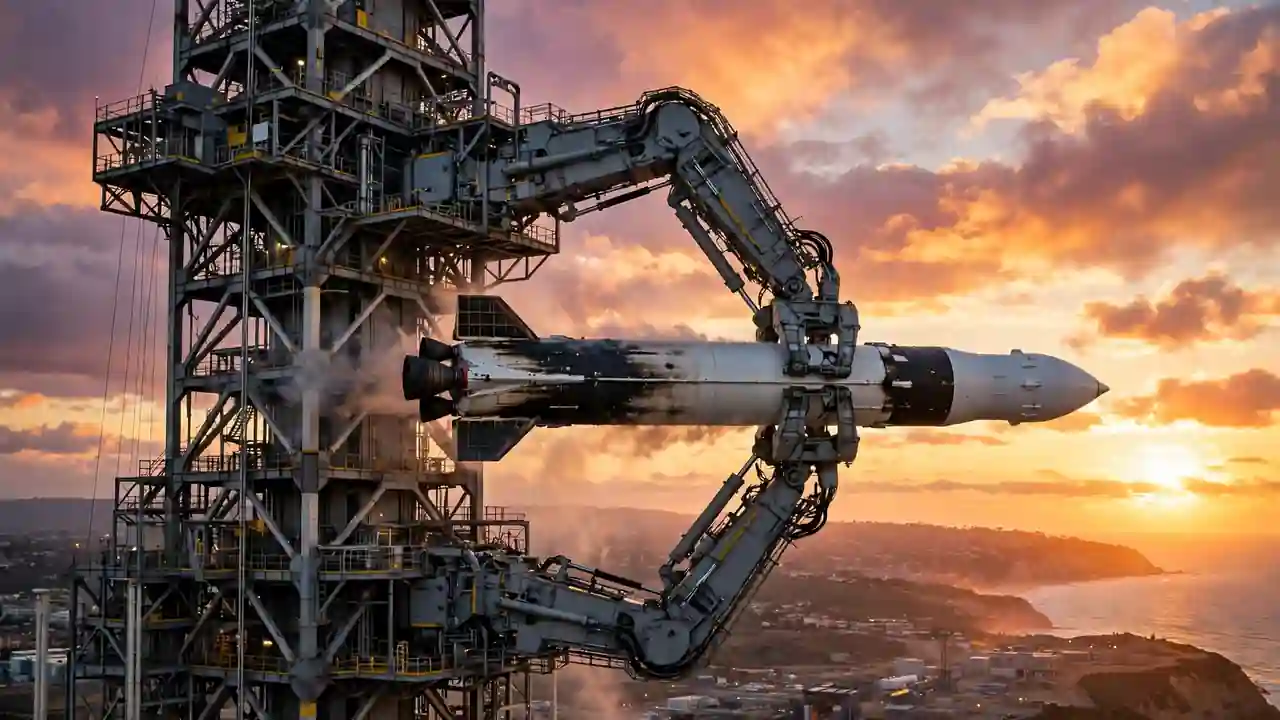
By 2026, coverage of the Starship programme notes that Super Heavy has been caught at the tower three times, on Flights 5, 7, and 8, while the Starship upper stage has not yet been caught. The May 2026 Starship V3 update described three larger grid fins instead of four, with a new catch point, and shorter, faster chopsticks switching to electromechanical actuators. I am telling you this detail because it shows the system is still evolving. The tower catch is not a finished trick. It is a live engineering project, improving flight by flight.
For a clear summary of the whole reusable sequence, this 2026 explainer on reusable rocket technology walks through the boostback, re-entry, and landing burns in the same order I have used here, and notes Blue Origin’s New Glenn beginning first-stage recovery too. The club of reusable rockets is growing, and that competition will make landings even more routine in the years ahead.
What Happens After the Landing
I love this part, because it is gloriously unglamorous. After a land landing, ground crews safe the booster, check it over, and fold or remove parts as needed. After a sea landing, the droneship sails home, a crane lifts the booster off, and it goes to a hangar for inspection. Engineers replace anything worn, test the engines, and stack the booster for its next flight. Some boosters have flown dozens of times with only routine work between flights. That is the whole point: the rocket is not a firework. It is a vehicle.
Not every landing succeeds, and I want to be honest about that. Boosters have tipped over, missed, and broken apart, especially in the early years and in rough sea conditions. Each failure taught SpaceX something, and the success rate climbed because of those lessons, not in spite of them. If you watch enough landings, you will eventually see a failure, and that is normal for a system pushing this hard. The story of reusable rockets is a story of learning in public, with explosions included.
If you enjoy following big engineering stories, my space reading also includes NASA’s Europa Clipper mission, which uses a very different kind of clever flying, borrowing speed from planets instead of landing on them, to reach Jupiter’s icy moon.
Frequently Asked Questions
Why does the booster land tail-first?
Because its engines need to point down to slow the fall, and its base is built to take the heat of re-entry. Flying engines-first also lets the landing burn work in the direction of travel, which is the only way to cancel the fall.
What are grid fins?
They are four waffle-like panels near the top of the booster that tilt in supersonic airflow to steer it during descent. Their grid shape works at speeds where normal fins would fail, and they guide the booster to its landing pad.
Why can’t the rocket just hover down gently?
Because even one engine at minimum throttle pushes harder than the nearly empty booster weighs. It cannot hover, so the computer times the final burn so speed reaches zero exactly at touchdown. That is the hoverslam.
What is a droneship?
It is an autonomous barge with a landing pad, stationed at sea downrange of the launch site. It lets boosters land on missions that cannot afford the fuel to return to land, and it sails the recovered booster back to port.
How is Starship’s landing different from Falcon 9’s?
Super Heavy has no landing legs. It flies back to its launch tower and is caught mid-air by mechanical arms, called chopsticks. The heavy catching gear stays on the ground, so the booster does not have to carry it.
How many times can a Falcon 9 booster fly?
Public 2026 reporting notes one booster has flown 37 times. The exact limit keeps growing as SpaceX inspects and reuses boosters, and each flight teaches engineers more about what wears out and what does not.
What happens if a landing fails?
The booster is usually lost, either crashing on land or at sea, or tipping over after touchdown. The payload, which separated earlier, is normally unaffected, because the landing happens after the second stage has already taken over.
Final Thoughts
I started this guide on my sofa, laughing because a rocket had just landed the wrong way up, and I am ending it with a calmer kind of amazement. A self-landing rocket is not one trick. It is a chain of tricks: a flip, a burn home, a fiery fall steered by waffle fins, and a final burn timed to the last second. Miss one link and the chain breaks. Get them all right and a 14-storey machine stands on a ship like it belongs there. You now know what to watch for, so the next landing will feel different. You will see the fins move, you will feel the hoverslam coming, and you will cheer with understanding, not just surprise. Tell me in the comments which landing you watched first, and whether you believed your eyes either.
React to this story