Key Points
Key Points
- A black hole is a region where gravity is so strong that nothing escapes past the event horizon, not even light.
- The event horizon is a point-of-no-return boundary, not a solid surface.
- Stellar black holes form when very big stars collapse; our Sun is too small to become one.
- Sagittarius A*, at the Milky Way's centre, holds about 4 million Suns' worth of mass.
- The Event Horizon Telescope imaged M87* in 2019 and Sagittarius A* in 2022.
- Spaghettification is the tidal stretching felt by anything falling too close.
On This Page
- What You Will Learn
- The Simple Picture I Wish Someone Had Given Me
- Subscribe to CAAW News
- What the Event Horizon Really Is
- How a Black Hole Is Born
- Three Sizes, From Small to Monstrous
- What Happens If Something Falls Too Close
- How We Photographed Something Invisible
- Frequently Asked Questions
- Can a black hole suck in the Earth?
- What is the event horizon in simple words?
- What is inside a black hole?
- How do we know black holes are real if we cannot see them?
- What is spaghettification?
- Could a human survive falling into a black hole?
- Will the Sun become a black hole?
- Final Thoughts
- React to this story
I first heard about black holes when I was a child, and I pictured a giant vacuum cleaner in space, sucking up stars. I worried about it at night. I am not a physicist, but I have spent years reading NASA explainers and following real astronomy news, and I can tell you plainly: that picture is wrong, and the real story is calmer and stranger. In this guide I will explain what a black hole is in simple words, why light cannot escape it, and what we have actually photographed. If space scares you a little, or confuses you a lot, this guide is for you. Keep reading, and the fear will shrink as the wonder grows.
Trust nudge: I am explaining published science here, not inventing it. The key facts below come from NASA explainers and Event Horizon Telescope reporting that I checked during my research, and where scientists are still unsure, I say so instead of pretending we know.
What You Will Learn
- What a black hole is, in one simple picture you can keep
- What the event horizon really means, and why it is a point of no return
- How black holes are born when big stars die
- The three sizes of black holes, from small to supermassive
- What happens if something falls too close, including spaghettification
- How we photographed black holes we cannot see directly
- Why the black hole at our galaxy’s centre is not a danger to Earth
- Answers to the questions I hear most
The Simple Picture I Wish Someone Had Given Me
I remember the night my teacher drew a trampoline on the board. She put a heavy ball in the middle, and the sheet dipped down. Then she rolled a small marble past it, and the marble curved. That was my first real picture of gravity, and I still use it today. A black hole is what happens when that dip becomes so deep and so steep that nothing can climb back out. It is not a hole in the ground. It is a place where gravity has won completely.
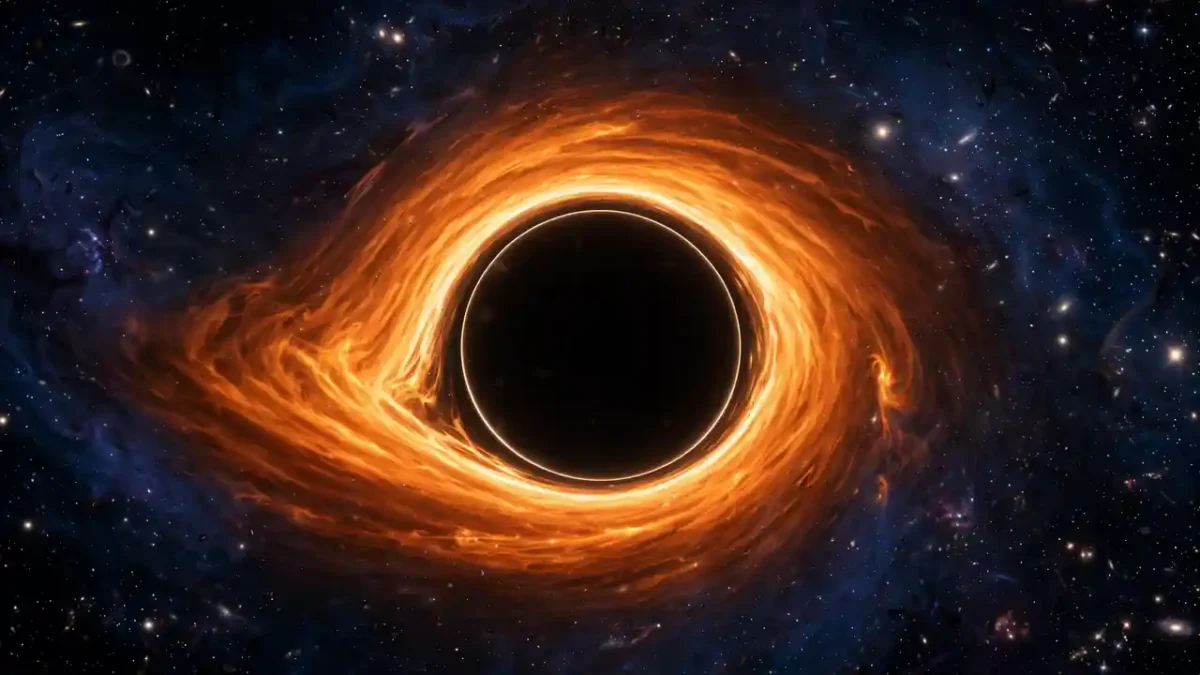
NASA explains a black hole as a region of space where gravity is so strong that nothing can escape from inside a boundary called the event horizon, not even light. That is the whole secret in one sentence. Light is the fastest thing we know. If light cannot escape, then nothing else can either. The black hole itself gives off no light, so we cannot photograph it the way we photograph the Moon. Instead, we study what it does to everything around it, and that turns out to be plenty.
Here is the part that calmed my childhood fear. A black hole does not reach across space and grab things like a vacuum cleaner. Its gravity works like any other gravity. Far away, it pulls just like a star of the same mass would pull. The danger only becomes extreme when you get very, very close. If our Sun were replaced by a black hole of the same mass, Earth would keep orbiting in the dark, but it would not be sucked in. That single fact changed how I think about these objects, and I hope it changes how you think about them too.
What the Event Horizon Really Is
I used to imagine the event horizon as a solid wall, like the surface of a planet. It is not. NASA describes it as a boundary, a point of no return, not a physical surface you could stand on. Think of it like the edge of a waterfall in a river. Upstream, you can still swim back. Past a certain line, the current is stronger than you, and every path leads downstream. The event horizon is that line in space.
Inside that boundary, the escape speed is faster than light. Escape speed is the speed you would need to break free from gravity. On Earth, a rocket needs about 11 kilometres per second to escape. For a black hole, inside the horizon, the needed speed is more than light speed, and nothing can go that fast. So nothing gets out. Not a rocket. Not a message. Not light itself. That is why the inside looks black to us.
Scientists also talk about the singularity at the centre, where theory says matter is crushed to extreme density. I want to be honest with you here. Nobody has seen a singularity. General relativity, Einstein’s theory of gravity, predicts it, but NASA itself describes that prediction carefully, because it may mean the theory breaks down under such extreme conditions. The honest answer is that we do not fully know what happens at the very centre. I find that exciting rather than disappointing. It means there is still a real mystery left for the next generation.
How a Black Hole Is Born
I love this part, because it starts with something familiar: a star. Stars shine because they are burning fuel in their cores, and that burning pushes outward while gravity pulls inward. For most of a star’s life, those two forces balance. But big stars run out of fuel. When the outward push stops, gravity wins, and the core collapses in on itself. If the collapsing core is heavy enough, it squeezes past the point where anything can hold it up, and a black hole is born.
Smaller stars do not make black holes. Our Sun, for example, will end its life as a white dwarf, a dense but calm leftover star, not a black hole. You need a much bigger star to start with. The collapse is violent, and it often comes with a supernova, a huge explosion that throws the star’s outer layers into space. What is left behind, if it is heavy enough, is the black hole. The star is gone as a shining thing, but its mass is still there, packed into a tiny region, pulling with all its old gravity.
There is another way black holes can grow. They can eat gas and stars that wander too close, and they can merge with other black holes. When two black holes merge, they send ripples through space itself, called gravitational waves. We have detected those ripples on Earth with instruments called LIGO and Virgo, and that is one more way we know black holes are real. We do not only see their effects on light. We feel their mergers in the fabric of space.
Three Sizes, From Small to Monstrous
I find it helps to sort black holes into three sizes, like small, medium, and giant. The smallest kind is the stellar black hole, made when a big star collapses. These are typically a few times the mass of our Sun, packed into a region only a few tens of kilometres across. Imagine the mass of several Suns squeezed into a city. That is how dense we are talking about. NASA’s Imagine the Universe pages note that to make a black hole from our Sun, you would have to squeeze it into a ball only about 3 kilometres in radius. That picture always stops me in my tracks.
The middle kind is the intermediate black hole, heavier than stellar ones but lighter than giants. Scientists are still learning about these, and they are harder to confirm. The giant kind is the supermassive black hole, millions or billions of times the mass of the Sun, sitting at the centre of most large galaxies. Our own galaxy, the Milky Way, has one called Sagittarius A*, with about 4 million times the Sun’s mass, sitting roughly 27,000 light-years away. I checked that number twice, because it sounds like science fiction, but it is the measured value behind the famous image.
Here is the part that surprises most people I talk to. Supermassive black holes are not dense in the way you might expect. Because their event horizons are so huge, their average density can actually be lower than water. The monster is not a tiny, super-dense ball. It is a vast region of no return. Size changes the story, and that is why I always ask which kind of black hole someone means before I answer their questions.
What Happens If Something Falls Too Close
I will be honest: this is the scary part, and it is also the most fascinating. NASA explains that as an object approaches a black hole, the side closer to it feels a stronger pull than the side farther away. That difference grows as the object gets closer, and it stretches the object out into a long, thin shape. Scientists call this spaghettification, a name first made famous by Stephen Hawking in his book A Brief History of Time. The object is stretched like spaghetti. It is not a joke name for a joke effect. It is a real tidal force, the same kind of force that makes ocean tides on Earth, pushed to an extreme.
At the same time, gas falling toward a black hole does not drop straight in. It spirals around, forming a hot, glowing disc called an accretion disc. That disc can get so hot that it shines in X-rays, and it is often what telescopes actually see. Some black holes also launch narrow jets of particles outward from the region around them, powered by magnetic fields. Those jets do not come from inside the event horizon. Nothing comes from inside. They come from the swirling material outside it, and they can stretch for thousands of light-years.
Time itself also behaves strangely near a black hole. Gravity slows time, an effect called gravitational time dilation. To a faraway observer, a clock falling toward the horizon would seem to slow down and never quite cross it. To the falling clock itself, the crossing would feel normal. Both views are correct in Einstein’s theory, because time is not the same for everyone. I do not pretend to fully picture that, and I do not think you need to either. The key idea is simple: near a black hole, space and time are bent together, and our everyday common sense stops working.
How We Photographed Something Invisible
I remember exactly where I was when the first black hole image came out in 2019. I stared at a blurry orange ring on my phone and felt my chest tighten. That ring was the shadow of the black hole at the centre of galaxy M87, called M87*, imaged by the Event Horizon Telescope. The telescope is not one dish. It is a network of radio observatories across the planet, linked together to act like one Earth-sized telescope. The first M87* image was published on 10 April 2019, and it showed glowing gas bending around a dark centre.
Then, on 12 May 2022, the same collaboration unveiled the first image of Sagittarius A*, the black hole at the centre of our own Milky Way. It looked similar: a bright, slightly lumpy ring around a dark shadow. That second image was harder to make, because the gas around Sagittarius A* changes faster than the gas around M87*, so the team had to work harder to build a steady picture. Together, those two images did something no one had done before. They let us see the shadow of a black hole directly, and the size of each shadow matched what Einstein’s theory predicted.
That is why I trust this science. It is not one person’s idea. It is a prediction made a century ago, tested by star orbits, by gravitational waves, and now by direct images of two different black holes. If you want to keep following this story, my own space reading continues with NASA’s Europa Clipper mission, which shows the same careful, measured style of exploration applied to a very different mystery.
Frequently Asked Questions
Can a black hole suck in the Earth?
No. The black hole at our galaxy’s centre is about 27,000 light-years away, and Earth is in a stable orbit around the galaxy. A black hole pulls like any other mass at a distance, and it does not reach out and grab things far away.
What is the event horizon in simple words?
It is the point of no return around a black hole. Outside it, escape is still possible. Inside it, the escape speed is faster than light, so nothing, not even light, can get back out. It is a boundary, not a solid surface.
What is inside a black hole?
Theory predicts a singularity at the centre, where matter is crushed to extreme density, but no one has observed it, and scientists openly say our theories may break down there. What we know for sure is what happens outside: stars orbit, gas glows, and light bends.
How do we know black holes are real if we cannot see them?
We see their effects: stars orbiting an invisible mass, hot gas glowing as it falls in, gravitational waves from mergers, and now direct shadow images of M87* in 2019 and Sagittarius A* in 2022. Several independent kinds of evidence point to the same objects.
What is spaghettification?
It is the stretching caused by tidal forces near a black hole. The nearer side of an object is pulled much harder than the farther side, so the object is pulled into a long, thin shape, like spaghetti, as described by Stephen Hawking.
Could a human survive falling into a black hole?
No. The tidal forces would tear a person apart long before the centre, and nothing can return past the event horizon to tell the story. This is why all real black hole science is done from a safe distance, with telescopes.
Will the Sun become a black hole?
No. The Sun is far too small. It will end its life as a white dwarf, not a black hole. Only much heavier stars collapse into black holes.
Final Thoughts
I started this guide as a frightened child picturing a vacuum cleaner in space, and I am ending it as an adult who feels wonder instead of fear. A black hole is not out to get us. It is a place where gravity, the same force that holds your feet to the ground, has been pushed to its absolute limit, and where light itself cannot climb out. We have photographed two of them. We have felt their mergers ripple through space. And we still do not know what sits at their very centre, which means the story is not finished. You did it: you now understand the basics better than most adults I meet. Tell me in the comments what still puzzles you about black holes, because your question might be the next guide I write.
React to this story