Key Points
Key Points
- My honest, complete 2026 Rubi Block guide: free daily phone mining, no signup bonus, no verified price or listing, Mana, KYC and the capped October 2026 migration, the live theft warning, and the PiBase pilot — an A-to-Z system.
On This Page
- Subscribe to CAAW News
- Today in Rubi Block: 27 October 2026 — read this box first
- What Rubi Block actually is
- The honest headline: no bonus, no listing, no price — yet
- Step by step: starting Rubi Block the safe way
- How mining actually works, and what it pays in 2026
- Mana: the second earning system most guides skip
- KYC and migration: the real withdrawal path, with real caps
- PiBase staking pilot: proposed rates, not guaranteed income
- Peer-to-peer trading and the theft warning
- The free-coins hunting checklist
- My honest verdict
- Frequently asked questions
- Is Rubi Block legit?
- What is one Rubi Block worth in October 2026?
- Can I withdraw or sell my mined Rubi today?
- Is there a Rubi Block signup bonus with code EARNCONTINUE?
- How much can I mine per day?
- What is Mana, and is it different from RBL?
- What does Rubi KYC cost?
- When will Rubi Block launch on an exchange or mainnet?
- How do I keep my Rubi account safe in October 2026?
- React to this story
Every guide in this series so far has started with an exchange welcome pack: a signup bonus, a deposit reward, a first-trade reward. Rubi Block breaks that pattern completely, and in a different way from Pi Network. Rubi Block is not an exchange at all. There is no signup cash, no deposit bonus and no trade reward to claim, because you deposit nothing and trade nothing to join.
What Rubi Block does offer is free: a phone app that lets you mine its own digital asset by tapping once a day, a social network where your interactions can earn a second commodity called Mana, and a referral system that raises your mining speed. The catch, which most Rubi articles skip, is that the mined asset has no verified market price, there is no confirmed exchange listing and no confirmed mainnet launch date, and moving your mined balance on-chain is currently capped at a few coins per transaction. On top of that, October 2026 has brought a live phishing and theft wave that has already cost miners tens of thousands of coins. This guide covers all of it honestly: what you actually get, how to start safely, how mining and Mana really work, how KYC and migration work today, and the scams to avoid.
Today in Rubi Block: 27 October 2026 — read this box first
Before you install anything, here is the live position on 27 October 2026, taken from Rubi’s own announcements on rubi.click.
First, email and password login is suspended. From 15:00 on 21 October 2026 until the expected end of December 2026, you cannot sign in with an email and password. Google login and Apple iCloud login are ready as alternatives, and a Meta ID login is listed as coming soon. If you already have an account tied to email login, plan around this before you need urgent access.
Second, migration is capped. Migration is the process of moving mined Rubi from the app to an on-chain wallet, and it is the only real withdrawal path. Phase 1, from 30 September to 14 October 2026, allowed a maximum of two migration transactions per day per account, at a maximum of three coins each. The planned Phase 2 expansion, from 15 to 29 October, which would have raised the cap to 1% of your available mined balance and up to ten coins per transaction, was cancelled. A planned face-verification rollout from 30 October has been postponed by at least two weeks. So today, migration stays at the small Phase 1-style caps.
Third, there is an active theft wave. In an official article dated 10 October 2026, Rubi reported around 14,400 thief transactions and around 78,000 coins stolen between 30 September and 10 October 2026, with the wave still ongoing at the time of writing. Thieves reuse previously phished login credentials and move coins within seconds using bots. Rubi has published thief wallet addresses and says buyer accounts with three or more transactions with thief wallets will be flagged. Never reuse a password, never enter your login on a strange site or app, and never pay anyone outside the app for KYC or migration.
Fourth, there is no live Rubi airdrop, quiz, quest campaign or launchpool on 27 October 2026 that I could verify on Rubi’s official site. Mining itself is sometimes loosely called an airdrop by promoters. It is not a separate airdrop, and I have not published a separate airdrop post for Rubi on that basis. If a genuine live campaign appears, it will be covered separately with its real terms.
What Rubi Block actually is
Rubi Block is the digital asset of Rubi Network, a free mobile project that calls itself a socialchain. The idea is simple: instead of mining with expensive hardware, you mine by interacting with an app every day. The project’s own description on Google Play says the app is a social networking platform that applies blockchain rules so users can increase their income by interacting with the Rubi Socialchain, and that owning Rubi Block is like owning a stake in that social network.
The Android app is published by NEMO-team, under the package name com.nemoholding.android.rubi, and it has been on Google Play since May 2022. AppBrain’s snapshot, updated 20 October 2026, shows 4.07 stars from 34,804 ratings and 5.7 million installs, with no ads in the app. Rubi’s own team puts the figure at around 5.2 million miner accounts in an October 2026 article. Those two numbers measure different things, installs versus accounts, so do not treat them as the same figure. The app is free to download and free to mine, and it is available on both Android and iOS. There is no desktop version.
One naming warning matters before you search for anything else. Rubi’s official site calls the mined asset RBL, the native asset of RUBI, while most third-party guides call it RUBI. I use RBL in this guide, and RUBI in a few places where a quoted claim uses that name, but they mean the same Rubi Network asset. Do not confuse it with three unrelated namesakes: Rubicon, a separate DeFi project also using the RUBI ticker; Rubico Inc, a US stock with the ticker RUBI; and various Ruby tokens. Any price, listing or market-cap figure you find for RUBI on a price tracker almost certainly belongs to Rubicon, not to Rubi Network. That confusion is behind a lot of the false Rubi prices circulating online.
The honest headline: no bonus, no listing, no price — yet
Let me answer the questions every reader asks first, plainly.
Is there a Rubi Block signup bonus? No verified one. There is no cash bonus, no deposit reward and no first-trade reward, because Rubi Block is not an exchange. You deposit nothing, so there is nothing to match.
Does a referral code give you a bonus? Not one I can verify for any specific code, including mine. Third-party guides report that using a referral code connects you to the referrer’s circle and may raise mining speed, and one guide mentions starting Mana for some codes, but no source verifies a specific bonus for my code. I will not promise you one. What my code does, certainly, is let you join through my link, which is how this series is supported, and it connects your account to my referral circle.
Join Rubi Block here — referral code EARNCONTINUE
My referral code is EARNCONTINUE, and it is in the link above: https://rubi.click/join/EARNCONTINUE. Open that link, install the official Rubi app from the official store listing it leads you to, and enter EARNCONTINUE when the app asks for a referral or invitation code. Do not install the app from a link sent to you on social media, and do not install a copy with a slightly different name.
Is Rubi Block listed on an exchange? No, not on any verified exchange as of 27 October 2026. One exchange’s academy page stated plainly in February 2026 that Rubi coin was not available on its platform, and no reliable evidence of a fresh listing has appeared since. Rubi’s own conditions for a listing, given in an official AMA, are a large enough miner and holder base for decentralisation, a mainnet stable for at least twelve months, and a proven application for the asset. If a listing proves difficult, Rubi says peer-to-peer trading, bridges or wrapped assets are the fallback. None of that is a listing date, and I will not invent one.
What is one Rubi Block worth? There is no verified market price. The founder’s own article on rubi.click estimates around $2 per block, based on an argument about the value of online interactions, and that figure is the project’s own estimate, not a traded price. Third-party guides quote $3 to $4 from unofficial peer-to-peer chatter, and an old 2023 article republished on the site contains a $6 figure derived from an AI-assisted argument, not a valuation. An independent review retested on 15 October 2026 puts it bluntly: RUBI does not have any monetary value yet, and there is no launch date. Treat every dollar figure you see for Rubi Network as a claim or a peer-to-peer asking price, never as a market price.
That is the honest offer in one paragraph. Rubi Block costs nothing but a daily tap and your patience, it may one day be worth something, and today it is unproven. Mine it only with time you can afford to lose, and only through the official app and site.
Step by step: starting Rubi Block the safe way
Do this in order, and do not skip the login warning.
First, open my link on your phone: https://rubi.click/join/EARNCONTINUE. Install the official Rubi app from the official store listing. The Android publisher is NEMO-team. If a store listing shows a different publisher, stop.
Second, create your account. Because email and password login is suspended from 21 October 2026 until the expected end of December 2026, use Google login or Apple iCloud login, whichever you already use and can keep long term. Enter the referral code EARNCONTINUE when asked. Use an account you control and will not lose, because losing access to the login behind a mining account is how people lose years of taps.
Third, set a password you have never used anywhere else, and turn on every security option the app offers. This matters more than usual right now. The October theft wave works by reusing credentials phished earlier, so a unique password is your main defence. Never enter your Rubi login on a website, bot or app that claims to check, boost or verify your account. Rubi’s own team will never ask for your password or private key that way.
Fourth, tap the Mine button to start your first 24-hour mining session. You do not need to keep the app open. When the session expires after 24 hours, tap again. Miss a day and you earn nothing that day. Set a daily reminder at the same time, because consistency is the entire game here, exactly as it is with my Pi Network guide.
Fifth, the app will ask you to pick a mining pool. Be honest with yourself here: the app does a poor job of explaining what the pools mean, and independent testers in both January and October 2026 reported the same confusion. Pick one, note which one you picked, and do not pay anyone to pick a better pool for you. No pool choice sold outside the app is legitimate.
Sixth, build your circle slowly, with real people. I explain referrals and the security circle below. Do not buy followers, do not join mining teams that ask for your login, and do not pay for referrals. Paid referrals are how fake accounts get attached to real ones, and fake activity is exactly what verification is designed to filter out.
If you already use exchanges, my Binance guide, my OKX guide, my Bybit guide and my Bitget guide all cover listed coins, which is a different world from Rubi’s unlisted, app-only stage. My shorter Pi Network mining post covers the mining basics in brief; Rubi is the closest cousin to Pi in this series, and the comparison is useful throughout this guide.
How mining actually works, and what it pays in 2026
The mechanics are simple, and that simplicity is the point. You open the app, tap the Mine button, and a 24-hour session starts. Your phone performs no heavy calculations, uses no extra battery beyond opening the app, and needs no special equipment. What you are really doing is checking in once a day to confirm you are an active, real person in the network, and the network rewards that participation with RBL. Think of it less like digging for gold and more like a daily check-in that happens to pay in a digital asset.
Your rate is not fixed. Rubi uses a halving model, but unlike Bitcoin, the halvings are driven by how many users have joined, not by block height. As the user base passes milestones, the daily reward falls. Third-party guides agree on the shape of that curve but conflict on the early numbers: one set of guides says early adopters earned up to 10 RBL per day, falling to 0.625 RBL per day after the network passed one million users, while another guide reports 1.25 RBL per day early and the same 0.625 step. Treat both as historical third-party claims, not official current figures.
Here is the important honesty point. The current daily mining rate in October 2026 sits behind the app login, and no official October 2026 source states it. I will not print a current rate in this guide, because any number I gave you would be a guess dressed up as a fact. Check the rate shown in your own app, and be suspicious of any article that quotes you a precise October rate without showing where it came from. At the historical 0.625 RBL per day step, a miner tapping every day would accumulate around 19 RBL in a month, but that is arithmetic on an old reported step, not a promise about today’s rate.
Boosters are where your choices matter, within limits. Guides widely report a mining speed boost of 10% per referral, and one guide reports a cap of 1,000 referrals per user, but that cap comes from a single source and I have not verified it. Inviting trusted users into a security circle is also reported to raise your speed, but the amount is unverified. My advice is practical, not mathematical: invite people you genuinely know, who will actually tap every day, because an inactive referral does not help you the way an active one does, and a circle of strangers is a security risk, not an asset.
Do not import the exchange sections of my other guides into Rubi. There is no spot trading, no futures trading, no grid trading, no launchpool and no learn-and-earn quiz system for Rubi Network that I could verify. Rubi’s earning system is mining, referrals, the security circle, social earning through Mana, and the PiBase pilot, which I cover next. Anyone selling you a Rubi futures strategy or grid bot is selling you something else.
Mana: the second earning system most guides skip
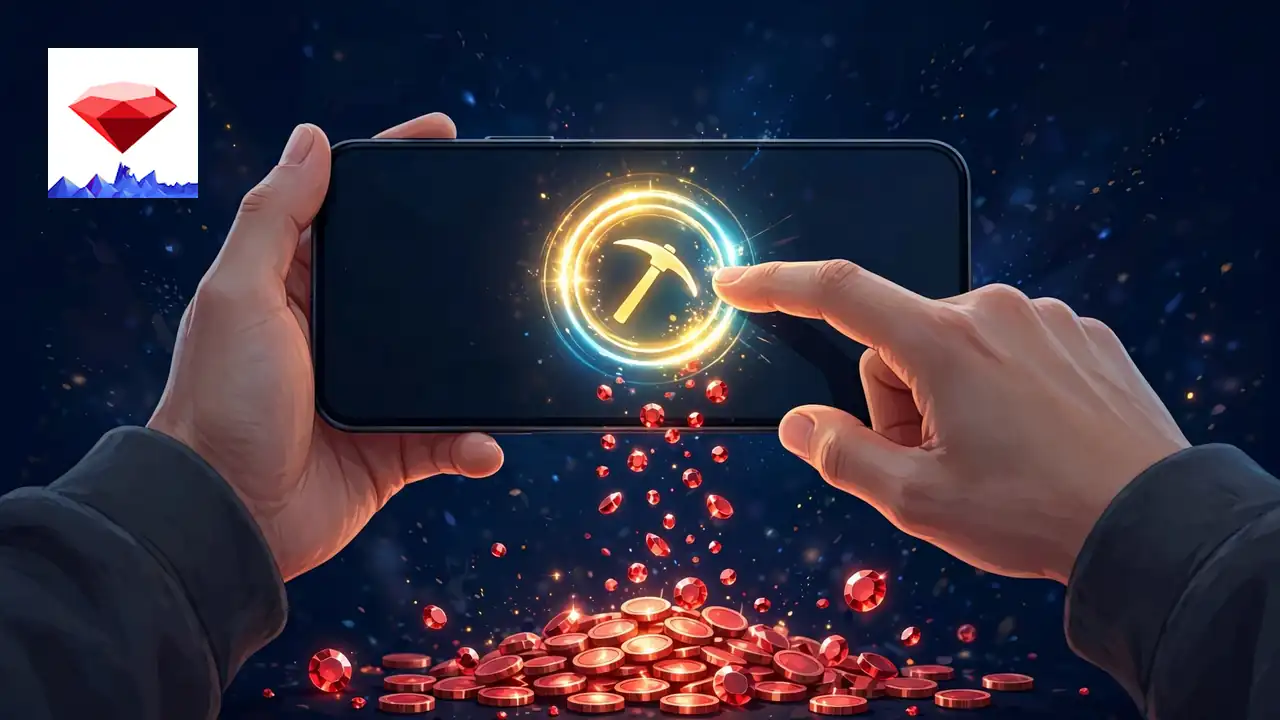
Mining RBL is only half of Rubi’s design. The other half is Mana, the commodity that comes from social interaction on the Rubi Socialchain, and most short reviews skip it entirely.
The idea is this. When you engage with content on the network, liking, sharing and commenting, that interaction crystallises into Mana. Creators who make content people engage with can earn from that engagement. The app’s own description puts it plainly: you can collect Mana from your interactions with other users’ content, and you can sell Mana on the free market for money, in the project’s own words.
Rubi’s official AMA in week three defines the Mana family precisely, and it is worth getting the terms right, because guides use them loosely. MnF is created at a rate of 1 RBL to 500 MnF, and it is used to place interaction requests. MnA is earned by completing those requests, at a one-to-one conversion from MnF, and it is transferable or usable as ecosystem credit. Star is accumulated from special or outstanding interactions, is funded by third-party partner programmes, and can, in Rubi’s own wording, be converted into fiat money. That Star-to-fiat claim is the project’s own claim, not an independently verified payout, and I present it as such.
You will also see the word Gems in some guides. Treat Gems as the same family under a looser name, not as a third confirmed currency alongside Mana and RBL. And be careful with the selling claim: can be sold on the free market is the project’s description of its design, not evidence of a liquid market paying cash today. Social earning is real as an activity, and unproven as income, in exactly the same way mining is.
KYC and migration: the real withdrawal path, with real caps
This is the section that decides whether Rubi is worth your time, so read it slowly.
First, the distinction Rubi itself makes. Verified Rubi can be moved to a wallet and recorded on-chain. Unverified Rubi cannot be moved. Verification exists to prevent fake supply, and it is the gate between app points and real coins. KYC is required before you can withdraw, it requires you to be 18 or older with a matching ID and selfie, and it costs mined RBL, not cash. That last point matters: never pay cash, crypto or a fee to a person or website for Rubi KYC. If someone asks, it is a scam.
Second, the fee and the gate are disputed, so I will not give you a single number. One guide says 30 days of consistent mining plus 30 RBL or 20,000 gems. Another says 30 to 40 RBL. One Play Store reviewer reports 2 RBL for KYC and flags it as a red flag. A dedicated KYC guide from November 2025 says payment is final and the number of attempts depends on the RBL spent. These cannot all be right for the same version of the app, and the exact fee and balance gate are shown in-app and vary by version. Check your own app, and never spend mined balance on KYC through any channel other than the app itself.
Third, migration itself. Migration is how mined RBL moves to an on-chain wallet, and in October 2026 it is tightly capped. Here is the official sequence.
Phase 1 ran from 30 September to 14 October 2026, at a maximum of two migration transactions per day per account, and a maximum of three RBL per transaction. That is at most six RBL per day, and only for accounts that qualified.
Phase 2 was planned for 15 to 29 October 2026, raising the cap to 1% of your available mined balance, up to ten RBL per transaction. It was cancelled in the 15 October system update, because theft damage had passed the first threshold of 100,000 RBL misappropriated. The same update suspended all RBL transfers, migration requests and KYC fee payments for a window on 15 October for the PANDORA protocol upgrade, and extended the suspension after a sync error on resuming.
Phase 3 was planned from 30 October 2026, with a face-verification rollout. It has been postponed by at least two weeks so engineers can work on tracing and marking tools for stolen coins. Face verification has therefore not launched on its original date, and Phase 2 limits do not apply today.
What does that mean in practice? Even if you have mined hundreds of RBL, you cannot move them all at once today. You move a few coins at a time, if you qualify, through the app’s own migration flow. Rubi also says that if theft damage had passed a second threshold of 200,000 RBL, the migration portal would close again. Whether that second threshold was crossed is not confirmed in the sources I read, so I will not claim the portal is closed. Check the app and rubi.click before you plan around a migration.
There is also a minimum-withdrawal trap in other articles. No single verified minimum withdrawal figure exists for Rubi. The operative limit in October 2026 is the migration cap, three RBL per transaction and two per day in Phase 1, not a published minimum. Do not quote a minimum withdrawal from a guide that does not show its source.
PiBase staking pilot: proposed rates, not guaranteed income
In June 2026 Rubi announced a partnership pilot called PiBase, and it is the closest thing Rubi has to a yield product. The terms were published as proposed rates, and Rubi explicitly says they may be adjusted, that PiBase is independent, that the announcement is not investment advice, and that returns are not guaranteed. I repeat those warnings because other articles drop them.
The proposed rates are: Flexible Earn around 3% per year; Fixed three months 4.5%; six months 5.0%; nine months 5.5%; and twelve months 6.0%. The pilot is backed by a 100,000 RBL operational reserve, of which the Rubi Foundation contributes 50,000 RBL for up to twelve months, with the on-chain memo hash published in the announcement. As of October 2026, no source I found confirms live payouts from this pilot. Present it in your own mind as a pilot with proposed rates, not as a live yield you can collect today, and never stake coins you cannot afford to have locked while a pilot is still proving itself.
Peer-to-peer trading and the theft warning
Peer-to-peer trading of migrated RBL exists, and guides report it, but it is unofficial and it is where the October theft wave bites. Sellers offer RBL in chat groups, video descriptions and messaging apps, often at prices far below the figures quoted in guides. Rubi’s October warning is explicit: merchants should not buy unusually cheap RBL from thieves, and buyer accounts with three or more transactions with thief wallets will be flagged.
My rule is simple. Do not buy RBL from a stranger on WhatsApp, Telegram or a video comment, do not sell your migrated RBL to a buyer who found you through a buy RUBI post, and do not treat a peer-to-peer price as the value of your coins. A price agreed between two strangers in a chat is not a market. It is an anecdote, and in October 2026 it may be a thief cashing out stolen coins. If you ever do trade peer-to-peer in future, when a legitimate market exists, use escrow, verify the counterparty, and accept that the risk is yours alone.
The same warning covers the wider scam pattern around Rubi. Ignore summit airdrop offers, KYC helper services, migration unlock sellers, and anyone who asks you to scan a wallet QR code or share a private key with a strange app. Rubi’s own warning names exactly that QR and private-key trick. Your private key is never needed by support, by a helper, or by a verification service. Anyone who asks for it is stealing from you.
The free-coins hunting checklist
Here is the complete system, in the order I would run it, for Rubi and for the free-earning habit generally.
One, tap every day. A missed day is a missed day’s mining, and no booster recovers it.
Two, invite real people only, through your own link, and help them tap daily. An active referral circle beats a large inactive one.
Three, build a security circle of people you genuinely trust, not strangers from a group.
Four, engage on the Socialchain itself. Likes, shares and comments are the Mana path, and content you create can earn engagement in return.
Five, complete KYC only inside the official app, only when your own app shows you qualify, and only with mined RBL. Never pay cash for it.
Six, migrate in small steps within the official caps, and never through a third party.
Seven, if you have not joined yet, start here: https://rubi.click/join/EARNCONTINUE with code EARNCONTINUE, then watch the official announcements on rubi.click before acting on any update you see on social media. The October sequence, theft warning, login suspension, cancelled Phase 2 and postponed face verification, all came from Rubi’s own site first.
Eight, keep the rest of your free-crypto hunting in listed, verifiable places while Rubi proves itself. My KuCoin guide, my Gate.io guide, my HTX guide, my Bitget Wallet guide and my Phantom Wallet guide all cover earning routes where the asset, the price and the withdrawal path are verifiable today. Rubi sits at the speculative end of that shelf, and that is fine, as long as you know which shelf you are on.
My honest verdict
Rubi Block is free, it takes under a minute a day, and it is built on an interesting idea: that your daily interactions have value, and that value should belong to you rather than only to platforms. The team takes no private reserve and mines like everyone else, according to its own site, and the socialchain plus Mana design is more thoughtful than a bare tap-to-earn clone.
Against that, the honest negatives are serious. There is no verified market price, no exchange listing, no confirmed mainnet date, and no launch date in the project’s own white paper. An independent review retested in October 2026 scored it 34 out of 100 and called it not worth the time, while another 2026 review called it high-risk and low-reward. Articles that said it would launch in 2025 were wrong. Team transparency is questioned by that same review, which reports unnatural-looking team photos and dead social links, and I present that as the reviewer’s finding, not as proven fraud. KYC costs mined tokens and is final. Migration is capped at a few coins per transaction. And a live theft wave is stealing coins from real miners right now.
My verdict is therefore narrow. Rubi Block is worth a daily tap if you understand it as a free lottery ticket on an unproven project, not as income, not as an investment, and not as money. It is not worth cash, it is not worth your password, it is not worth your private key, and it is not worth paying anyone for KYC, migration or a better pool. If you want free crypto with a verifiable cash-out today, use the listed guides above. If you want to bet a minute a day on Rubi’s idea, join through the official app, tap daily, keep your account secure, and wait for a real listing, a real mainnet date and real migration limits to prove the project before you believe any price claim about it.
Start Rubi Block free — code EARNCONTINUE
That link is https://rubi.click/join/EARNCONTINUE, and the code is EARNCONTINUE. Join only through the official app, keep your login unique and private, and treat everything in this guide’s warning sections as part of the deal, not as fine print.
Frequently asked questions
Is Rubi Block legit?
Rubi Block is a real, free app with millions of installs, real daily mining and real official announcements, and it costs no money to start. It is not proven as income: there is no verified market price, no exchange listing and no confirmed mainnet date, and an independent October 2026 review scored it 34 out of 100. Treat it as a real but unproven project, not as a scam verdict and not as a guaranteed earner.
What is one Rubi Block worth in October 2026?
There is no verified market price. The project’s own site estimates around $2 per block, third-party guides quote $3 to $4 from unofficial peer-to-peer chatter, and an old article contains a $6 figure from an AI-assisted argument. None of these is a traded price. Any price-tracker figure for RUBI almost certainly belongs to Rubicon, a different project.
Can I withdraw or sell my mined Rubi today?
Only in a limited way. Verified, KYC-passed users can migrate mined RBL to an on-chain wallet, but migration is capped, currently at Phase 1-style limits of a few coins per transaction, after the planned Phase 2 expansion was cancelled in October 2026. There is no verified exchange to sell on, and peer-to-peer selling is unofficial and risky, especially during the October theft wave.
Is there a Rubi Block signup bonus with code EARNCONTINUE?
No verified bonus. No source verifies a cash bonus or a specific benefit for EARNCONTINUE, and Rubi is not an exchange, so there is no deposit or trade reward. A referral code connects you to the referrer’s circle and is reported to raise mining speed, but the amount is unconfirmed. Do not join expecting a bonus.
How much can I mine per day?
The current October 2026 daily rate is not published by an official source and sits behind the app login, so I will not quote one. Historically, guides report up to 10 RBL per day for early adopters, falling to 0.625 RBL per day after one million users. Check the rate in your own app, and ignore articles that quote a precise current rate without a source.
What is Mana, and is it different from RBL?
Mana is Rubi’s second commodity, earned from social interaction on the Socialchain. RBL is the mined block asset. In the official AMA definitions, MnF is created at 1 RBL to 500 MnF to place interaction requests, MnA is earned by completing those requests, and Star comes from special interactions and is claimed by the project to be convertible to fiat through partner programmes. That conversion claim is the project’s own claim, not independently verified.
What does Rubi KYC cost?
KYC costs mined RBL, not cash, but the exact fee and balance gate are disputed across guides, with figures from 2 RBL to 30 or 40 RBL reported, and payment is described as final. Check the fee shown in your own app, complete KYC only inside the official app, and never pay a person or website for it.
When will Rubi Block launch on an exchange or mainnet?
No date is confirmed. Rubi’s own listing conditions are a large decentralised miner and holder base, a mainnet stable for at least twelve months, and a proven application for RBL. Articles that predicted a 2025 launch were wrong, and the white paper gives no date. A face-verification rollout planned from 30 October 2026 has been postponed by at least two weeks, and the migration expansion planned for mid-October was cancelled.
How do I keep my Rubi account safe in October 2026?
Use a password you have never used anywhere else, sign in with Google or Apple login while email and password login is suspended until the end of December 2026, never share your password or private key, never scan a wallet QR code in a strange app, never pay for KYC or migration outside the app, and never buy or sell RBL with strangers in chat groups during the theft wave.
Follow CAAW News for more free-crypto guides: Website https://caawnews.com, Facebook https://facebook.com/caawnews, Telegram https://t.me/caawnews, WhatsApp channel https://whatsapp.com/channel/0029Vb8vBqCCHDyoU4uecT18.
React to this story