
Key Points
Key Points
- Two to three strength sessions a week, with at least one rest day between sessions, is the beginner standard for adults over sixty.
- Start with one to two sets of eight to twelve repetitions using light resistance and slow, controlled movements.
- Build the routine around real-life patterns: sit-to-stand, pushing, pulling, hip hinging and carrying.
- Muscle effort is expected; sharp pain, one-sided pain or new numbness is a signal to stop and seek advice.
- Progress one small step at a time, and check with a health professional first if you have a heart condition, osteoporosis, a joint replacement or a balance condition.
- Strength training supports osteoporosis care with care: avoid loaded spinal flexion and high fall-risk exercises.
On This Page
- Subscribe to CAAW News
- Why Strength Matters More After Sixty, Not Less
- First, Check You Are Ready to Start Safely
- How Much Should a Beginner Over Sixty Actually Do?
- Your Simple Two-Day Home Routine
- How to Progress Without Hurting Yourself
- Strength Training With Osteoporosis, Arthritis, or a Joint Replacement
- What About Protein, Sleep, and Rest Days?
- The Mistakes I See Beginners Make Again and Again
- Your First Four Weeks, Week by Week
- Frequently Asked Questions
- Is it safe to start strength training at sixty or older?
- How heavy should I lift as a beginner over sixty?
- Can I still build muscle after sixty?
- Do I need a gym or a barbell?
- Is soreness after my first week normal?
- How often should I train?
- What if I miss a week?
- Will I get bulky?
- Final Thoughts
- React to this story
I turned sixty and noticed something I did not want to admit. The shopping bags felt heavier. The stairs felt longer. Getting up from a low chair took a small plan instead of just happening. I am not telling you this to worry you. I am telling you because I have been exactly where you are now, reading a guide like this and wondering if it is too late, if it is safe, and if a beginner can really start at this age.
Here is my honest answer, and it is also my promise for this guide. It is not too late. Strength training after sixty is safe for most people when you start light, move slowly, and progress a little at a time. By the end of this guide you will know a simple two-day routine you can do at home, how heavy to lift, how to tell good muscle effort from warning pain, and what to do in your first four weeks. This guide is for you if you are over sixty, new to strength training, and want to stay independent, steady on your feet, and strong enough for real life.
Trust nudge: I am not a doctor, and this guide does not replace medical advice. I have built this plan from widely published beginner guidance for older adults, and I flag clearly where you should check with your doctor or a physical therapist first. If something here ever conflicts with your doctor’s advice, your doctor wins.
In this guide, you will learn: why strength matters more after sixty than it did at thirty; how to check you are ready to start; the simple two-day home routine; how to progress without hurting yourself; and the mistakes I see beginners make again and again.
Why Strength Matters More After Sixty, Not Less
I used to think strength training was for young people in gyms. I was wrong, and my knees taught me the lesson before my brain did. After sixty, we lose muscle more quickly if we do nothing. That loss is not just about looking strong. It is about carrying groceries, getting out of a car, catching yourself if you trip, and living in your own home on your own terms.
When I started, I did not chase a big goal. I wanted to carry one bag in each hand without stopping halfway up the stairs. That small goal changed how I trained. I stopped comparing myself to anyone else and started measuring progress in real life. The stairs got easier. The bags got lighter. That is what strength training after sixty is really for.
The good news is that older adults can still build muscle and strength with regular resistance training. Progress may be slower than it was at thirty, but it is real, and it shows up in daily life. You do not need a barbell, a gym membership, or any fancy kit to get it. You need a chair that does not wobble, a wall, a resistance band, and a little patience.
First, Check You Are Ready to Start Safely
I made my first mistake before my first workout. I jumped straight in because I felt fine that morning. Please do not copy me. Take five honest minutes first.
Speak with a health professional before you start if you have chest pain, unexplained shortness of breath, fainting, a recent fall, a recent operation, a new joint injury, uncontrolled blood pressure, or a condition that affects your balance. Ask, too, how your medicines may affect your heart rate, dizziness, or exercise tolerance. This is not red tape. It is the step that keeps a good plan safe for your body.
Set up your space like you mean it. Choose a room with good light and no loose rugs, cords, or clutter underfoot. Wear supportive shoes that will not slip. Use a sturdy chair that does not roll or fold. Keep water nearby and keep your phone within reach if you train alone. I train near a counter I can hold if I wobble, and I have never regretted that habit.
Learn the one rule that matters most. Muscle effort is expected. Sharp pain is not. A joint that feels like it might give way is not. New numbness is not. Stop and seek help for chest pressure, severe trouble breathing, fainting, or sudden weakness on one side. Those are emergency signs, not workout soreness.
How Much Should a Beginner Over Sixty Actually Do?
I worried I would need to train every day. I did not, and you do not either. Most guidance for adults over sixty recommends two to three strength sessions per week, with at least one rest day between sessions. For a beginner, two sessions is a strong, honest start.
Begin with one to two sets of eight to twelve repetitions per exercise, using light resistance and slow, controlled movements. A session of twenty to forty minutes, including your warm-up and cool-down, is plenty. If the last two or three repetitions feel challenging but your form stays good, you have picked about the right resistance. If your form falls apart before you finish the set, the resistance is too heavy. If you could easily keep going for many more repetitions, it is too light.
Focus on the movements real life asks for. Sit-to-stand. Pushing. Pulling. Hip hinging, which is simply bending at the hips with a straight back to pick something up. Carrying. Those five patterns cover almost everything your day demands, and they are the backbone of the routine below.
Your Simple Two-Day Home Routine
I designed this routine for my own living room, and I still use a version of it. Do it on two non-consecutive days, such as Monday and Thursday. Warm up first with five minutes of easy walking around the home or gentle marching beside a counter. Move slowly enough to stay in control. Breathe out during the hardest part of each movement and breathe in as you return. Never hold your breath.
Day one, strength A. Start with the chair sit-to-stand. Sit near the front of a sturdy chair with your feet about hip-width apart and under or slightly behind your knees. Lean forward from your hips with your chest lifted, press through your feet, and stand. Pause, then push your hips back and lower slowly. Do not drop into the seat. A higher chair makes it easier. Start with five to eight repetitions.
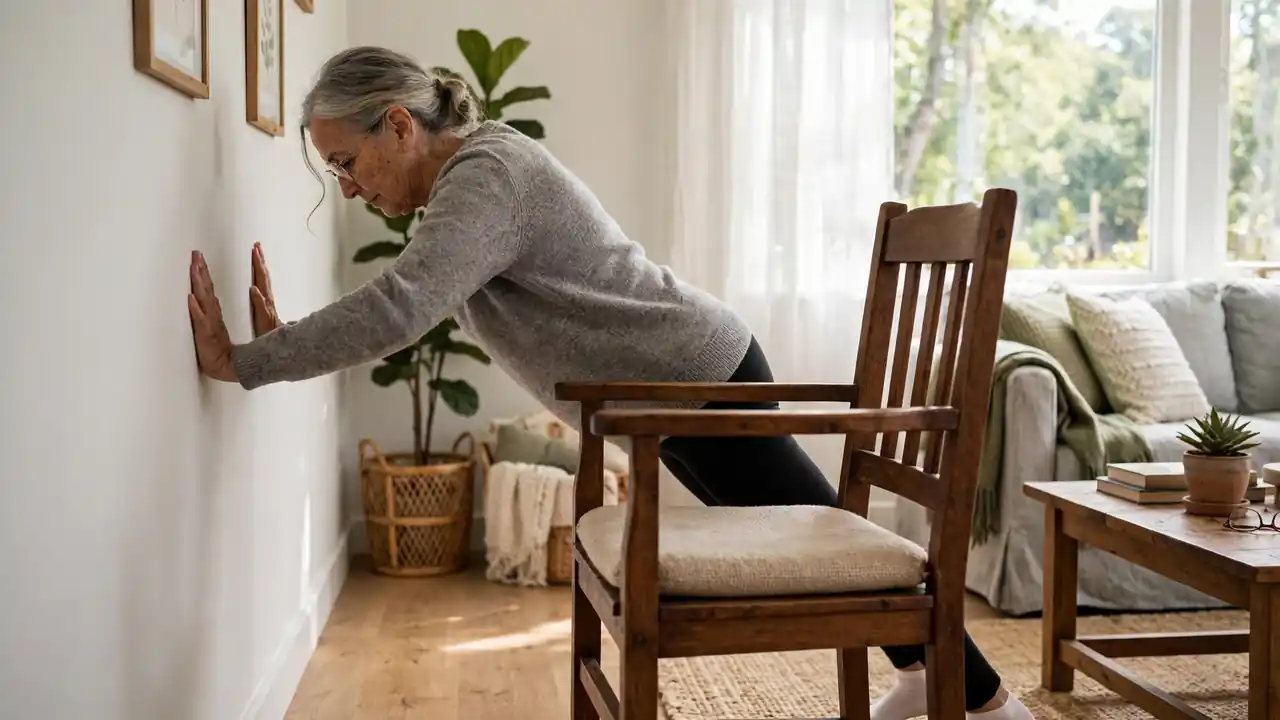
Next, wall push-ups. Stand facing a wall, place your hands on it at shoulder height, step back a little, and bend your elbows to bring your chest toward the wall, then press away. Keep your body in one straight line from head to heels. Start with five to eight repetitions, and step closer to the wall to make it easier.
Then a resistance band row. Sit or stand tall, hold a band in front of you, and pull your elbows back as if you are squeezing a pencil between your shoulder blades. Pause, then return slowly. This one matters more than it looks, because pulling strength helps your posture and your back.
Finish with heel raises. Hold a chair or counter for balance, rise slowly onto your toes, pause, and lower slowly. Your calves do a quiet, important job every time you walk, and this simple move trains them directly.
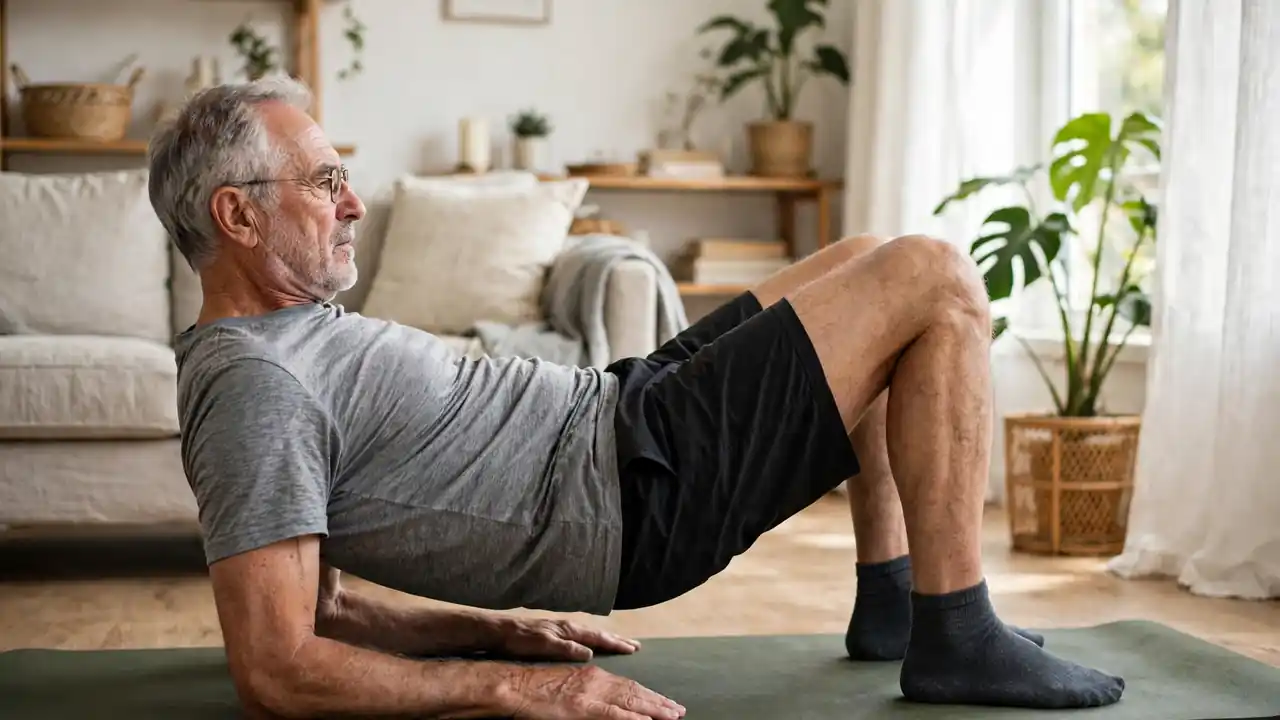
Day two, strength B. Start with glute bridges. Lie on your back with your knees bent and feet flat, press through your heels, and lift your hips until your body forms a straight line from shoulders to knees. Pause, then lower slowly. This wakes up the muscles that help you stand, walk, and climb stairs.
Then repeat the sit-to-stand and the wall push-up, because beginners improve fastest by practising the same key moves often. Finish with a suitcase carry. Hold a light bag or dumbbell in one hand, stand tall, and walk slowly across the room. Swap hands and repeat. Carrying is real-life strength, and it trains your grip and your core at the same time.
On non-strength days, add balance and mobility work. Single-leg stands beside a counter, gentle walking, and light stretching all count. They are not extras. Balance work is part of staying steady, and it pairs with strength training rather than competing with it.
How to Progress Without Hurting Yourself
My biggest early mistake was adding weight too fast. I felt good after two weeks, so I doubled the effort. My shoulders complained for a week. Learn from me. Progress slowly, and let your tendons and ligaments catch up with your muscles, because connective tissue adapts more slowly than muscle does.
Here is the simple rule I use now. When you can complete all your repetitions with good form and the last few still feel manageable, add a tiny bit. That might mean one or two more repetitions, a slightly stronger band, or a slightly heavier household object. Change only one thing at a time. If you add repetitions and weight in the same week, you will not know which change caused the soreness.
Expect some soreness at first. Delayed onset muscle soreness, the stiffness that peaks twenty-four to forty-eight hours after a new workout, is normal in the first two to four weeks. It is a sign your muscles are adapting, not a sign you are injured. Mild to moderate soreness is fine. Sharp pain during exercise, pain on one side only, or soreness that does not improve within three or four days is different. Stop, rest, and get advice.
Track three simple markers of progress. First, can you do more repetitions with the same resistance than you could four weeks ago? Second, does your recovery feel faster, with less soreness? Third, does daily life feel easier, with stairs, groceries, and getting off the floor taking less effort? When all three move in the right direction, your plan is working, whatever the scale says.
Strength Training With Osteoporosis, Arthritis, or a Joint Replacement
I hear this question more than any other, and it deserves a straight answer. Strength training is one of the primary recommended interventions for osteoporosis, because mechanical loading stimulates bone-forming cells. That does not mean every exercise suits every person. It means the right exercises, chosen with care, help rather than harm.
If you have osteoporosis, avoid exercises with significant spinal flexion, such as sit-ups, crunches, and bent-over rows with heavy rounding. Avoid high-impact activities and exercises with a high fall risk. Fall prevention through lower-body strengthening and balance work is especially important, because hip fracture risk is higher with osteoporosis. Your physician or a physical therapist can give you personalised guidance, and that conversation is worth having before you progress.
If you have arthritis, start even lighter than you think you need to, and favour slow, controlled movements through a comfortable range. Some stiffness after a session is common. Sharp joint pain during a movement is your signal to change the movement, reduce the range, or stop and ask for advice. If you have a joint replacement, follow your surgeon’s and therapist’s guidance first, and treat this guide as general information, not a personal prescription.
Consider a trainer who understands older adults, even for a few sessions. A trainer can watch your form, adjust for arthritis or past injuries, and build your confidence. In-person coaching suits many people, and online coaching suits others who prefer to train at home. Either way, good coaching is an investment in safety, not a luxury.
What About Protein, Sleep, and Rest Days?
I used to think the workout was the whole story. It is only half of it. Your muscles rebuild between sessions, not during them, which is why rest days matter. Train the same muscles on two days in a row and you rob them of that rebuild time. Keep at least one rest day between strength sessions.
Eat enough protein across the day, spread over your meals rather than loaded into one dinner. Older adults often eat less protein than they need without noticing, and a little planning helps. Eggs, yogurt, fish, poultry, beans, and lentils are all ordinary, affordable options. You do not need special powders to start. You need regular meals with a protein food in each one.
Sleep is the quiet partner of strength. When I sleep badly for several nights, my sessions feel harder and my soreness lasts longer. That is not a failure of willpower. It is your body telling you recovery is incomplete. A shorter, lighter session on a bad week beats skipping entirely, and it beats pushing through exhaustion.
The Mistakes I See Beginners Make Again and Again
I have made most of these myself, so I list them without judgement. First, starting too heavy to impress someone, including yourself. The first two to three weeks should feel almost too easy, and that is intentional. Your goal in those weeks is to learn movement patterns and let your body adjust.
Second, skipping the warm-up. Five easy minutes feels boring, and it is also the cheapest injury prevention you will ever buy. Third, holding your breath during hard efforts. Breathe out on the effort, breathe in on the return, and keep breathing through every repetition.
Fourth, training through sharp pain because you think soreness means progress. Soreness and pain are different signals, and confusing them is how small problems become big ones. Fifth, quitting after a missed week. Missing one week costs a little recent progress, and it is recoverable. Drop back one small step, do one session at that level, and progress as normal. Do not try to make up for lost time in a single session.
My honest take: You do not need to become an athlete. You need to become a person who can carry, climb, stand, and catch themselves with confidence. Two short sessions a week, done patiently for three months, will change your daily life more than any dramatic one-month effort ever will.
Your First Four Weeks, Week by Week
Week one is about learning, not effort. Do both sessions with the lightest resistance that lets you practise good form. Five to eight repetitions per exercise is plenty. Finish each session feeling like you could have done a little more, and call that a win.
Week two is about repeating the same routine and noticing what feels smoother. Keep the same resistance. Add a repetition or two only if your form stays clean. Start your balance practice on one non-strength day.
Week three is about gentle progression. If week two felt comfortable, add one set to your two most comfortable exercises, or move to a slightly stronger band. Keep everything else the same. Your body is adapting, and steady beats spectacular.
Week four is about review. Compare yourself to week one. Can you do more repetitions? Is your recovery faster? Do the stairs feel easier? If yes, keep progressing one small step at a time. If a particular exercise still causes sharp pain or worry, swap it or ask a professional before you push further.

Frequently Asked Questions
Is it safe to start strength training at sixty or older?
For most older adults, yes, when you start light, use good technique, progress gradually, and allow recovery. Many injuries happen not because strength training itself is dangerous, but because people lift too heavy too soon. Check with a health professional first if you have a heart condition, osteoporosis, a joint replacement, or another chronic condition.
How heavy should I lift as a beginner over sixty?
Start lighter than you think you need to. Choose a resistance where you can complete all repetitions with good form and the last two or three feel challenging but not impossible. If you can easily complete all repetitions, increase slightly. If your form breaks down before you finish, decrease.
Can I still build muscle after sixty?
Yes. Muscle protein synthesis slows slightly with age, but your body still responds to progressive resistance training. You may not gain as quickly as you did at thirty, but steady progress in muscle mass, strength, and daily function is realistic.
Do I need a gym or a barbell?
No, not for the first months. Dumbbells, resistance bands, and bodyweight movements train everything a beginner over sixty needs. A barbell is an option later if you want it, not a requirement for starting.
Is soreness after my first week normal?
Yes. Delayed onset muscle soreness peaks twenty-four to forty-eight hours after a new workout and is common in the first two to four weeks. Mild to moderate soreness is fine. Sharp pain, one-sided pain, or soreness that does not improve within three or four days warrants stopping and seeking advice.
How often should I train?
Two to three sessions per week, with at least one rest day between sessions. Two sessions is a strong start for a beginner. Three sessions is a good goal once the routine feels comfortable.
What if I miss a week?
Drop back one small step, complete one session at that level, and then progress as normal. Missing a week is recoverable. Trying to make up for it in one hard session is how injuries happen.
Will I get bulky?
No. Building large muscles takes years of heavy, specialised training and a large calorie surplus. A beginner routine like this builds functional strength and steadiness, not bulk.
Final Thoughts
I started because the stairs were getting harder, and I stayed because my life got easier. That is the deal I want to offer you. Not a transformation photo. Not a promise of youth. Just a stronger, steadier version of your own life, built two short sessions at a time.
Start this week, not next month. Pick your two days. Set up your chair. Do week one gently, and let yourself feel proud of a session that felt almost too easy. That easy start is not a wasted week. It is the foundation everything else stands on. I am cheering for you, and I would love to hear in the comments which part of daily life you want to make easier first.
Sources: beginner guidance for strength training after sixty, including session frequency, sets and repetitions, and home movements, is summarised from published safe-routine guidance for adults over sixty and a complete 2026 guide to senior strength training. This article is general information only and is not medical advice.
React to this story