Key Points
Key Points
- A star shines because fusion pushing outward balances gravity pulling inward
- Massive stars of at least eight solar masses end in core-collapse supernovae when their iron cores collapse in seconds
- Type Ia supernovae destroy white dwarfs that gain too much mass from a companion star
- Leftovers become neutron stars, black holes, or glowing supernova remnants
- Supernovae forge heavy elements including gold and scatter them to form new stars and planets
- Our Sun is too small to go supernova and will end as a white dwarf
On This Page
- Subscribe to CAAW News
- In This Article
- What a Star Actually Is: A Balancing Act That Lasts Millions of Years
- Why Big Stars Explode: The Core-Collapse Story, Second by Second
- Why Some Small Stars Explode Too: The White Dwarf Story
- What Is Left Behind: Neutron Stars, Black Holes, and Glowing Clouds
- Why Supernovae Made You: The Elements, the Planets, and New Stars
- What About Our Sun? The Honest, Reassuring Answer
- Frequently Asked Questions
- What is a supernova, in one sentence?
- What are the two main types of supernova?
- How bright is a supernova?
- What is left after a supernova?
- Do supernovae create gold?
- Will our Sun go supernova?
- How often do supernovae happen?
- What is the difference between a supernova and a nova?
- Final Thoughts
- React to this story
I will never forget the first time someone told me that the iron in my blood came from an exploding star. I was sitting in a school science lesson, half asleep, when the teacher said it casually, as if it were nothing. It was not nothing. It stopped me cold. You mean, I thought, that a star had to die so that I could be here? That single sentence changed how I look at the night sky, and it is the reason I wanted to write this guide.
I am not an astrophysicist, and I will be upfront about that. I am a space writer who has spent years reading the best explainers from NASA, the US Department of Energy and Encyclopaedia Britannica, and turning them into plain words for readers who, like me, did not study physics at university. What follows is that translation: what happens when a star dies, why some stars explode and others fade away, and why those explosions matter to every one of us.
Here is the fear I want to take off the table straight away. If you have ever worried that our Sun might explode tomorrow, you can relax. The Sun is not the kind of star that goes supernova, and I will explain exactly why. But other stars do explode, and when they do, they briefly outshine entire galaxies. Understanding how that works is not just a party trick. It is the story of where the elements in your body, your phone and your planet came from.
Trust nudge: Every fact below is tied to a published source linked in the text. Where astronomers use estimates, such as how often supernovae happen in our galaxy, I give the estimate and say that it is an estimate.
In This Article
- What a star actually is, and why it does not collapse right away
- Why big stars explode: the core-collapse story, step by step
- Why some small stars explode too: the white dwarf story
- What is left behind: neutron stars, black holes, and glowing remnants
- Why supernovae made you: the elements, the planets, and new stars
- What about our Sun? The honest, reassuring answer
- Your questions, answered simply
What a Star Actually Is: A Balancing Act That Lasts Millions of Years
Let me start with the simplest picture I know, because it makes everything else click. A star is a giant ball of gas, mostly hydrogen, held together by gravity. Gravity pulls everything inward, trying to crush the star. At the same time, nuclear fusion in the core pushes outward. Fusion is the process of smashing light atoms together to make heavier ones, and it releases huge amounts of energy as heat and light. For most of a star’s life, those two forces balance each other perfectly. Gravity pulls in, fusion pushes out, and the star shines steadily for millions or billions of years.
That balance is the key to the whole story. A star does not explode because it is angry or unstable. It explodes because the balance breaks. When a star runs low on fuel, fusion slows down, the outward push weakens, and gravity starts to win. What happens next depends entirely on how massive the star is. Small stars and big stars die in completely different ways, and I think that is one of the most beautiful facts in astronomy.
It helps to think of a star’s life as a series of fuels. First it burns hydrogen into helium, the way our Sun is doing right now. When the hydrogen runs out, a massive star moves on to helium, then carbon, then oxygen, and so on, building heavier and heavier elements in its core, like layers of an onion. Each stage burns faster than the last. The final stage is iron, and iron is where the story ends, because fusing iron does not release energy. It absorbs it. Once a massive star has an iron core, it has no fuel left that can hold gravity back. The collapse is coming, and when it comes, it comes fast.
Why Big Stars Explode: The Core-Collapse Story, Second by Second
I want you to imagine a star at least eight times the mass of our Sun. That number matters, because eight solar masses is roughly the dividing line astronomers use for a core-collapse supernova. Such a star has lived fast and bright, burning through its fuel in millions of years rather than billions. Now its core is iron, and the outward push has failed.
What happens next is almost too fast to believe. Gravity takes over, and the core collapses in on itself in a matter of seconds. The core shrinks from something the size of Earth to a ball just a few kilometres across. The outer layers of the star, meanwhile, are still falling inward, rushing toward the collapsed core at a large fraction of the speed of light. Then they hit something they cannot pass through: the core itself, now squeezed into an ultra-dense state, stops collapsing and pushes back. The infalling material rebounds.
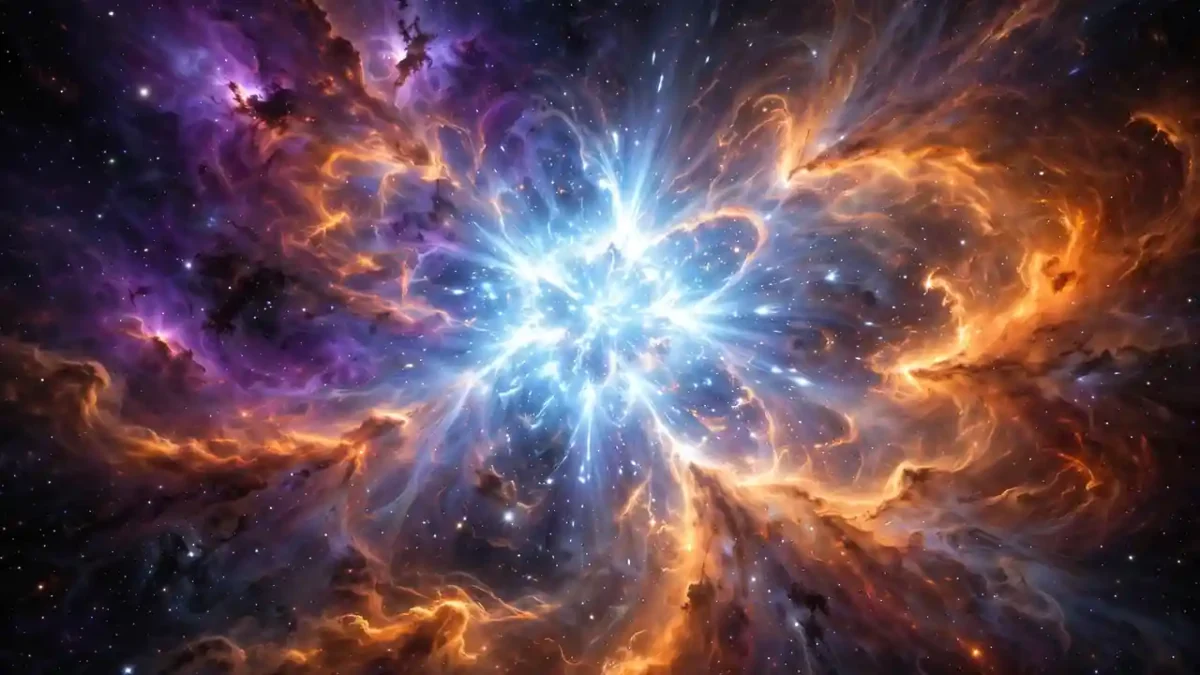
That rebound creates a shock wave that races outward through the star, blowing the outer layers into space. That is the supernova explosion. It is so bright that, for days or weeks, it can outshine its entire home galaxy. It releases more energy in a few seconds than our Sun will release in its whole lifetime. I have read that sentence a dozen times, and it still gives me goosebumps.
There is a detail here that I love, because it shows how clever astronomers are. The explosion does not just scatter the elements the star already made. The shock wave itself causes new fusion in the outer layers, creating even heavier elements in a process called nucleosynthesis. Gold, silver, uranium and many other heavy elements are forged in these moments. When I look at a gold ring now, I do not just see jewellery. I see the death of a star, billions of years ago, and I think that is a wonderful way to see it.
Why Some Small Stars Explode Too: The White Dwarf Story
Now let me tell you about the other kind of supernova, because it breaks the simple rule that only big stars explode. This one involves a white dwarf, which is what is left when a star roughly the size of our Sun runs out of fuel. A white dwarf is tiny and dense: about the size of Earth, but with the mass of a star packed inside it. On its own, it just cools down slowly over billions of years, fading like an ember. Nothing dramatic happens.
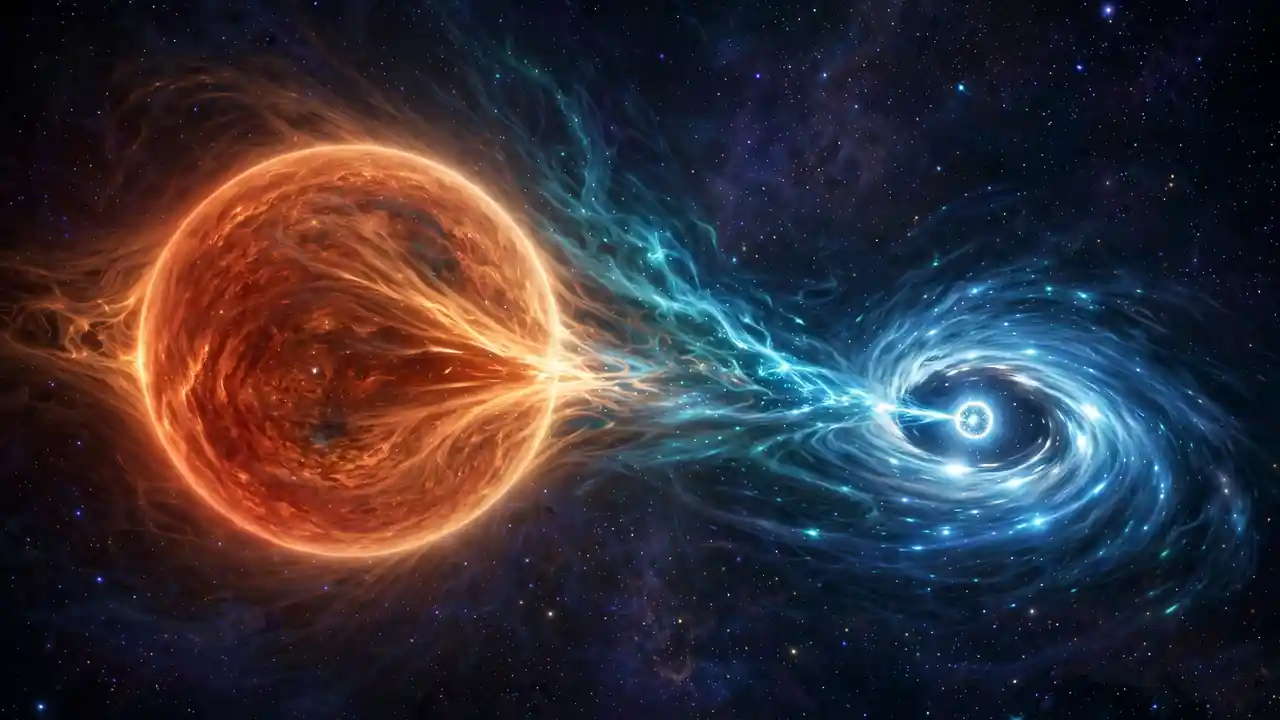
But many stars live in pairs, orbiting each other. If a white dwarf has a companion star close by, it can steal gas from that companion, pulling material onto itself and growing heavier. There is a limit to how heavy a white dwarf can get, known as the Chandrasekhar limit, roughly 1.4 times the mass of our Sun. When the white dwarf approaches that limit, carbon fusion ignites in its core all at once, in a runaway thermonuclear explosion. The white dwarf is completely destroyed. Nothing is left behind except the expanding debris.
Astronomers call this a Type Ia supernova, and it is special for a reason that has nothing to do with fireworks. Because white dwarfs all explode at roughly the same mass, Type Ia supernovae all reach roughly the same peak brightness. That makes them standard candles: cosmic light bulbs of known brightness that astronomers can use to measure distances across the universe. By comparing how bright a Type Ia supernova looks with how bright it should be, scientists can work out how far away its galaxy is. Those measurements helped reveal that the expansion of the universe is speeding up, one of the biggest discoveries in modern astronomy. A dying star, used as a ruler for the cosmos: I think that is extraordinary.
Do not confuse a supernova with a nova, by the way. A nova is a smaller explosion on the surface of a white dwarf, where stolen hydrogen ignites but the star itself survives. It can happen again and again. A supernova destroys or transforms the star. The names sound similar, but the events are very different, and I have mixed them up myself in the past.
What Is Left Behind: Neutron Stars, Black Holes, and Glowing Clouds
After the explosion, the sky does not just go quiet. What remains depends on the type of supernova, and I find each outcome fascinating in its own way. In a core-collapse supernova, the collapsed core survives as either a neutron star or a black hole. If the core is not too massive, it becomes a neutron star: a city-sized ball so dense that a teaspoon of its material would weigh about a billion tonnes. Neutron stars spin fast and can beam out pulses of radiation like a lighthouse. When they do, astronomers call them pulsars, and I love that we can detect them across the galaxy by their steady ticking.
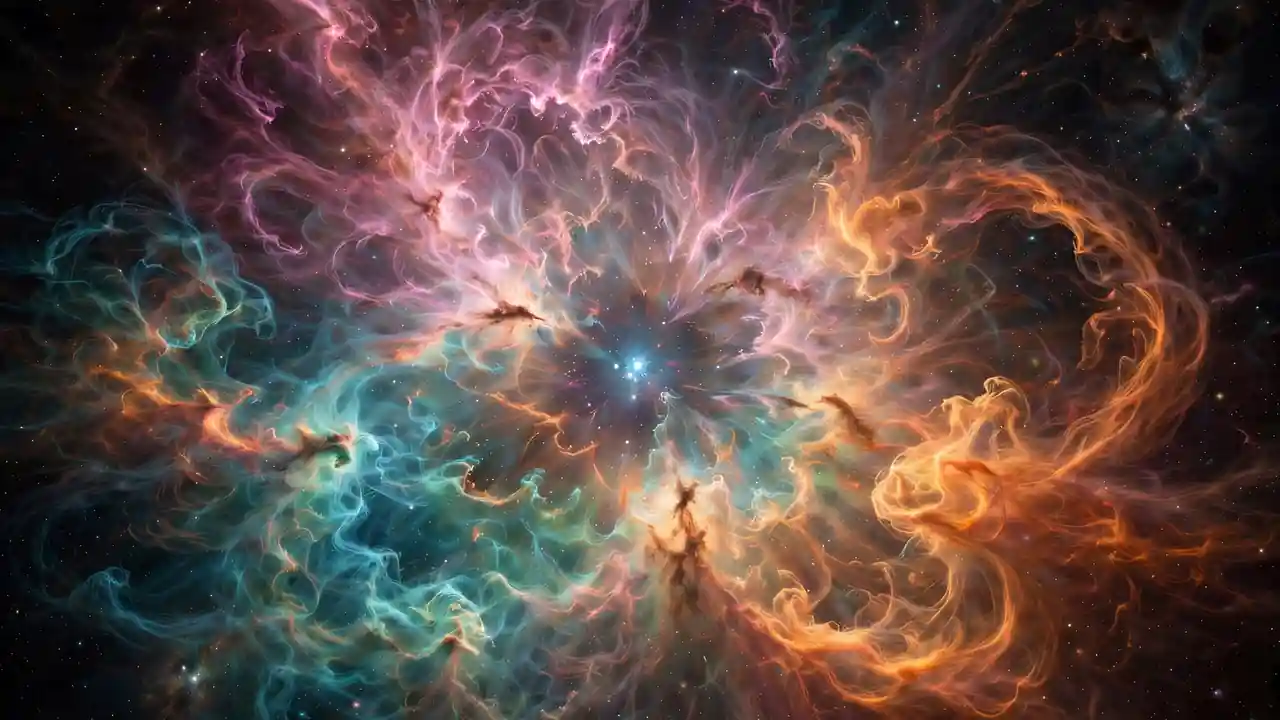
If the collapsing core is more massive, gravity wins completely, and it becomes a black hole, a region where gravity is so strong that not even light can escape. The rest of the star’s material is blown outward into space, forming a glowing, expanding cloud called a supernova remnant. These remnants are some of the most beautiful objects in the sky. The Crab Nebula, for example, is the remnant of a supernova seen by astronomers in the year 1054, and it is still expanding today, nearly a thousand years later.
In a Type Ia supernova, there is no core left behind, because the white dwarf is destroyed completely. What remains is just the expanding debris, enriched with heavy elements, drifting into the space between stars. Over thousands of years, that debris cools, mixes with other gas, and can be swept up into new stars and planets. That is the recycling story of the universe, and it is still going on around us right now.
How often does this happen? In our Milky Way galaxy, astronomers estimate roughly two supernovae per century. That sounds rare, and it is, on a human timescale. But the universe contains trillions of galaxies, so somewhere in the universe, a star is exploding right now. Astronomers detect them all the time with survey telescopes, and each one teaches us something new.
Why Supernovae Made You: The Elements, the Planets, and New Stars
Here is the part of the story that brings it home, literally. The early universe contained mostly hydrogen and helium, and almost nothing else. Every heavier element had to be made inside stars, and the heaviest ones could only be made in supernova explosions. The calcium in your bones, the iron in your blood, the oxygen you are breathing right now: all of it was forged in stars, and much of it was scattered by supernovae long before our Sun was born.
Think about that chain for a moment, because I think it is the most humbling idea in science. A massive star lived, died and exploded. Its debris drifted through space for millions of years. That debris mixed with other gas and dust, collapsed under gravity, and formed a new star: our Sun. Around that Sun, the leftover debris formed planets, including Earth. On Earth, those elements became rocks, oceans, and eventually, living things. You are, quite literally, made of stardust, and more precisely, you are made of exploded stars.
Supernovae do one more job that I think is underappreciated. Their shock waves can compress nearby clouds of gas and dust, triggering those clouds to collapse and form new stars. So a star’s death can cause new stars to be born. The universe is not a one-way street from birth to death. It is a cycle, with explosions at the heart of it, and I find that deeply comforting. Nothing is wasted. Everything is reused.
The one thing to remember: A supernova is not just an explosion. It is a factory and a delivery service: it forges heavy elements, scatters them across space, and triggers the birth of new stars. Without supernovae, there would be no planets like Earth, and no one to look up and wonder.
What About Our Sun? The Honest, Reassuring Answer
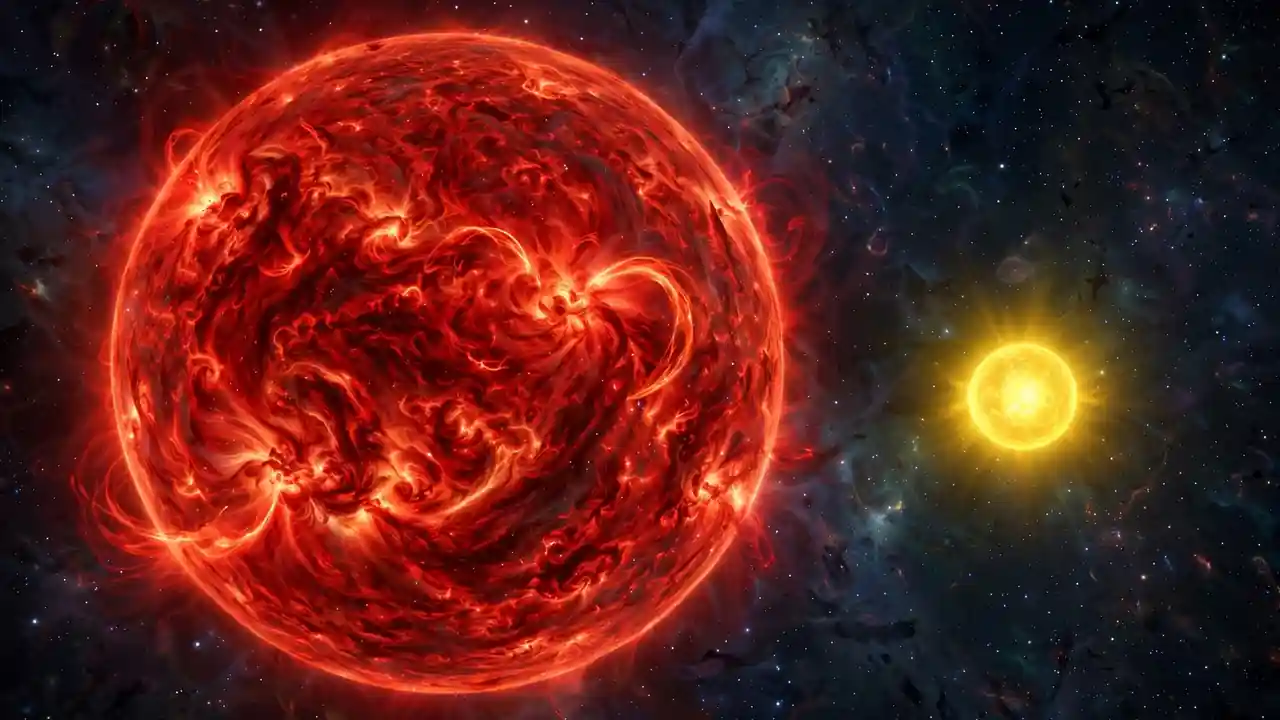
Let me answer the question I get asked most often, directly. Our Sun will not go supernova. It is far too small. At roughly one solar mass, it sits well below the eight-solar-mass threshold for a core-collapse explosion, and it does not have a close companion star feeding it material toward a white dwarf explosion either. In about five billion years, the Sun will swell into a red giant, shed its outer layers gently into space, and settle down as a white dwarf, cooling slowly for trillions of years. That is a dramatic end for any planets nearby, but it is not a supernova, and it is not happening any time soon.
Could a nearby supernova harm Earth? This is a fair worry, and astronomers have studied it. A supernova would need to be very close, within a few dozen light-years, to seriously damage our atmosphere, and no star that close is expected to explode any time soon. The famous red supergiant Betelgeuse, in the constellation Orion, is a candidate for a future supernova, but it is hundreds of light-years away, and even when it does explode, which could be tomorrow or in a hundred thousand years, it will be a spectacular sight in our sky, not a danger to us. I, for one, hope I am alive to see it.
Frequently Asked Questions
What is a supernova, in one sentence?
A supernova is the gigantic explosion of a star at the end of its life, or of a white dwarf pushed past its mass limit, briefly outshining its whole galaxy.
What are the two main types of supernova?
Core-collapse supernovae happen when a massive star, at least eight times the Sun’s mass, runs out of fuel and its core collapses. Type Ia supernovae happen when a white dwarf in a binary system gains too much mass and explodes in runaway fusion.
How bright is a supernova?
At its peak, a supernova can shine as brightly as billions of Suns, and can briefly outshine its entire home galaxy, before fading over weeks or months.
What is left after a supernova?
After a core-collapse supernova, the core becomes a neutron star or a black hole, surrounded by an expanding supernova remnant. After a Type Ia supernova, no core remains, only expanding debris.
Do supernovae create gold?
Yes, heavy elements including gold, silver and uranium are forged in supernova explosions and in similar violent events, then scattered into space where they can later form planets.
Will our Sun go supernova?
No. The Sun is too small. It will end its life as a red giant and then a white dwarf, without exploding.
How often do supernovae happen?
Astronomers estimate about two per century in our Milky Way galaxy, but with trillions of galaxies in the universe, supernovae are observed somewhere in the universe all the time.
What is the difference between a supernova and a nova?
A nova is a smaller surface explosion on a white dwarf that does not destroy the star and can repeat. A supernova destroys or transforms the star.
Final Thoughts
I started this article with a school lesson that changed how I see myself, and I want to leave you with the same feeling. The next time you look up at the night sky, remember that some of those points of light are living on borrowed time, balancing gravity against fusion, and that when the balance breaks, they will light up the darkness and seed the future. The iron in your blood, the calcium in your bones, the gold in a ring you might be wearing: all of it passed through a star, and much of it passed through an explosion.
Stars die. That is true, and it sounds sad. But their deaths are not endings. They are beginnings, for new stars, new planets, and eventually, for people who look up and ask how it all works. If this guide helped you understand that story a little better, then it has done its job. Tell me in the comments: which part surprised you most, the collapsing core, the white dwarf bomb, or the idea that you are made of exploded stars?
Sources: US Department of Energy, DOE Explains Supernovae; Encyclopaedia Britannica, Supernova; Space.com, What is a Supernova; ESO Supernova exhibition.
React to this story