Key Points
Key Points
- President Donald Trump has said he is highly unlikely to order fresh strikes on Iran as long as talks to end the conflict keep making progress, even as the United States expands its pressure campaign on land and Iran lifts the limit on its missile range.
On This Page
- What Trump said
- Subscribe to CAAW News
- Task Force Iron Gate: the pressure moves onto land
- Iran lifts its missile range limit
- The tankers and the Strait of Hormuz
- Two tracks at once
- What is confirmed and what is not
- What happens next
- Frequently asked questions
- Did Trump rule out strikes on Iran?
- What is Task Force Iron Gate?
- Has Iran built a missile that can fly further than 2,000 kilometres?
- What happened to the two tankers in the Strait of Hormuz?
- How long has the US-Iran war been going on?
- React to this story
President Donald Trump has said he is highly unlikely to order fresh attacks on Iran as long as negotiations to end the conflict keep making progress. The message, given in a telephone interview on Sunday, November 8, 2026, arrived on the same weekend the United States widened its pressure campaign onto land and Iran announced it had lifted the self-imposed limit on how far its ballistic missiles can fly.
The three developments together describe the standoff as it stands on Monday morning: talks continue, but both sides are also preparing for failure. Trump made a deal the condition for restraint. The Pentagon’s Central Command stood up a task force to choke off Iran’s overland supply routes. And Iran’s Revolutionary Guard said the old 2,000-kilometre ceiling on its missile range no longer applies, while conceding it has yet to prove any longer reach.
What Trump said
Trump spoke to CNN by telephone on Sunday. According to CNN’s account, reported by Reuters, he said he was highly unlikely to order fresh attacks while talks progress — if Iran signs what he called a very strong agreement.
“It depends on whether or not they sign a very strong agreement. The answer is, highly unlikely it’s going to be necessary.”
Trump also said the United States had identified potential infrastructure targets, including 38 bridges that he said American forces could knock down in literally one hour, according to the CNN report carried by Reuters. CNN did not specify exactly what it had asked the president, and the bridge figure is Trump’s own claim, not an independently verified military assessment.
The tone is a shift from recent days. Trump had said a decision on Iran was coming soon, keeping open strikes, pressure, or a deal. Sunday’s comments tilt toward a deal — but only on his terms. “Highly unlikely” is reassurance and warning at once: if talks stall, strikes return to the table.
Task Force Iron Gate: the pressure moves onto land
On Saturday, November 7, the United States military’s Central Command, known as CENTCOM, announced a new unit called Task Force Iron Gate. Its job is to prevent Iran from using ground routes to transport advanced weapons and other materials, extending a pressure campaign that until now has been fought mainly at sea.
CENTCOM Commander Admiral Brad Cooper directed the creation of the task force: about 20 civilian and military personnel based in Tampa, Florida, coordinating with other United States government agencies on preventing the movement of advanced weapons systems, dual-use technologies, sanctioned materials, and illegal revenue streams across Iran’s land borders and the Caspian Sea.
That distinction matters: the task force is an internal team that finds routes and works out how to disrupt them, not a force sent to stand on a border. Its announcement expands the campaign’s scope; it does not put new combat forces in the region.
CENTCOM framed the move as building on its naval blockade, which it said had prevented Iran from exporting more than $25 billion worth of crude oil in recent months. That figure is CENTCOM’s own claim and has not been independently verified.
A CENTCOM graphic described the mission as “monitor, detect and disrupt,” and highlighted Iran’s borders with four neighbours: Türkiye, Afghanistan, Turkmenistan and Pakistan. Dawn noted Pakistan shares an approximately 900-kilometre border with Iran, while stressing CENTCOM announced no agreement with Islamabad. The Caspian Sea — connecting Iran with Russia, Central Asia and the Caucasus — is explicitly in the mandate. A June 2026 Centre for Strategic and International Studies assessment had flagged the Caspian as a possible route for Iran to keep acquiring military components despite maritime restrictions; the task force appears designed to close that gap.
Iran lifts its missile range limit
On the same day CENTCOM announced its task force, Iran’s Revolutionary Guard announced a change of its own. Brigadier General Hossein Mohebbi, the spokesman for the Islamic Revolutionary Guard Corps, told a press conference in Tehran marking the force’s Aerospace Week that the self-imposed limit of about 2,000 kilometres on the range of Iranian ballistic missiles had been lifted.
“That restriction has been lifted for us.”
The ceiling dated to 2017, set under the former supreme leader, Ali Khamenei, and described by Foreign Minister Abbas Araghchi as a deliberate limit. A 2,000-kilometre range already puts parts of Greece and the Balkans, the entire Arabian Peninsula, the Levant and most of Egypt within reach. Lifting it signals Iran may seek missiles capable of reaching more distant targets, including, by the Guard’s own framing, American military installations in Europe.
But the announcement was narrower than the headline suggests, and Mohebbi himself drew the line. He did not say Iran already had missiles capable of exceeding the limit — only that Iran would “demonstrate these capabilities in practice” rather than make statements about them in advance, and that work on extending range continues. There is no evidence in the reporting that Iran has tested or fielded an operational missile able to fly beyond the old limit; its longest declared system is the Khorramshahr-4, also known as Kheibar, credited at or near 2,000 kilometres. The lifting of the limit is a statement of policy and intent, not a test report.
The timing was pointed: the comments came days after Iran’s supreme leader warned that any threat from the United States or Israel would face a response without geographic limits. One uncertainty should be noted: outlets have rendered the supreme leader’s name differently — Mojtaba Khamenei in some reports, Mojtaba Khomeini in others — and the correct form has not been settled in the sources reviewed. It does not change the substance, but it shows details in this story are still settling.
Mohebbi also said the Guards’ aerospace division has built underground missile and drone production facilities, and that Iran would prepare for a shift in nuclear doctrine if its leadership ordered one — a warning about what could be ordered, not an announcement that it has been.
The tankers and the Strait of Hormuz
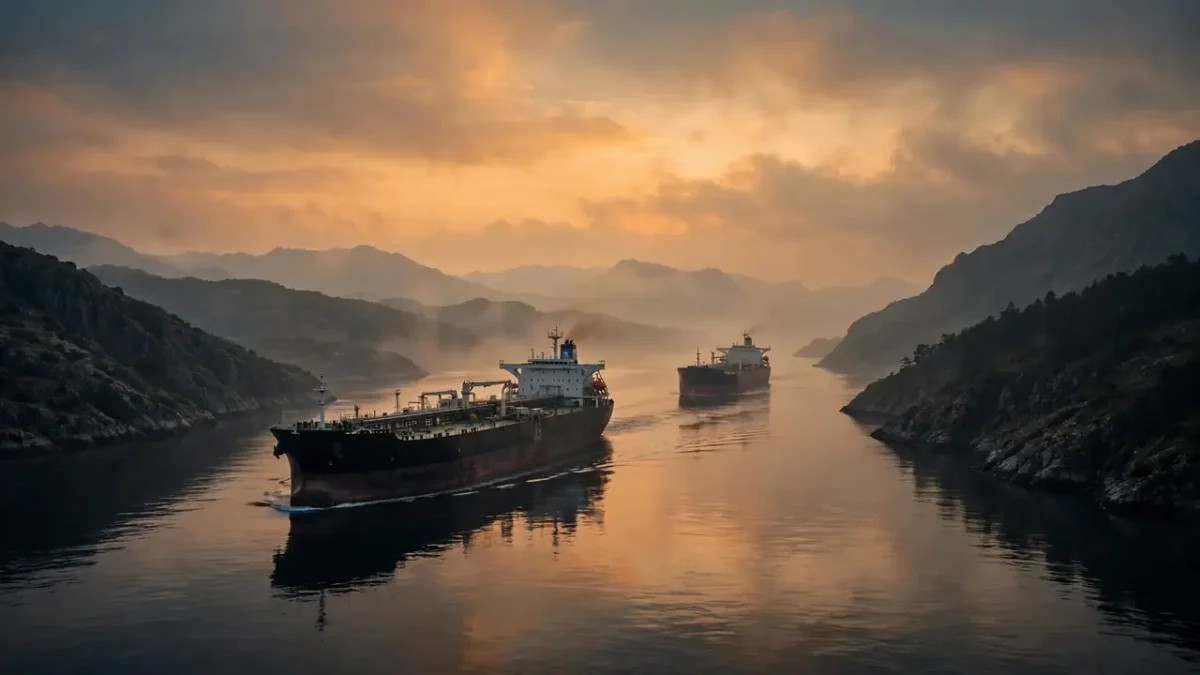
Behind the weekend’s announcements sits the Strait of Hormuz, the narrow channel through which a large share of the world’s seaborne oil passes. Iran has imposed restrictions on vessels seeking to pass through it and has attacked ships it says violate those restrictions, seeking to assert control over the waterway and pressure the United States.
A week ago, on Sunday, November 1, Iran’s Revolutionary Guard Corps Navy said two oil tankers had “exploded” after striking mines on what it called an unauthorised route in the strait, via Iranian state media reported by Reuters. The tankers’ names and flags were not given, and no independent account has established what happened to the vessels or their crews. Separately, the UAE National Guard rescued 22 crew from a burning cargo ship in the Gulf of Oman — again with the ship unnamed and the cause unstated. In both cases the vessel is unnamed and key details unconfirmed.
The war has run about eight months. Le Monde describes it as a war in Iran that broke out at the end of February 2026 and led to the closure of the Strait of Hormuz; The Hindu likewise describes an eight-month war in which Tehran has restricted passage through the strait, choking global energy supplies. Oil prices have already fallen sharply, with Brent crude below $94, but the strait remains the single point of failure for energy markets if the conflict escalates again.
Two tracks at once
What makes this weekend significant is how the three announcements fit together. Trump offers talks a chance while keeping strikes explicit. CENTCOM widens pressure from sea to land and the Caspian. Iran answers with a missile doctrine that extends its threatened reach, while not claiming a capability it has not shown. Each side is negotiating in public: Trump’s “highly unlikely” gives Tehran a reason to keep talking and a reason to fear stopping; the task force gives Washington a lever that does not depend on bombing; the missile announcement gives Tehran a lever of its own.
The risk is that the two tracks collide. Disrupting shipments across land borders and the Caspian touches the interests of Iran’s neighbours, including Russia, and any incident can be read as escalation. A missile programme moving toward longer ranges will be read in Washington, Europe and Israel as a direct threat, whatever Tehran’s intentions. And talks that depend on a “very strong agreement” can collapse over a single word.
What is confirmed and what is not
Confirmed: Trump told CNN on Sunday that fresh strikes are highly unlikely if talks progress, conditional on a very strong agreement. Confirmed: CENTCOM announced Task Force Iron Gate on Saturday, about 20 people based in Tampa, to disrupt Iran’s land and Caspian supply routes. Confirmed: the Revolutionary Guard said the 2,000-kilometre missile limit has been lifted.
Not confirmed: that Iran has a missile able to fly beyond 2,000 kilometres; the identities, flags or fates of the two tankers reported to have struck mines on November 1; or the scale of oil exports the blockade has prevented, beyond CENTCOM’s own figure of more than $25 billion. Not independently verified: the claim that 38 bridges could be knocked down in one hour — the president’s own assertion. Two uncertainties remain: the supreme leader’s name appears in different forms across outlets, and no date or venue has been announced for the next talks round.
What happens next
There is no published timetable. The talks continue without an announced round, the task force is stood up but its first disruptions unreported, and Iran’s longer-range missile programme exists so far as a policy decision, not a demonstrated weapon. To watch: any date for the next talks round or statement from Tehran; any shipment seized or route closed; any missile test beyond the old range; and any incident in the Strait of Hormuz.
For now the position is a strange one: a president saying strikes are unlikely, a military command widening a blockade, and a Revolutionary Guard extending its reach, all in 48 hours. The talks are why the strikes are on hold; the pressure is why the talks have something to talk about. Whether that balance holds is the question the coming days will answer.
Frequently asked questions
Did Trump rule out strikes on Iran?
No. He told CNN on Sunday, November 8, that fresh strikes are “highly unlikely” as long as talks keep making progress, and that it depends on whether Iran signs “a very strong agreement.” If the talks fail, the option remains open.
What is Task Force Iron Gate?
A new US Central Command unit announced on November 7, 2026, made up of about 20 civilian and military personnel based in Tampa, Florida. Its mission is to monitor, detect and disrupt Iran’s movement of advanced weapons, dual-use technologies, sanctioned materials and illegal revenue across land borders and the Caspian Sea. It is a coordination team, not a troop deployment.
Has Iran built a missile that can fly further than 2,000 kilometres?
There is no evidence of that. The Revolutionary Guard said on November 7 that the self-imposed 2,000-kilometre limit has been lifted, but its spokesman said Iran would demonstrate any new capability in practice rather than claim it in advance. Iran’s longest declared missile, the Khorramshahr-4, is credited at or near 2,000 kilometres.
What happened to the two tankers in the Strait of Hormuz?
On November 1, Iran’s Revolutionary Guard Navy said two oil tankers “exploded” after striking mines on an unauthorised route in the strait, according to Iranian state media reported by Reuters. The tankers’ names and flags were not given, and no independent account has confirmed the details.
How long has the US-Iran war been going on?
About eight months. The conflict broke out at the end of February 2026, and it has included a US naval blockade of Iranian ports and Iranian restrictions on passage through the Strait of Hormuz.
React to this story