Key Points
Key Points
- Neutron stars form when massive stars collapse in supernovae
- A star heavier than the Sun fits into about 20 kilometres
- A teaspoon of neutron star material would weigh billions of tons
- The crust is a crystalline lattice with millimetre-high mountains
- Below the drip line, free neutrons form a superfluid sea
- The inner core may contain hyperons or quark matter, still unproven
- Pulsars and mergers let scientists probe the interior from afar
On This Page
- Subscribe to CAAW News
- Table of Contents
- How a neutron star is born in a supernova
- Why a city-sized star can outweigh the Sun
- What the outer crust is really like
- What happens at the neutron drip line
- What the superfluid core may contain
- Why pulsars flash like cosmic lighthouses
- What magnetars and mergers teach us
- Frequently Asked Questions
- What is a neutron star made of?
- How dense is a neutron star?
- How big is a neutron star?
- What is the difference between a neutron star and a pulsar?
- What is a magnetar?
- Can a neutron star become a black hole?
- Why do scientists study neutron stars?
- Final Thoughts
- React to this story
I will admit something straight away: the first time someone told me a teaspoon of neutron star material would weigh billions of tons, I laughed, because it sounded like a joke from a science quiz, not a real fact about the universe. I am not a physicist, I am a curious writer who got hooked on this topic after reading about pulsars, and I have spent a long time checking the numbers in plain language so I can explain them without pretending to be an expert. If you have ever looked at the night sky and wondered what is left when a giant star dies, or felt a little dizzy at the idea of matter squeezed beyond anything we can make on Earth, you are in exactly the right place. In this guide I promise you a clear journey from the surface of a neutron star down to its mysterious core, with honest labels wherever scientists themselves are still unsure, so you will finish knowing what is settled, what is debated, and why it matters. This is for stargazers, students, and anyone who loves a good cosmic mystery, so let us dive in, carefully, together.
Trust nudge: I have based the structure and densities below on published neutron star guides and Space.com, and I link the claim text to those sources, with uncertainty flagged wherever the core is still unknown.
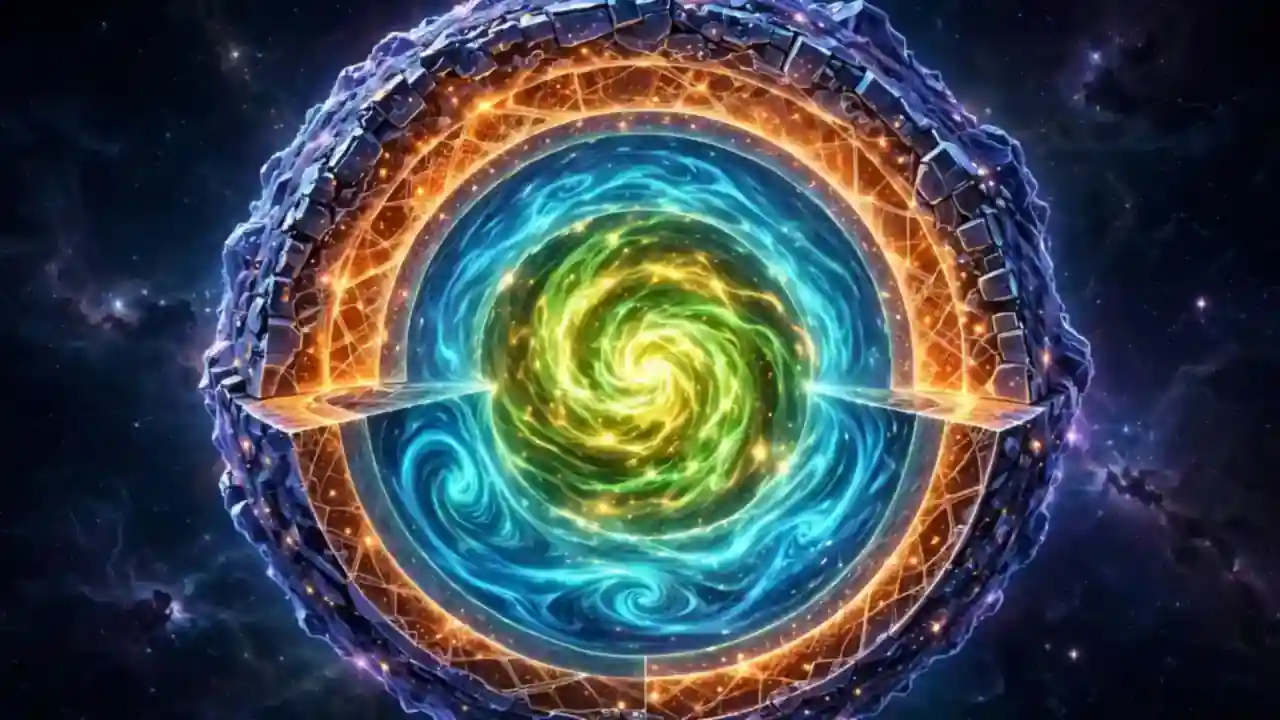
Table of Contents
- How a neutron star is born in a supernova
- Why a city-sized star can outweigh the Sun
- What the outer crust is really like
- What happens at the neutron drip line
- What the superfluid core may contain
- Why pulsars flash like cosmic lighthouses
- What magnetars and mergers teach us
How a neutron star is born in a supernova
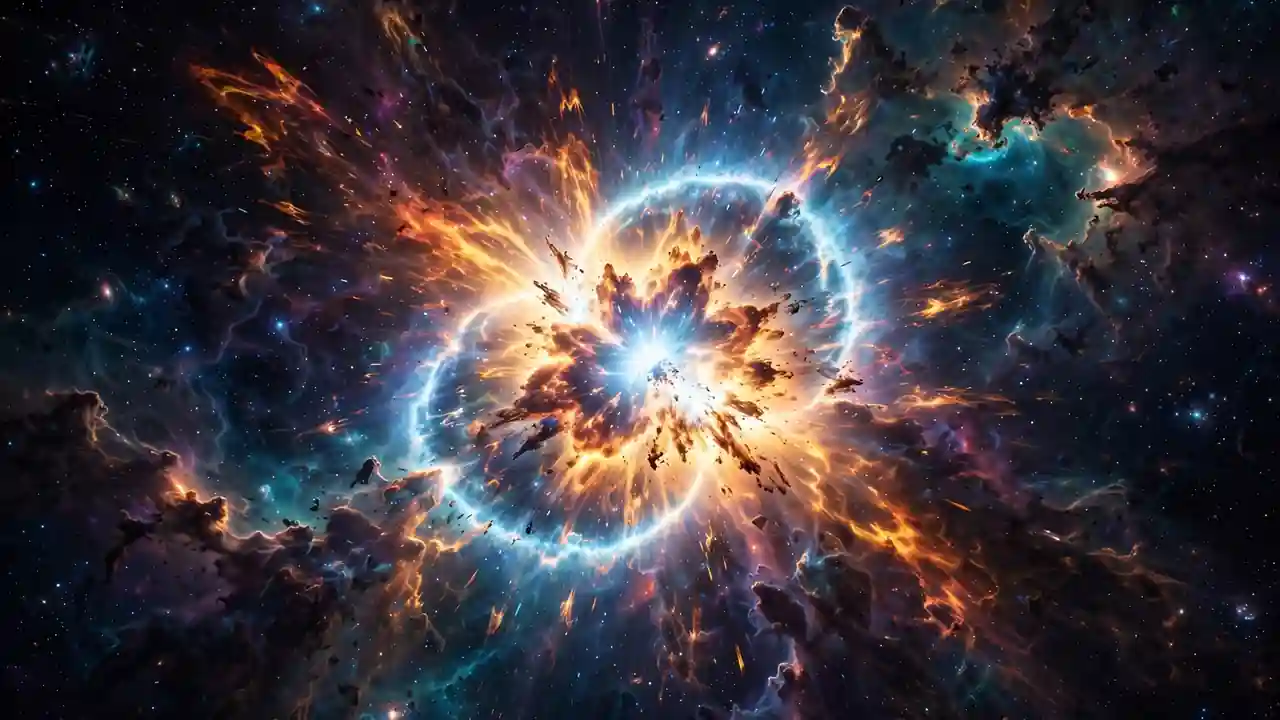
I used to picture stars as gentle glowing balls that simply fade away, and learning how massive stars die corrected that picture completely. When a star roughly eight to twenty times the mass of the Sun runs out of fuel, its core can no longer hold itself up, so it collapses while the outer layers explode as a supernova, leaving behind an ultra-dense remnant. StarDate explains that the collapsing core squashes protons and electrons together to make neutrons, and by the time the collapse halts, the core is trillions of times as dense as Earth. A chunk the size of a sugar cube would weigh as much as a mountain, which is the kind of sentence I had to read twice before I believed it.
What moves me about this story is that destruction and creation are the same event. The supernova scatters heavy elements that later become planets and people, while the core becomes something stranger than any laboratory material. I find that humbling, because it means the atoms in my body passed through violent stellar events long before I existed, and neutron stars are the compact, spinning reminders of that violence. They are not stars in the normal sense anymore, they are what remains when a star has given everything it had, and that is why scientists study them with such intensity.
Why a city-sized star can outweigh the Sun
The size still shocks me every time I write it down. A typical neutron star packs more mass than the Sun into a sphere only about 20 kilometres across, roughly the size of a small city, according to a guide to neutron star physics. Its average density reaches around 10 to the power of 17 kilograms per cubic metre, which is comparable to the density inside an atomic nucleus. In everyday terms, ordinary matter is mostly empty space, with tiny nuclei far apart, but in a neutron star that empty space has been crushed away, so neutrons pack together with almost no gaps left.
That is why the famous teaspoon comparison exists, and why I now use it carefully rather than as a party trick. A teaspoon of neutron star material would weigh about six billion tons, as a density explainer puts it, because the material is not just heavy, it is matter in a state that does not exist anywhere else in nature. Gravity at the surface is around 200 billion times Earth’s surface gravity in some accounts, and the escape velocity exceeds half the speed of light. I cannot truly imagine standing there, and nobody could, because the forces would destroy any visitor instantly, but I can respect what those numbers mean: this is gravity winning almost completely, stopped only by a quantum rule.
What the outer crust is really like
When I first imagined a neutron star surface, I pictured a smooth glowing ball, but the real crust is stranger and more solid than that. Space.com describes a crust of heavy atomic nuclei squeezed into a crystalline lattice, with electrons free to swim among them, and surface mountains only a few millimetres tall because gravity flattens everything. The outer crust is only about 0.3 kilometres thick, with densities from ten million to hundreds of billions of grams per cubic centimetre, and it is the only layer we can even indirectly observe. I love that detail, because it means the most alien landscape in the universe has mountains smaller than a grain of rice.
Deeper in the crust, gravity allows exotic, neutron-rich nuclei to exist in abundance, holding hundreds of neutrons at a time, which would fall apart under normal conditions. That idea changed how I think about the periodic table: the rules we learn in school are not universal laws, they are local rules for gentle conditions. Under neutron star pressure, matter finds new arrangements, and the crust becomes a kind of ultra-strong crystal, brittle in some models and capable of cracking in starquakes. When the crust cracks, the star can glitch, suddenly spinning a little faster, and astronomers can actually detect that tiny change from light-years away, which still amazes me.
What happens at the neutron drip line
About a kilometre down, even those giant nuclei reach their limit, and this is the part I find most poetic. Space.com explains the drip line as the depth where neutrons begin to leak out of nuclei, and normally a free neutron decays in roughly fifteen minutes, but the intense confines of the star keep free neutrons stable and flowing. Below this line, in the inner crust, you find neutron-rich nuclei plus free neutrons and electrons, with densities climbing toward a hundred trillion grams per cubic centimetre. It is a sea with islands in it, islands of nuclei floating in neutron fluid, and I picture it as a strange ocean that never rests.
I admit I got this wrong at first, because I assumed neutrons inside a star were just sitting still, packed like marbles in a jar. They are not, and that is the key insight. The inner crust and outer core contain neutron superfluid, matter that flows without friction, which affects how the star spins, cools, and glitches. Superfluidity is a quantum behaviour we can study in laboratories at extremely low temperatures, but in a neutron star it happens at stellar scale, driven by density rather than cold alone. If that sounds impossible, you are in good company, because it challenges intuition, and that is exactly why physicists love these objects.
What the superfluid core may contain
Now we reach the honest frontier, and I want to be clear about what is known and what is not. The outer core is mostly free neutrons with a small admixture of protons and electrons, perhaps five to ten percent, and neutron pressure becomes the dominant force holding the star up. That pressure comes from the Pauli exclusion principle, which prevents neutrons from occupying the same quantum state, and it is called neutron degeneracy pressure. Without it, gravity would crush the star further, into a black hole, and the fact that a quantum rule can hold up a star still gives me goosebumps.
The inner core, above densities of about three thousand trillion grams per cubic centimetre, remains unknown, and scientists offer several serious possibilities: hyperons containing strange quarks, pion or kaon condensates, or free quark matter where quarks are no longer confined inside neutrons and protons. I will not pretend one of these is proven, because it is not, and any article that tells you otherwise is overselling the science. What we do know is that the maximum mass is around 2.2 times the Sun’s mass in many models, beyond which even degeneracy pressure fails and collapse to a black hole wins. That limit, called the Tolman-Oppenheimer-Volkoff limit, is a reminder that even the strongest quantum resistance has a breaking point.
Why pulsars flash like cosmic lighthouses
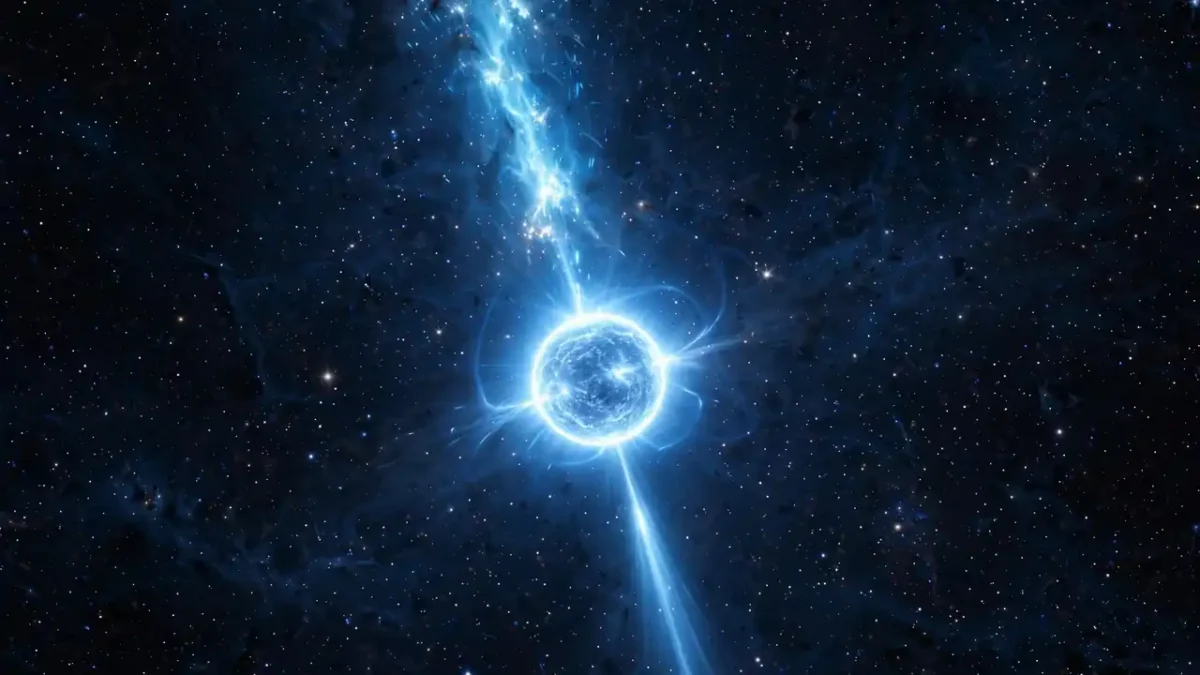
Some neutron stars are pulsars, and they are my favourite way into this topic because you can almost picture them. A pulsar is a rapidly spinning neutron star with beams of radiation from its magnetic poles, and as it spins, those beams sweep past Earth like a lighthouse, producing regular pulses. Because the star is so compact and massive, its spin is astonishingly stable, which is why pulsars are described as the most precise clocks in the universe. I remember first hearing a sonified pulsar signal and thinking it sounded like a heartbeat, and that image has stayed with me: a dead star, still beating in radio waves.
This precision is not just beautiful, it is useful. Astronomers use pulsar timing to test general relativity, to hunt for gravitational waves, and to probe the interstellar medium. When a pulsar glitches, or when its pulses arrive slightly early or late, scientists learn something about the superfluid interior or about spacetime itself. I find that deeply hopeful: we cannot visit a neutron star, we cannot drill into it, and yet by listening carefully to its flashes, we can infer what is happening inside a city-sized atomic nucleus spinning hundreds of times per second.
What magnetars and mergers teach us
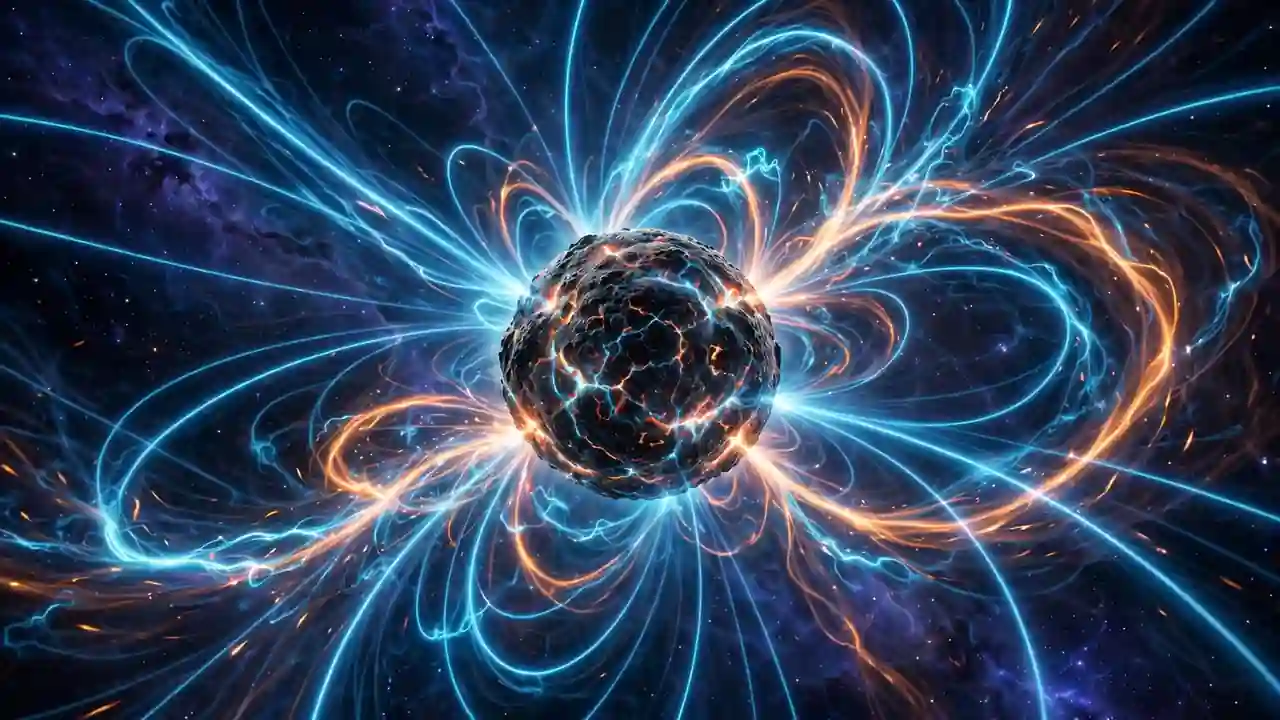
Magnetars are neutron stars with the most powerful magnetic fields in the universe, and they produce some of the most violent outbursts known. Their fields are so strong that they distort atoms and crack the crust, releasing bursts of X-rays and gamma rays that we can detect across the galaxy. I used to think magnetic fields were a gentle force, the kind that holds a note to a fridge, but magnetars corrected me: at these strengths, magnetism becomes a destructive, star-shaping force. Studying magnetars helps physicists understand matter under conditions no laboratory can reproduce, and that is a theme running through all neutron star science.
Neutron star mergers teach us even more, and the famous event GW170817, detected in gravitational waves and light, produced dozens of simultaneous research papers because it showed heavy elements forming in the merger debris. When two neutron stars collide, they briefly create conditions denser and hotter than either star alone, and the gravitational wave signal reveals how stiff or soft the matter inside is. That stiffness, called the equation of state, is the central puzzle: it tells us how pressure rises with density, and therefore what the core can contain. Every new merger, every new NICER radius measurement, and every new pulsar timing result narrows the possibilities a little further, and I find that slow narrowing more exciting than any single answer.
Key takeaway: Inside a neutron star, ordinary atoms are gone. A crystalline crust gives way to a neutron drip sea, then a superfluid core, and finally a mysterious inner core that may contain hyperons or quark matter. What holds it all up is not heat, but neutron degeneracy pressure, a quantum rule operating at stellar scale, and that is why these city-sized remnants are the best laboratories we have for extreme physics.
Frequently Asked Questions
What is a neutron star made of?
Mostly neutrons, with a crust of heavy nuclei and electrons, an inner crust of nuclei plus free neutrons, and an outer core of neutron superfluid with some protons and electrons. The inner core composition is still unknown.
How dense is a neutron star?
Its average density is comparable to an atomic nucleus, around 10 to the power of 17 kilograms per cubic metre, so a teaspoon-sized amount would weigh billions of tons. A sugar-cube-sized piece would weigh as much as a mountain.
How big is a neutron star?
Typically about 20 kilometres across, roughly the size of a small city, while packing more mass than the Sun. That combination of mass and size is what makes its gravity so extreme.
What is the difference between a neutron star and a pulsar?
A pulsar is a type of neutron star that spins rapidly and beams radiation from its poles, producing regular pulses as it rotates, like a lighthouse. Not all neutron stars are observed as pulsars, because their beams must point toward Earth.
What is a magnetar?
A magnetar is a neutron star with an extraordinarily powerful magnetic field, producing violent outbursts of X-rays and gamma rays. Magnetars are among the most magnetic objects known in the universe.
Can a neutron star become a black hole?
Yes, if it gains enough mass beyond roughly 2.2 solar masses, neutron degeneracy pressure can no longer support it, and gravity wins, collapsing the star into a black hole. That limit is known as the Tolman-Oppenheimer-Volkoff limit.
Why do scientists study neutron stars?
Because they are the only places where matter exists at such densities, letting physicists test nuclear physics, general relativity, and quantum behaviour together, in conditions no Earth laboratory can create.
Final Thoughts
I started this guide thinking a neutron star was simply a very heavy ball, and I finish it thinking of it as a layered mystery, a crystal skin over a frictionless sea over a core we cannot yet name with certainty. That uncertainty does not disappoint me, it delights me, because it means there is still a real frontier in physics, not just in distant galaxies but in the question of what matter itself can become. If you felt dizzy at the densities, or awed by the pulsar heartbeat, you understood the point perfectly. Congratulations for sticking with one of the strangest objects in the universe, and please tell me in the comments: which idea blew your mind most, the teaspoon weighing billions of tons, the millimetre mountains, or the core we still cannot see?
For more space reading, see what a black hole really is, the search for life on Enceladus, and how rockets land themselves.
React to this story